 Henan Otywell Electronic Technology Co., Ltd

A carbon monoxide monitor may show a normal reading while an engine is running indoors. That reading says nothing definite about nitrogen dioxide. NO2 needs its own measurement channel, chosen for the work area and the decision the reading will support.
Start here: Identify where NO2 could reach workers, then decide whether you need a portable personal alarm, a fixed area detector or a pumped check at a remote point. Request the NO2 sensor configuration, its usable range and accuracy near the intended action level. Include the alarm destination and maintenance method in the same specification.
Where an Industrial NO2 Reading Matters
Nitrogen dioxide is one of several substances associated with combustion. The OSHA diesel-exhaust chemical list includes NO2. A site with diesel-powered equipment may therefore need to consider more than carbon monoxide, particularly where exhaust can enter a partially enclosed work area.
Consider a loading bay with frequent engine idling. The most useful first question is not “How many detectors fit this room?” It is “Where can exhaust reach people during normal work and when the ventilation is reduced?” The same reasoning applies near a diesel generator enclosure, an engine test area or a combustion-equipment maintenance location. A room name by itself cannot define a sensor position.
| Area or task | Possible NO2 source | Measurement question |
|---|---|---|
| Enclosed loading bay | Diesel vehicle exhaust entering the work zone | Where do staff stand while engines run and doors change position? |
| Generator or engine room | Exhaust leak, startup or maintenance activity | Is a continuous room alarm needed when equipment operates? |
| Vehicle repair or test bay | Diesel engines run during inspection | Would a personal monitor, fixed points or both cover the work? |
| Boiler or combustion-equipment area | Combustion products around equipment or exhaust routes | Which emissions are plausible for this fuel and equipment? |
| Temporary maintenance work | Changing exhaust route or ventilation arrangement | Does the person need a mobile NO2 alarm at the actual work position? |
This is an equipment-selection map, not a claim that every boiler or warehouse contains NO2 at a concerning concentration. The gas list should follow the equipment, fuel, work pattern and available measurements. If diesel exhaust is present, NO2 may be only one of the relevant exposures; an NO2 channel does not measure the entire exhaust mixture.
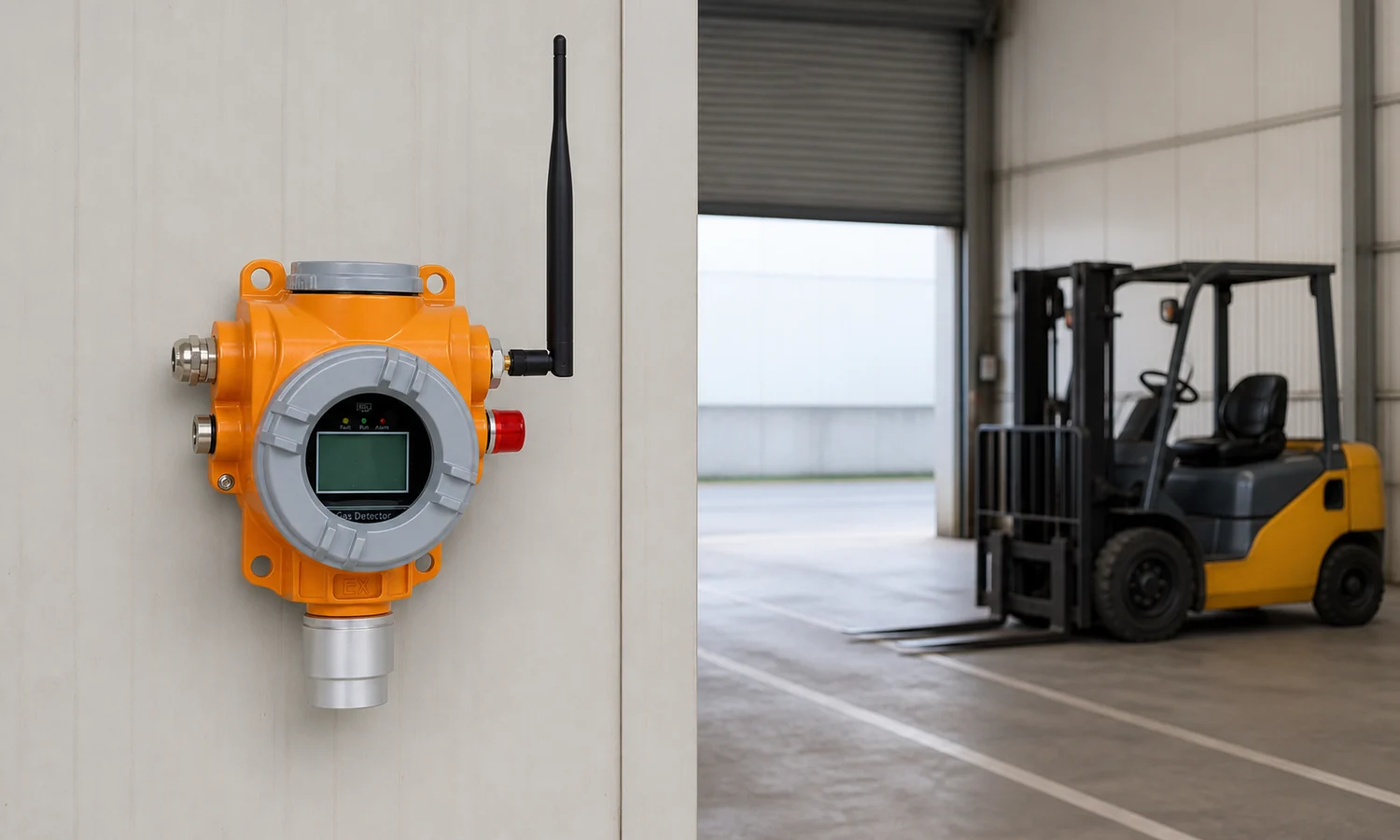
NO2 Is Not NO, N2 or CO
The names are similar enough to cause mistakes in a purchase order. Nitrogen dioxide (NO2) is a toxic nitrogen oxide. Nitric oxide (NO) is a different gas with a different sensor channel. Nitrogen (N2) is the inert gas used in purging and generation systems; the common personnel-safety concern there is oxygen displacement. Carbon monoxide (CO) is another combustion product, but its reading cannot be converted into an NO2 reading.
| Gas or channel | What the detector measures | Purchase-order check |
|---|---|---|
| NO2 | Nitrogen dioxide concentration, usually displayed in ppm | Specify an installed NO2-capable sensor and its range |
| NO | Nitric oxide concentration | Do not accept “NOx” as proof of a separate NO2 reading |
| N2 / O2 | Nitrogen concentration in a process, or oxygen level in room air | Distinguish process purity from oxygen-deficiency monitoring |
| CO | Carbon monoxide concentration | A CO-only monitor cannot report NO2 exposure |
A standard four-gas personal monitor often means O2, combustible gas, CO and H2S. None of those abbreviations is NO2. The NIOSH Pocket Guide for nitrogen dioxide identifies NO2 by formula and gives its occupational hazard information. Put that exact formula on the specification, instrument label, calibration record and quotation.
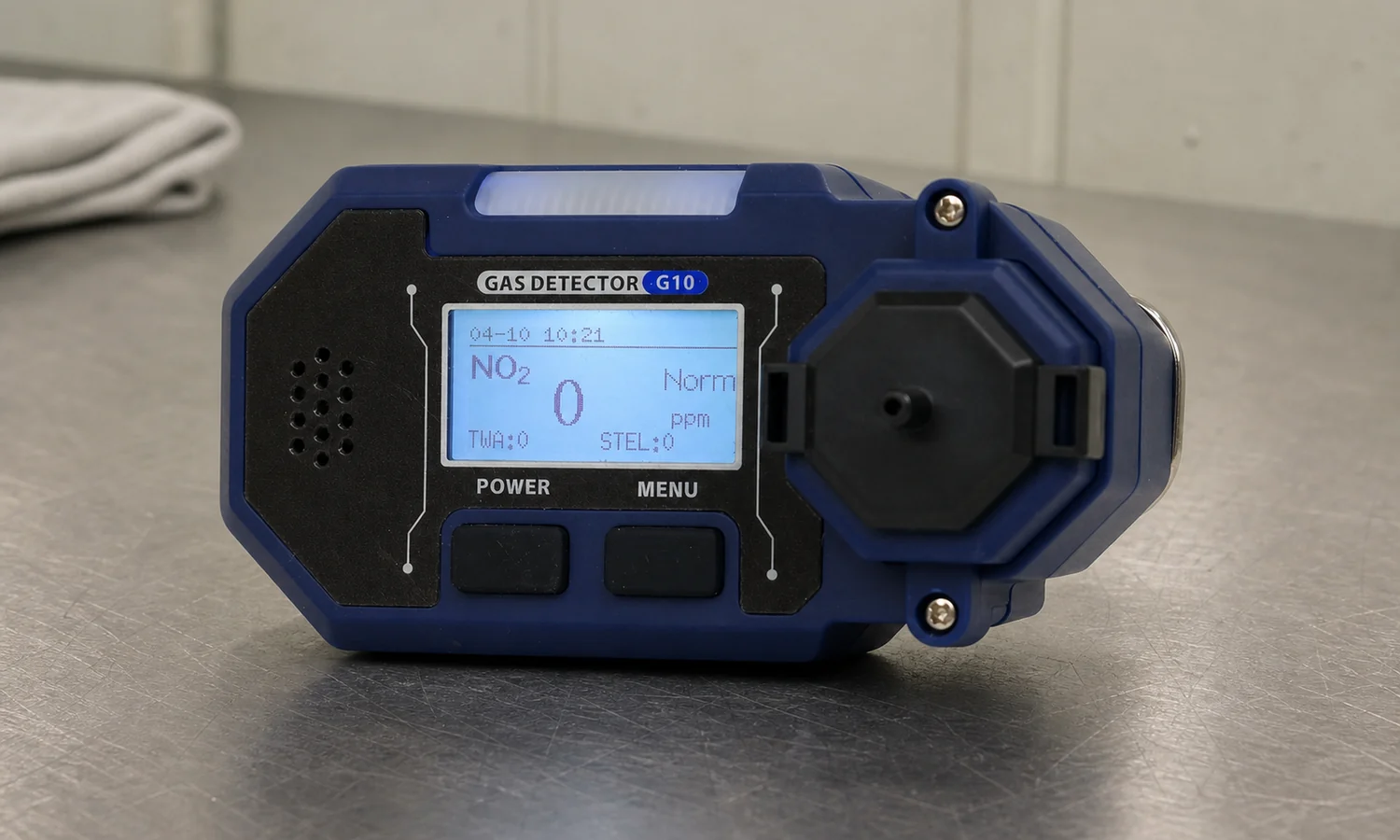
Choose Portable, Fixed or Pumped Monitoring
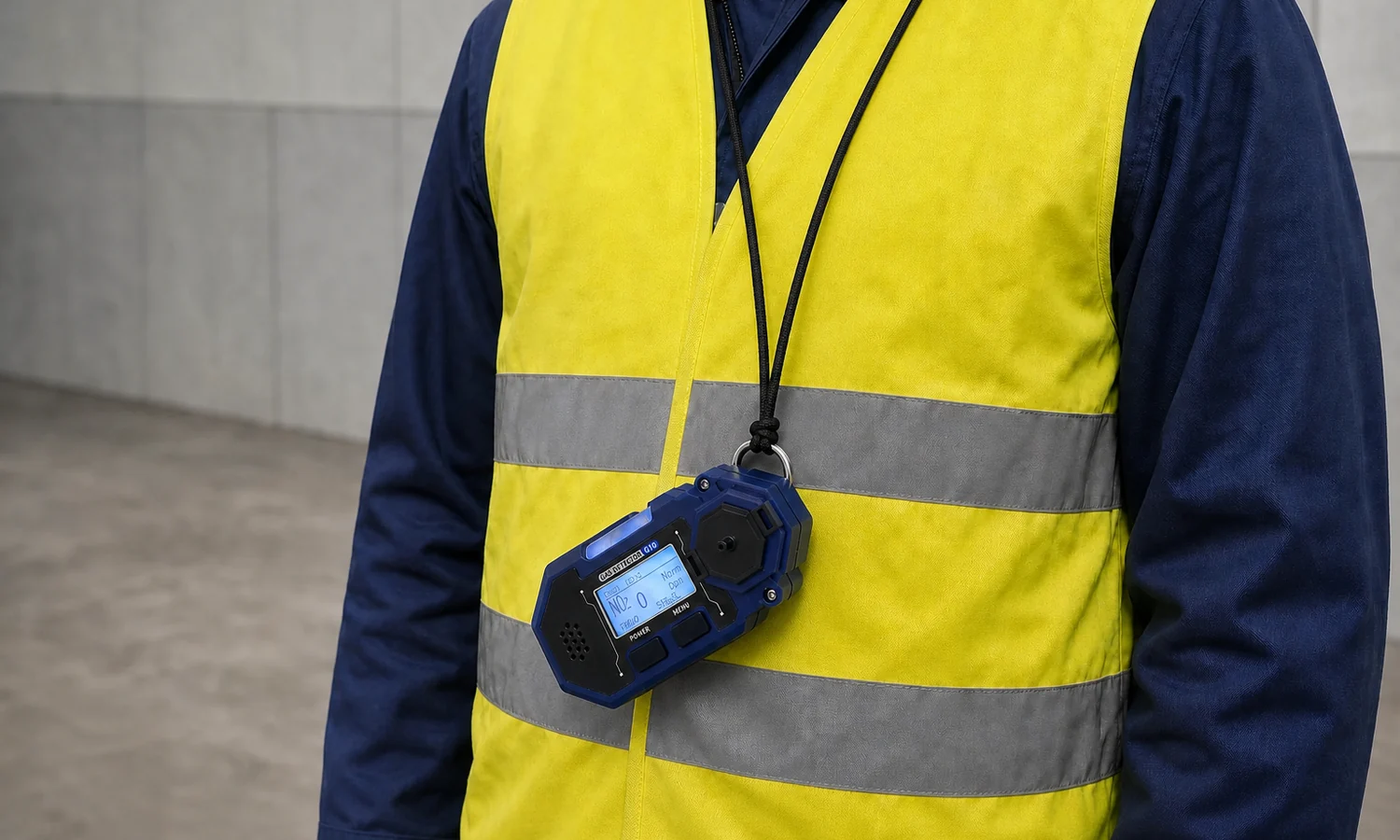
Portable diffusion for a moving worker
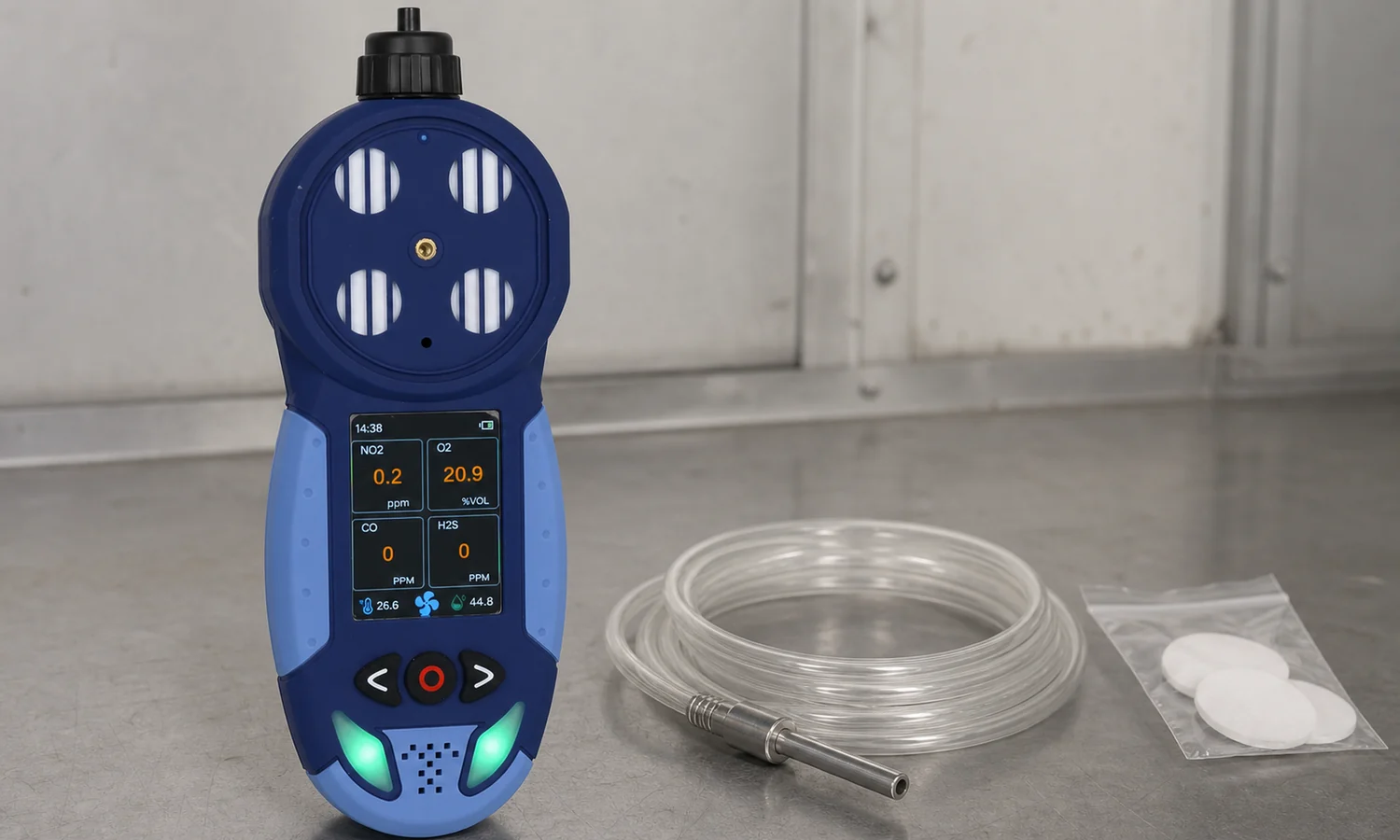
A diffusion unit samples the air reaching the sensor on the instrument. It suits work that moves between an engine bay, loading area and maintenance room. Check where the detector will be worn. If the inlet is covered by clothing or tucked behind equipment, the reading may not represent the worker’s breathing zone. Look at alarm visibility, battery arrangement, event records and the exact NO2 channel supplied.
Fixed detection for a defined area
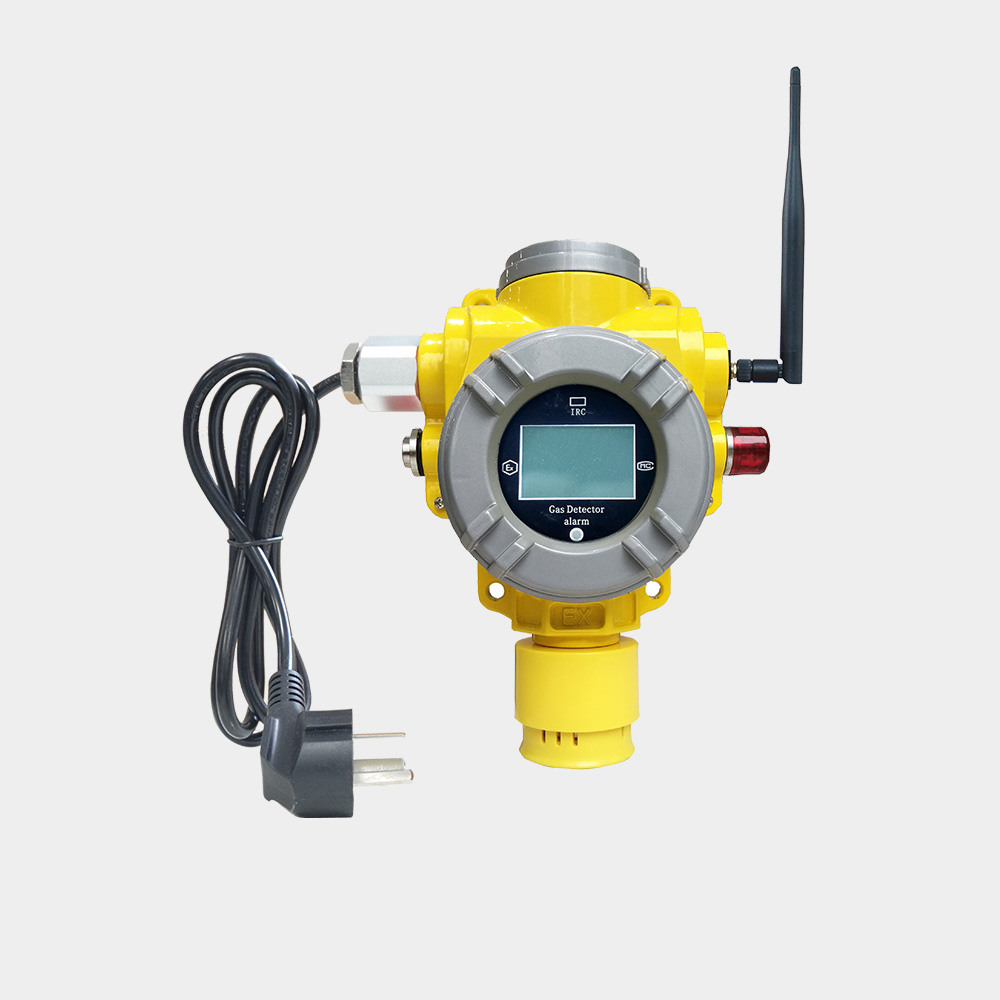
A fixed nitrogen dioxide gas detector operates at a planned point when no one is carrying a portable unit through the area. Its value depends on both its location and what happens when it alarms. Specify who receives the signal, whether a controller displays the affected point, and how power or communication faults are shown. A fixed sensor near one engine cannot be assumed to cover every corner of a large bay.
Pumped sampling for a remote check
A pump draws a sample from a probe or line to the detector. It can help with a cabinet, duct opening or other point that should be checked from a distance. The response at the display occurs after gas travels through the line. Tubing length, flow, moisture, filters and possible absorption can alter that delay or the amount of NO2 reaching the sensor. Ask the supplier to specify the allowed sample path for the ordered sensor.
The roles overlap, but they are not interchangeable. A worker leaving with a portable instrument takes its protection with them; a fixed detector remains in one place. A pumped portable instrument checks its sample inlet, not every location between the inlet and the operator.
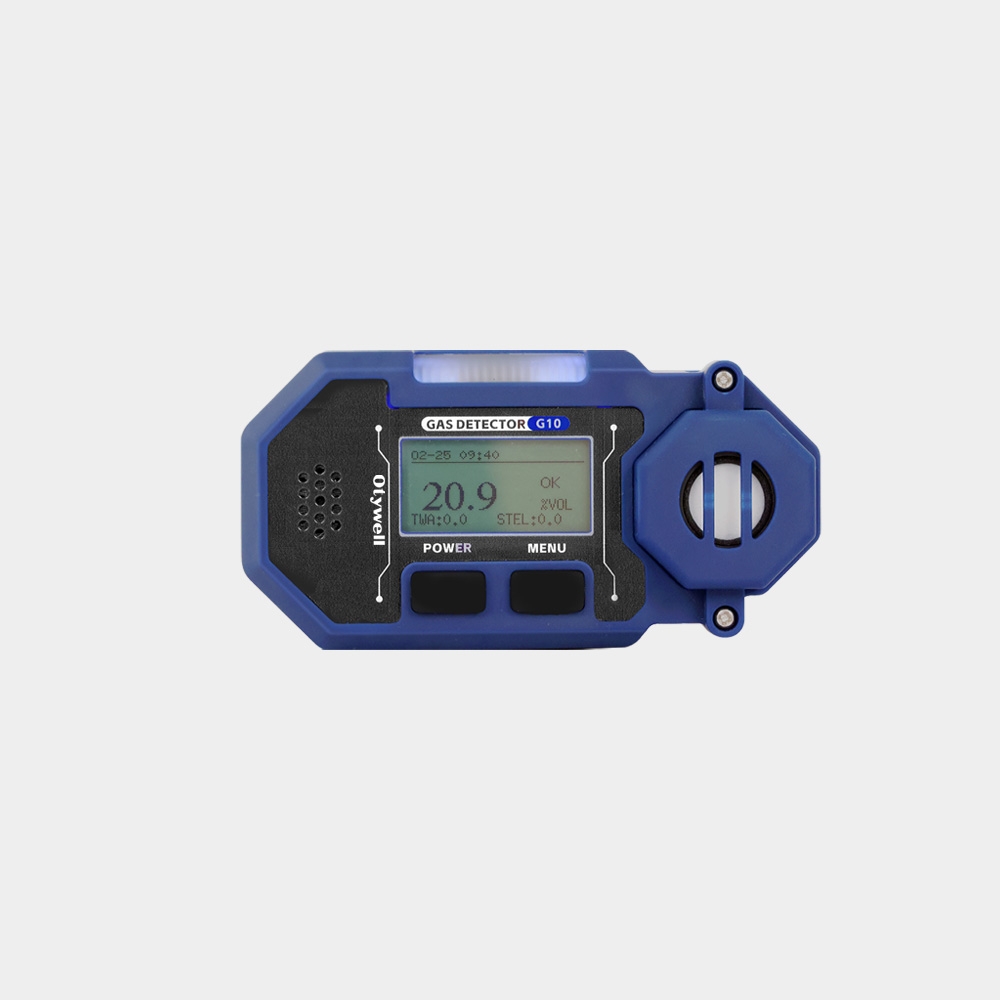
Otywell NO2 Detector Configurations to Review
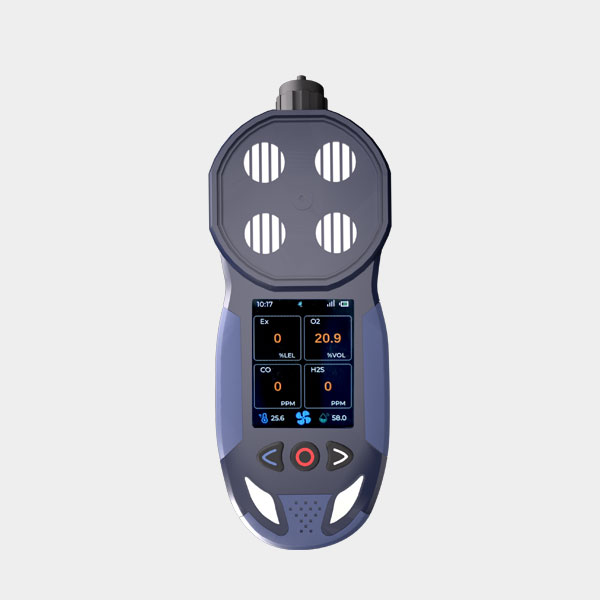
Each product page below lists nitrogen dioxide in its gas-configuration table. Confirm the NO2 sensor, range, sampling method and alarms on the actual quotation. A family page listing many gases does not mean every shipped unit contains all of them.

Check These Six Specifications Before Ordering
1. The usable NO2 range
The published range must include the concentrations the site intends to measure, but the bottom of the scale deserves the closest reading. Ask for the accuracy statement at the low end as well as the full-scale value. Resolution is only the smallest displayed step. A 0.1 ppm display increment does not prove accuracy to 0.1 ppm.
2. Sensor response and interference data
Request the datasheet for the selected NO2 sensor, not a general family brochure. Check response time, expected lifetime, temperature and humidity limits, and cross-sensitivity to substances plausibly present nearby. An exhaust area can contain several gases at once. The detector’s response to each cannot be inferred from the word “electrochemical” alone.
3. Alarm type and action
The OSHA nitrogen dioxide data page lists a 5 ppm ceiling limit and a NIOSH 1 ppm short-term recommended exposure limit. A ceiling, a 15-minute short-term exposure limit, a live detector reading and an alarm setpoint are not the same measurement. Specify the alarm logic and action for the actual jurisdiction and work procedure rather than copying a number from a table into every instrument.
4. Sampling path
Diffusion, a built-in pump and a remote fixed sample line are different configurations. For a pumped order, state the proposed tube material, length, probe, filter, flow indication and response-time requirement. If condensate or dusty exhaust is possible, ask how the inlet is protected and how that protection is maintained.
5. Fixed-system interface
For permanent monitoring, document the power supply, local indication, output signal, controller compatibility, alarm recipient and fault behavior. If the NO2 reading will start ventilation or create a remote alert, that complete chain must appear in the commissioning test. A relay listed on a detector datasheet does not by itself describe the final system action.
6. Service over the intended operating period
Confirm calibration gas and accessories, replacement sensor availability, filter changes, battery management and the records the site expects to keep. Before purchase, ask what a failed bump test or calibration check will require and how long a unit may be out of service. Service logistics matter as much as the initial purchase price when monitoring is scheduled every shift.
Place the Detector Around People and Air Movement
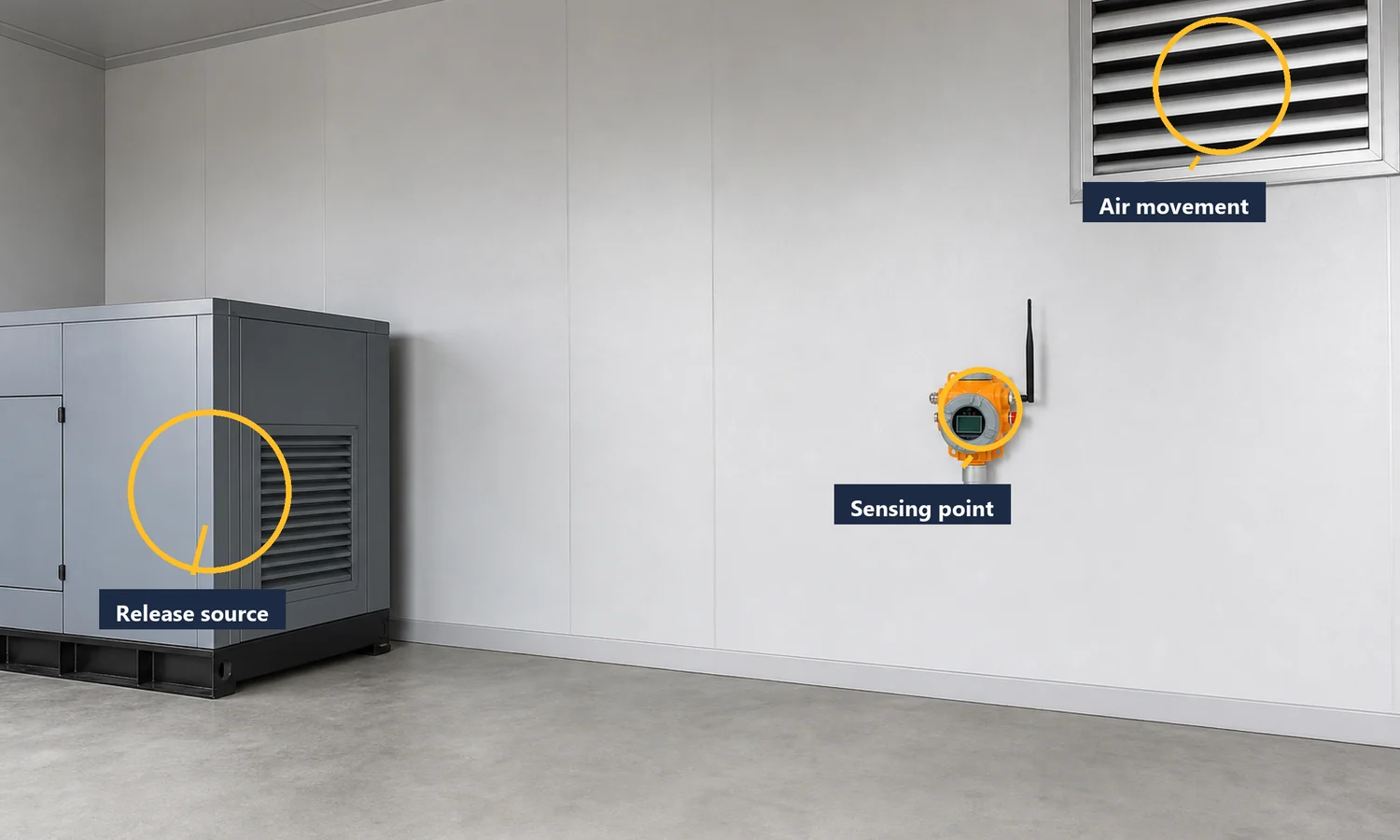
NIOSH reports that nitrogen dioxide is denser than air, but density does not give a universal mounting height. A warm exhaust jet, fan, open loading door or local extraction can move gas before it settles. Mark the engines, exhaust outlets, doors, return-air paths and occupied positions on a site drawing. Then ask which release path each proposed fixed point is meant to cover.
Do not place a point where fresh supply air continually dilutes it unless that point is deliberately monitoring supply air. Equally, a sensor hidden behind a partition may miss a release in the work zone. Consider normal production and less common conditions such as startup, door closure or maintenance. The placement record should name the detector, the monitored area and the person or system receiving its alarm.
Where several points feed a controller, distinguish physical detectors, measurement channels and alarm zones. Our industrial gas detection system planning guide explains how to put those quantities on a monitoring schedule. Keep this article’s NO2 requirement on its own line rather than burying it inside a generic “exhaust gas” entry.
An NO2 Purchase Enquiry That Suppliers Can Answer
A short, specific enquiry is more useful than “Please quote a nitrogen dioxide detector.” Include the operating situation and the proof you need for each proposed configuration.
- Target gas: NO2, not NO, N2 or CO
- Work area and likely source of NO2
- Portable personal, pumped or fixed role
- Required range, low-end accuracy and display resolution
- Expected interfering gases and environmental limits
- Sample-line details, if remote sampling is planned
- Alarm destinations, outputs and fault indication
- Calibration method, accessories and service records
Ask the supplier to reply with the exact NO2 sensor configuration and any limitations attached to it. That avoids comparing a fully specified NO2 instrument with a multi-gas enclosure that has not yet been fitted with an NO2 channel.
Frequently Asked Questions
Can a standard four-gas detector measure nitrogen dioxide?
Not unless the ordered unit includes an NO2 sensor. A common four-gas combination of O2, combustible gas, CO and H2S does not include NO2.
Can a CO detector stand in for an NO2 detector near diesel equipment?
No. CO and NO2 are separate gases. One reading does not establish the concentration of the other, even when both can be associated with combustion.
Should an NO2 detector always be installed close to the floor?
No single height fits every release. Density is one factor; exhaust temperature, ventilation, obstructions and worker position also affect where gas travels. Choose the point from the monitored scenario.
Is a fixed NO2 detector enough for maintenance staff?
A fixed unit watches its planned point. Maintenance work may move to another location or change ventilation conditions. Decide separately whether the person doing that work needs a portable NO2 instrument.
Specify the NO2 Channel, Not Just the Box
For diesel and combustion work, the purchasing decision is about a measurable NO2 concentration at a defined place. State the gas code, range, low-end performance, sampling format, alarm route and calibration support. Only then compare product families.

WeChat
Scan the QR Code with wechat