 Henan Otywell Electronic Technology Co., Ltd

The short answer: a laser methane detector measures methane from a distance — no probe, no ladder, no standing where the gas is — using TDLAS, tunable diode laser absorption spectroscopy. Most gas utilities and pipeline contractors still doing surveys with contact sniffers need one, because a probe physically cannot do half of what a survey route demands. I did not arrive at this conclusion from a textbook.
I arrived at it in 2017, on a compressor station job, pointing a laser at a valve rack nobody could reach without scaffolding.
What a Laser Methane Detector Does That a Point Detector Cannot
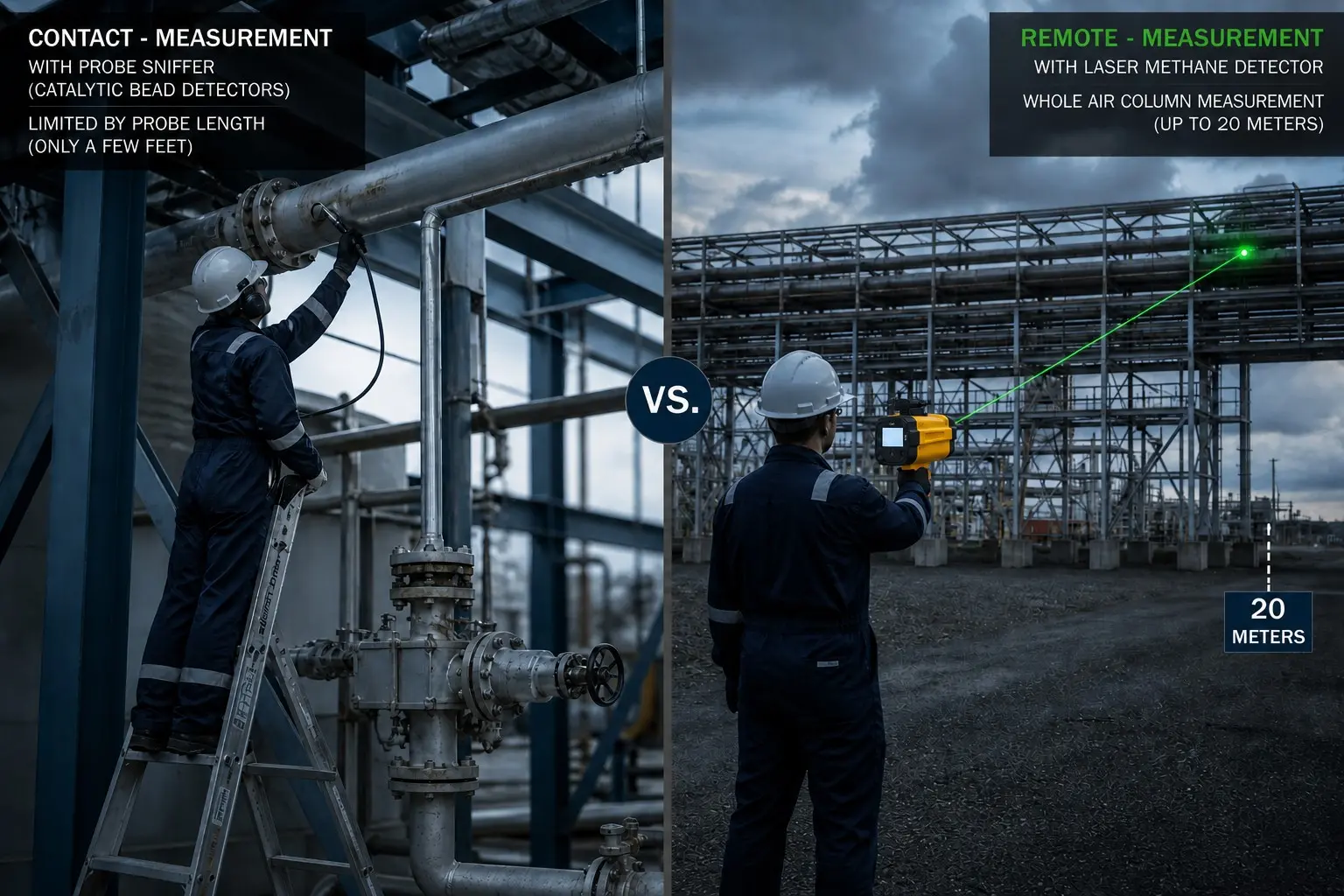
A point detector — catalytic bead, or a diffusion-type infrared head — reports the gas concentration at the sensor. Put it in the right place and it will do that all day. The limitation is the word “place”: the sensor only sees what actually reaches it. A laser methane detector instead measures the air column between the instrument and a target surface — whatever sits between you and that pipe flange, that valve stem, that meter pit cover. The reading is integrated across the whole path, and that is precisely what a moving leak survey wants.
A telemeter reads ppm·m. Parts per million of methane, integrated over a metre of path, and it reads like a physics exam until you have done a few hundred metres of survey with one. A point detector says “1,000 ppm at this flange.” The laser unit tells you what the whole column between your feet and that flange contains. The plume drifts off the fitting, the probe reads nothing, the crew walks on. The column still catches the bump. That is how crews end up finding screw-loose fittings that sniffer surveys walked past for months.
Why ppm·m, Not Just ppm, on a Survey Route
Because a survey is done on your feet, not from a fixed point. Pipe racks, valve stations, meter sets, half of them in spots you cannot get a ladder into anyway. Nobody clamps a sensor to every joint, and honestly you would not want to. A path-integrated reading lets one operator sweep a long run of piping in seconds, and the number still means something when the target is six metres up a rack.
| Catalytic Bead | Point Infrared (IR) | Laser Methane Detector (TDLAS) | |
|---|---|---|---|
| Reach | Probe length only | Probe length only | Up to 300 m with aiming laser |
| Response | Seconds, after gas reaches sensor | Seconds | 0.1 s typical |
| Poisoning / drift | Susceptible (silicones, H2S, coatings) | Low drift, some contamination risk | None, no chemical sensor element |
| Best use | Confined space / point monitoring | Fixed point monitoring | Leak survey, elevated or inaccessible piping |
Run the same comparison against any brand you care to name and the reach column does not change. That column is the reason this product category exists.
How TDLAS Works — the Part Most People Get Wrong
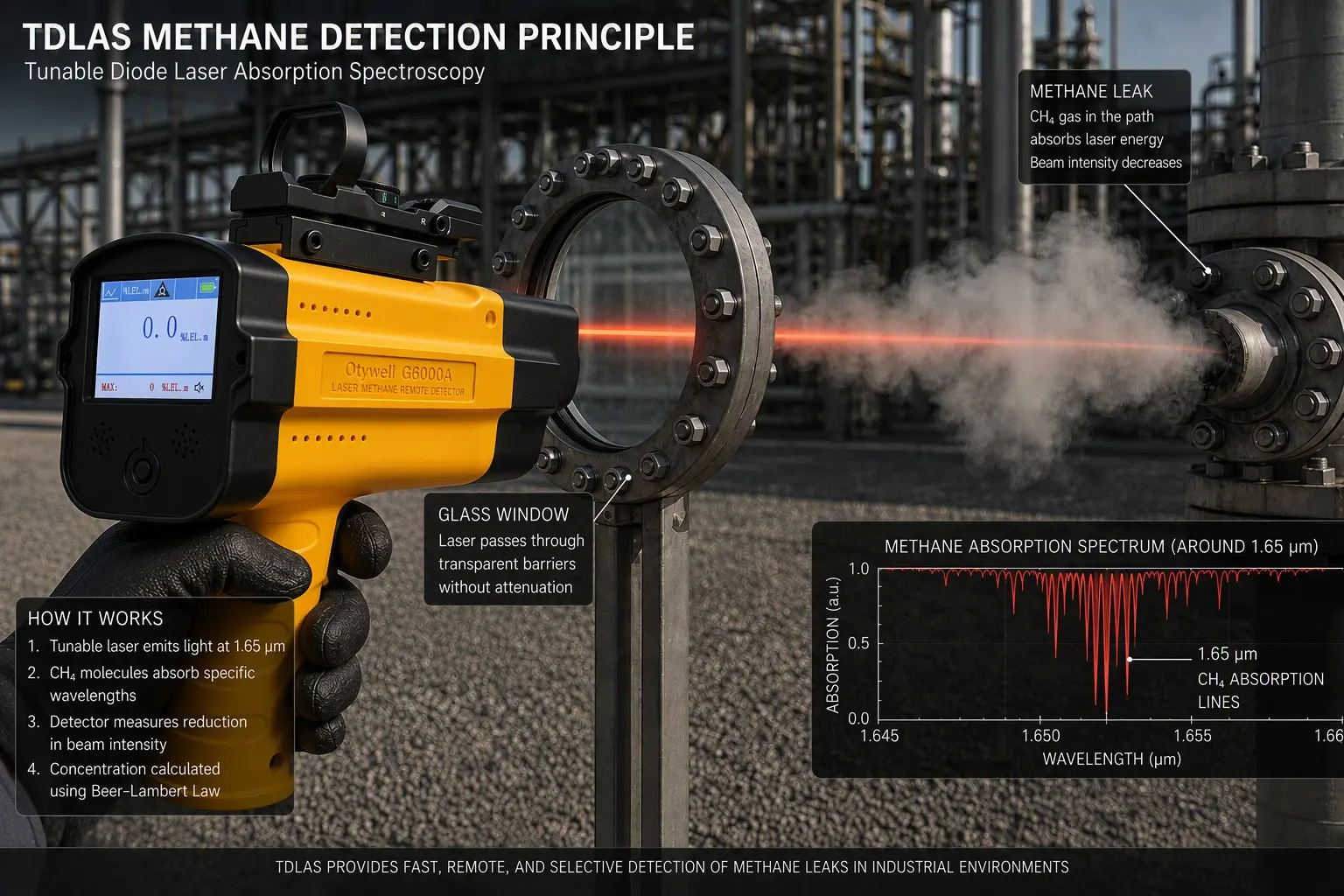
The laser diode is tuned to a wavelength methane absorbs in the near infrared, about 1.65 µm. The unit fires that beam at the target, whatever methane sits in the path absorbs a slice of it, and the detector works out how much. More absorption, more gas. That is the whole trick, absorption spectroscopy done properly. A visible red or green pointer rides alongside so the operator can see what he is actually pointing at, because pointing at the wrong flange is embarrassingly easy.
People assume this works like a sniffer on a long straw. It reads the whole path instead. The same unit checks a flange at three metres and a roof vent at eighty without you moving a step, and because it is optical, glass does not stop it. The G6000A handheld will read through a meter box window, which in the field matters a lot more than the datasheet suggests.
The absorption line is methane’s own, so other gases and water vapour leave the reading alone. That fingerprint is why you do not get false hits off solvents or humidity.
Where the Old Method Breaks Down
2018. City gas network in Southeast Asia, district regulator stations on a twelve-month inspection cycle. The crews carried handheld LEL sniffers with rubber probes, and the routine was ladder up, probe in the vent, ladder down, walk fifty metres, repeat. By late morning in that heat the pace dropped, and the elevated valve trains, the ones that actually leak, were getting the fastest checks. Fastest, in this case, meant worst.
Most utility leaks are small and slow. A loose gland, a hairline crack in a thread, corrosion quietly eating a fitting from the inside. The plume rises and dissipates before a probe gets there.
We ran the laser unit over the same stations. One operator on the ground, three or four vantage points per skid, reading the columns across the whole assembly. It took about a third of the time, and it caught two leaks the sniffer passes had missed, both above four metres. The crew leader stopped giving me grief about the laser after that.
Three Ways to Deploy a Laser Methane Detector
I have never found one right deployment for everyone. There is the right tool for the route, and a network that runs well usually ends up with more than one of these in different drawers. Same TDLAS core, three different bodies.
Handheld — the Daily Survey Tool
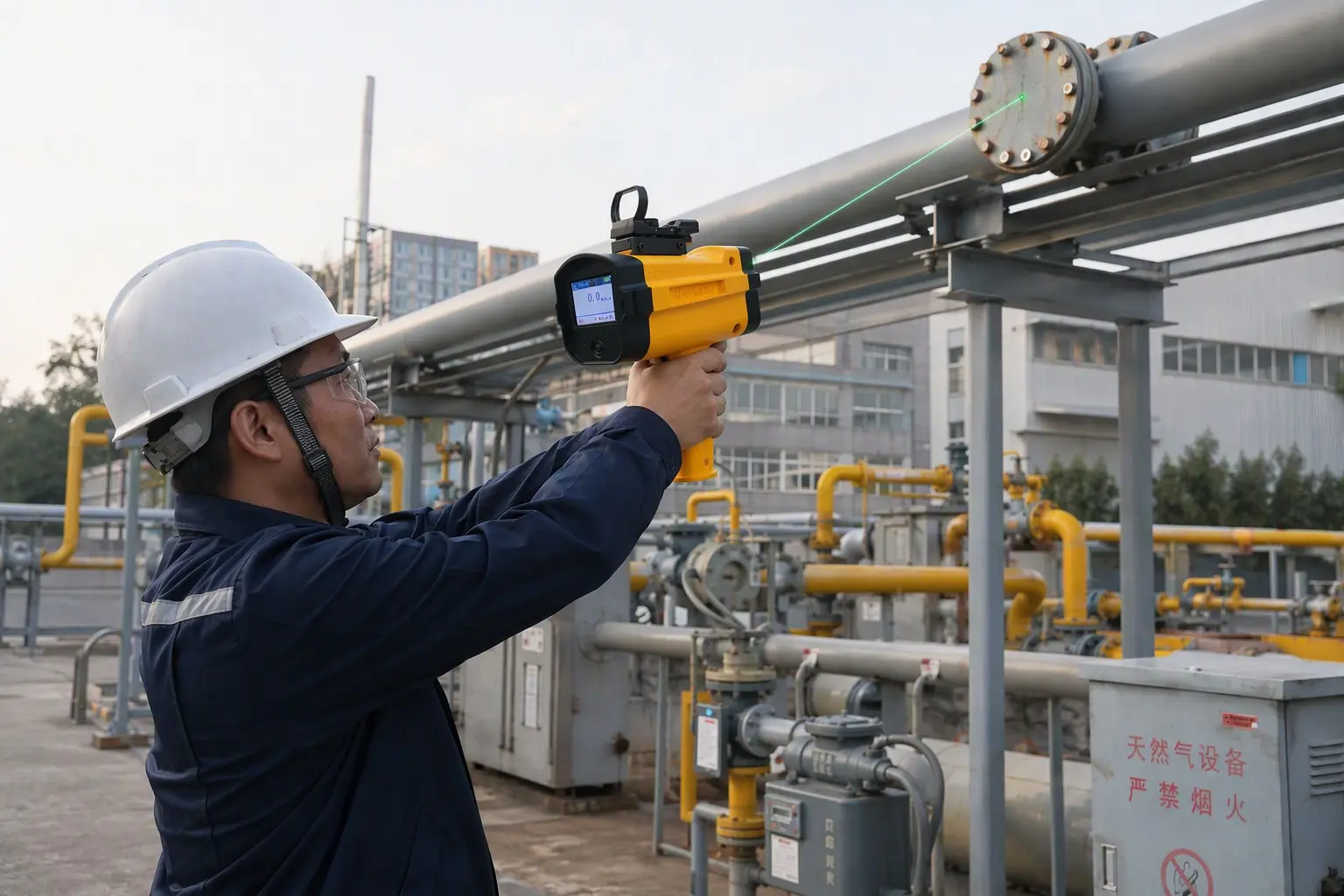
For routine rounds and plant walk-downs the handheld is the workhorse, and I will not pretend otherwise. The G6000A laser methane remote detector reads 0 to 5000, 10000 or 50000 ppm·m depending on the build, down to a 1 ppm·m minimum detection, with telemetry out to 100 or 300 metres and a 0.1 s response. Intrinsically safe, Ex ib IIB T3 Gb, IP65, and it reads through glass, which keeps the operator out of enclosures altogether. A full shift on one battery, and the thing is built for about a decade of service.
Night routes and dark vaults are where the G6000AS flashlight-style unit earns its keep; same telemeter in a flashlight body with a green aiming beam. If it has to live in a pocket, the G6000Z thumb-type detector does short-range checks out to fifteen metres and takes an optional 4G link for field reporting. Same measurement, three very different jobs.
UAV-Mounted — Pipelines You Cannot Walk
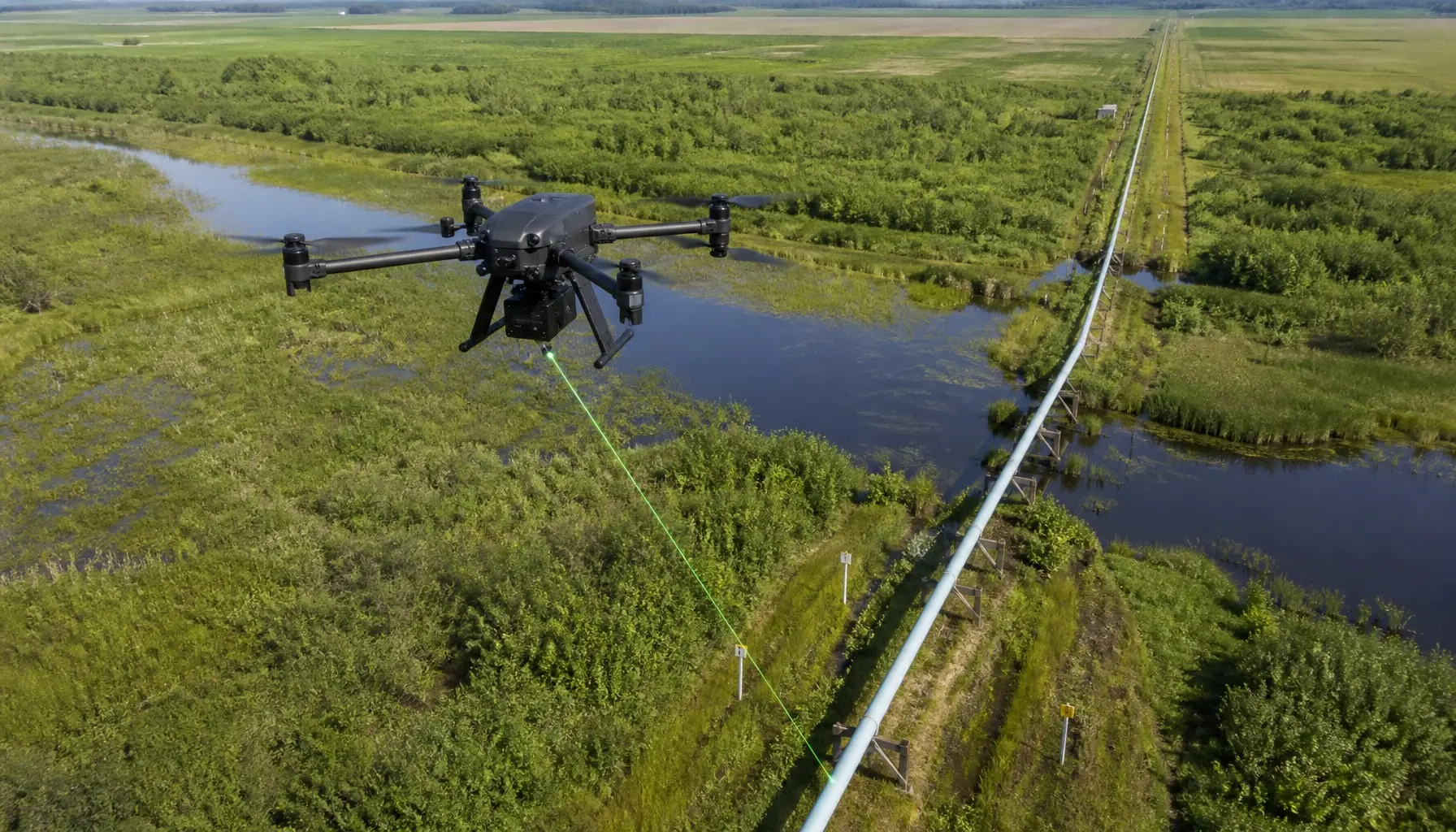
Long lines across farmland, marsh or river crossings were never properly surveyed from the ground, for the simple reason that the ground is not there. The S350-W2 UAV laser methane module bolts the TDLAS core to a drone. It detects leaks up to a hundred metres ahead and beside the flight path at 5 ppm·m sensitivity, and the software logs the flight track and produces a PDF report with alarm points photographed in real time. That last bit is worth more than the specs, because it happens to be exactly what an audit department wants to see. You would not believe how many crews buy these just to stop arguing with auditors.
Fixed PTZ — Continuous Eyes on the Plant
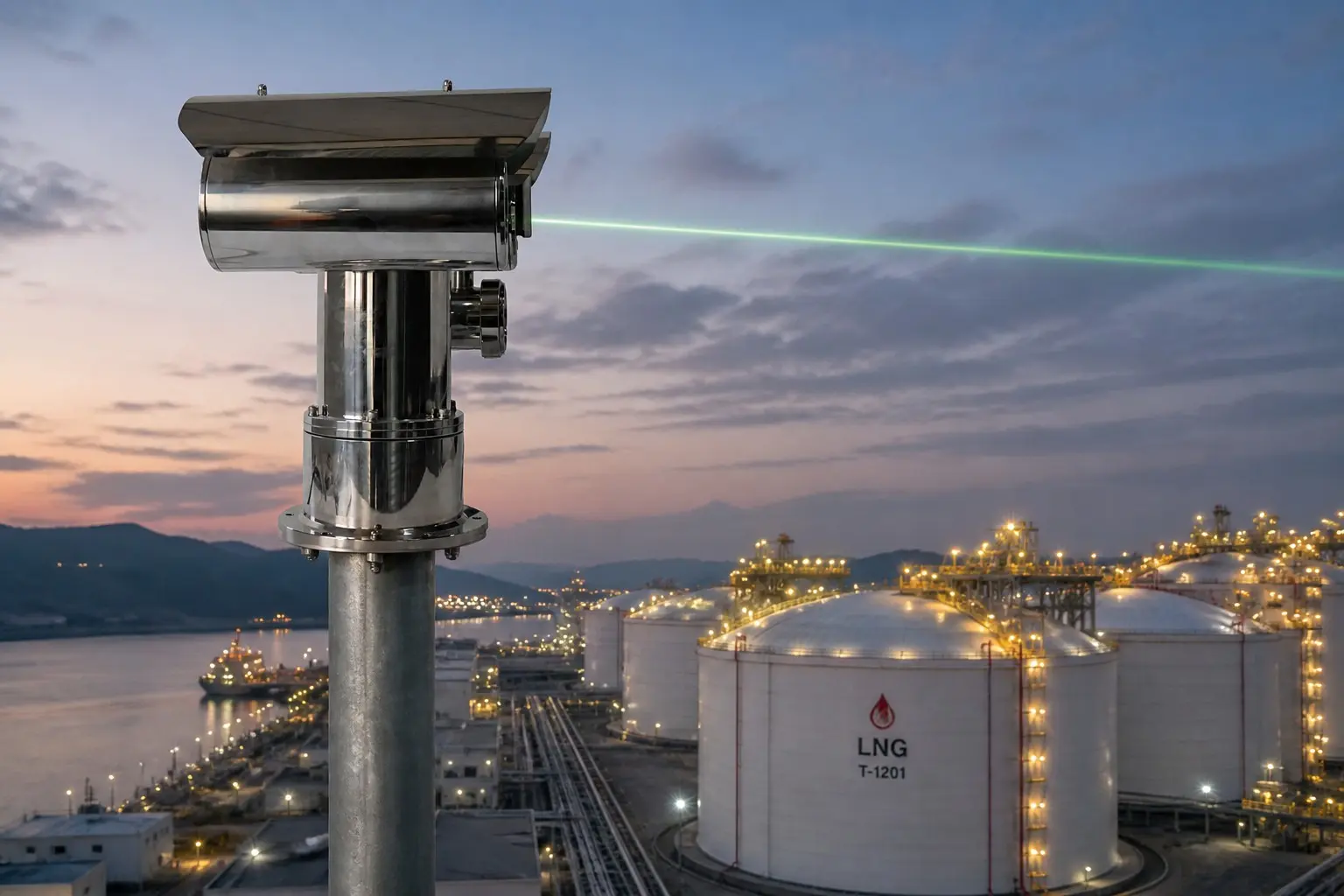
Compressor stations, LNG terminals, tank farms. The answer there is a permanent installation, something that never goes home at night. The XT-G6000C PTZ scanning system sits on a pan-tilt head, 360° horizontal and ±90° vertical, sweeping a 100-metre radius around the clock with a camera riding along and a local sound and light alarm. Flameproof, Ex db IIC T6 Gb, IP68, and it talks to the control room over RS485. A leak at 2 a.m. is an alarm event, not a discovery the morning crew makes.
How to Choose a Laser Methane Detector for Your Team
Specs matter, but the buying decision almost always comes down to four questions. Work through them in order and the right model more or less picks itself.
| Question | What to look for |
|---|---|
| How far do you actually need to reach? | Overhead piping and elevated racks mean 100 m or more. Vaults and meter sets: 15–30 m is plenty and costs less. |
| What is the smallest leak you must catch? | Early pinhole leaks need 1–5 ppm·m minimum detection. Past that, survey speed matters more than raw sensitivity. |
| Which zone do your crews work in? | Portable gear should be intrinsically safe, Ex ib. Fixed plant kit gets flameproof, Ex db. Check the certificate, not the brochure. |
| What happens after the sale? | Calibration policy, spares, response time when a unit dies. A telemeter that sits in a drawer for a month is worse than none. |
One honest disclosure before you start comparing quotes: I work with Otywell, so I have a dog in this fight. But the recommendation stands on the physics. Remote column measurement replaces contact sniffing on survey routes, full stop. The company has been building gas detection since 2009 in Zhengzhou, ships to 128 countries, and holds ISO 9001, SGS, CE and ATEX across the range. The factory runs the full test loop in-house, including the laser alignment that cheap imports skip.
Frequently Asked Questions About Laser Methane Detectors
How far can a laser methane detector measure?
It depends on the model and the surface it reflects off. Handheld units like the G6000A offer telemetry ranges to 100 or 300 metres; UAV modules and fixed PTZ systems are specified around 100 metres. Short-range thumb-type units cover 15 metres. Real-world range also depends on the reflectivity of the target — dark, rough surfaces return less signal than light ones, so treat the datasheet figure as the ideal case.
What does ppm·m mean on a laser methane detector reading?
It is the methane concentration integrated over the length of the laser path — parts per million of methane averaged over each metre of beam. A reading of 5,000 ppm·m could mean 5,000 ppm spread across 1 metre, or 500 ppm across 10 metres. That is why a telemeter suits survey work: it sees the whole column between you and the target, not just one point.
Can a laser methane detector measure through glass?
Yes. Because the measurement is optical, the laser passes through transparent barriers, and our handheld units are routinely used to check meter boxes, cabinet windows and enclosure sight-glasses from outside. The visible aiming laser shows the operator exactly where the measurement is being taken.
Does a laser methane detector need calibration like a catalytic sensor?
Yes, it needs periodic verification, but the burden is different. A catalytic bead drifts and can be poisoned by silicones or H2S; a TDLAS unit has no chemical sensing element, so there is no poisoning mechanism and no drift in the usual sense. The recommended practice is still regular bump testing and scheduled calibration against a certified gas cell — it is cheaper to verify than to be wrong.
Is a laser methane detector suitable for confined space entry?
Not as the primary instrument. Confined space entry requires a personal multi-gas monitor with oxygen and toxic sensors — the laser telemeter does not measure O2 or H2S. Use them together: the multi-gas monitor protects the entrant, and the laser unit surveys the piping and ducting from outside before and during the job. Our G60 4-in-1 multi-gas detector covers the entry side.
The Bottom Line
The decision is not whether laser methane detection works — it is whether your survey crews still spend half the day on ladders when they do not have to. Contact sniffers have a place at point monitoring and confined space entry. For leak survey, elevated piping, and anything you cannot walk up to, a TDLAS telemeter is not a luxury; it is the difference between finding the leak and walking past it.
Get it right and a single operator clears a station in a third of the time, with the report to prove it. Get it wrong and the small leak keeps growing until it is an incident.
If you want to spec the right unit — handheld, UAV, or fixed PTZ — send the survey route and gas details to inquiry@otywell-safety.com or use the contact page. We will tell you which deployment fits, and which ones you should not buy.
Prev: What Is a 4 Gas Monitor? Complete Guide & Selection Criteria
Next: How to Choose a Combustible Gas Detector: LEL, IR & Fixed vs Portable
 Author: Jack Niu
WeChat
Scan the QR Code with wechat