 Henan Otywell Electronic Technology Co., Ltd

A combustible gas detector is the instrument that catches a leak before it becomes a flame. In most facilities, you need a unit reading in percent LEL that triggers alarms at or below 10% LEL with a sub-10-second response time. Above all, you need that answer from two places at once: a fixed detector on the process line, and a portable monitor in the operator’s hand.
What Is a Combustible Gas Detector — and Why LEL Matters
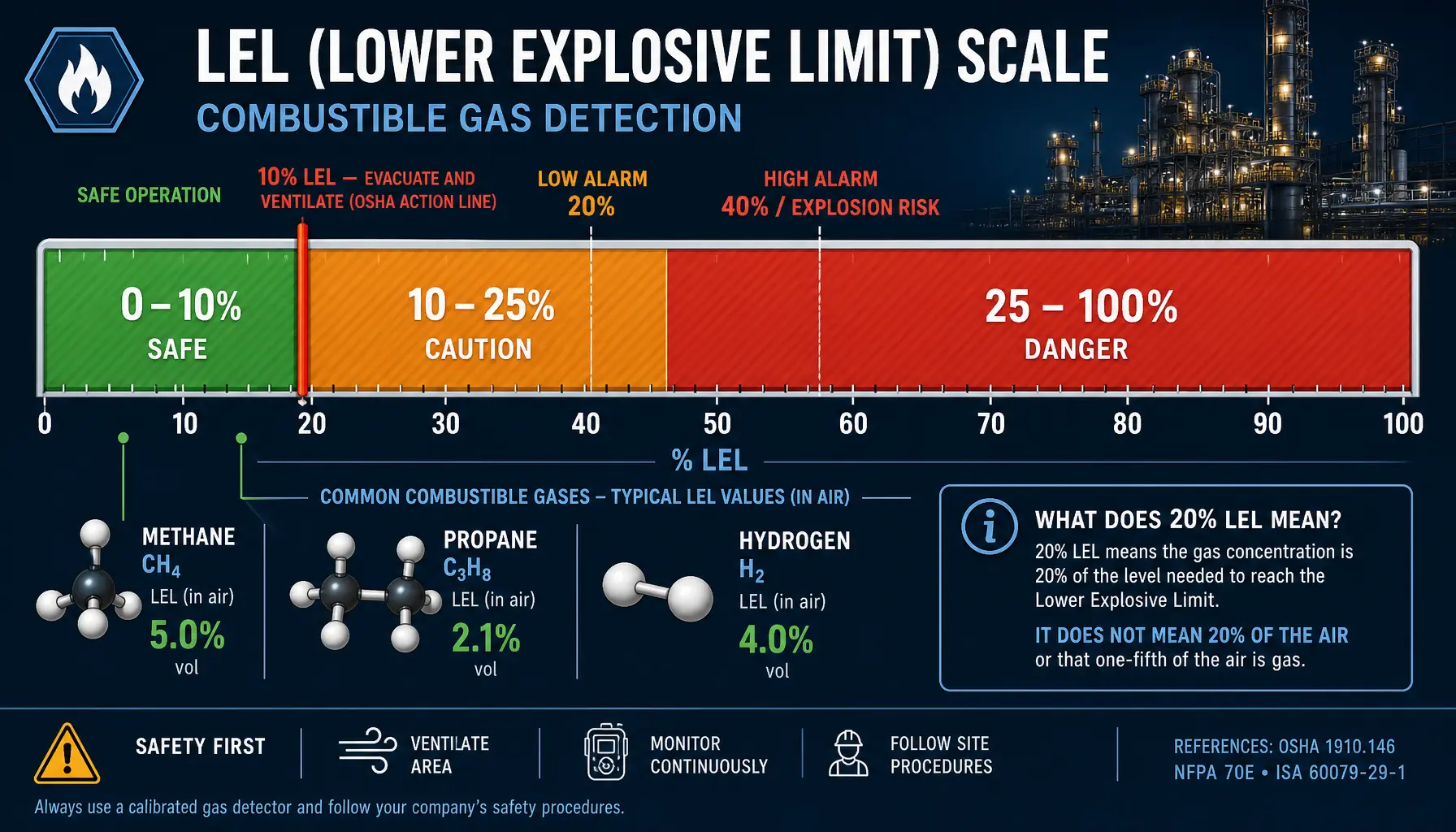
A combustible gas detector measures the concentration of flammable gas or vapor in air and alarms before the mixture can ignite. The scale that matters is percent LEL — lower explosive limit — the minimum concentration at which a gas–air mixture propagates a flame: 5.0% by volume for methane, 2.1% for propane, 4.0% for hydrogen. A reading of 20% LEL does not mean a fifth of the air is gas; it means the concentration is at 20% of the level needed to explode.
That gap between zero and 100% LEL is the entire game. OSHA’s flammable liquids and confined-space rules anchor on the 10% LEL line — cross it and you evacuate and ventilate — and the OSHA Technical Manual treats percent LEL as the display unit of record for gas monitoring. The detector is the tripwire between “leak” and “boom.”
Reading the Display: LEL vs %VOL vs ppm
Operators mix these three scales up constantly, and I do not blame them. Percent volume is the raw fraction of gas in air — 2.1% propane by volume. Percent LEL is the same number expressed against the ignition threshold. ppm belongs to toxic gas work, where a lethal leak sits far below anything flammable. A catalytic bead head is a percent-LEL instrument; an electrochemical toxic sensor is a ppm instrument — swap the two and you get very wrong readings delivered with total confidence.
| Gas / vapor | LEL (% vol) | 10% LEL (ppm) | Typical alarm points |
|---|---|---|---|
| Methane (CH4) | 5.0 | 5,000 | 20% LEL low / 40% LEL high |
| Propane (C3H8) | 2.1 | 2,100 | 20% LEL low / 40% LEL high |
| Hydrogen (H2) | 4.0 | 4,000 | 20% LEL low / 40% LEL high |
| Butane (C4H10) | 1.8 | 1,800 | 20% LEL low / 40% LEL high |
| Gasoline vapor | ≈1.4 | ≈1,400 | 10% LEL action line (entry) |
LEL values cross-checked against the NIOSH IDLH documentation for propane (2.1% LEL; 2,100 ppm at 10% LEL) and the NIOSH Pocket Guide to Chemical Hazards. Confirm values for the specific gas you monitor before setting alarm points.
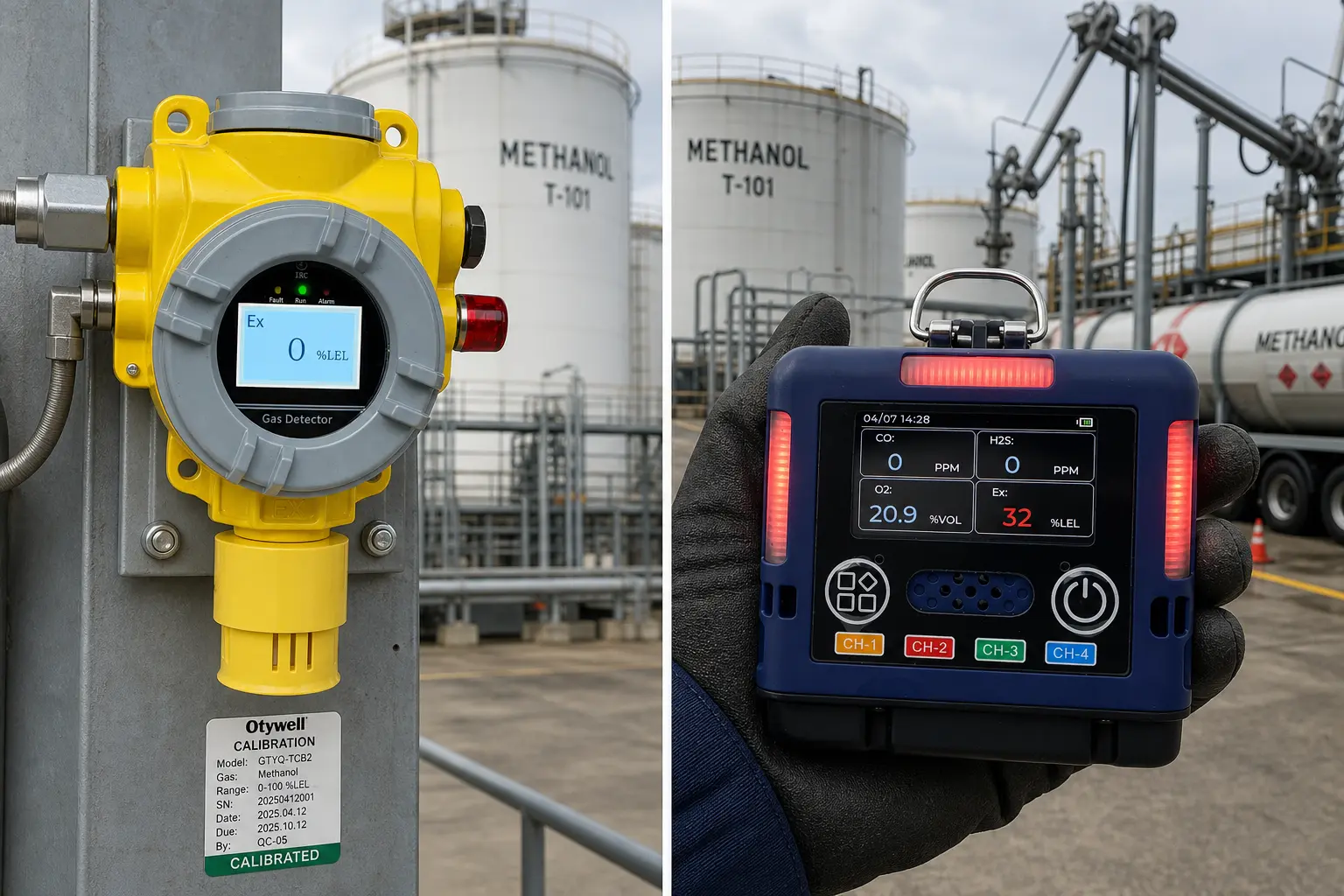
2016. A methanol terminal in Tianjin. Fourteen loading arms. The maintenance plan called for quarterly calibration of every fixed head, and the paperwork said the job was done — the critical sensor had a logbook signature dated three months back. A vapor recovery blower tripped during a tanker loading, and methanol vapor drifted across the bay; methanol is easy to miss by smell. The fixed head read 6% LEL. The crew’s portable, bump-tested daily, hit 34% LEL in ninety seconds. They shut the arm and purged the bay; nobody died, but the terminal lost a shift and a berth slot worth about eleven thousand dollars.
How to Choose a Combustible Gas Detector: Range, Response Time, and the Questions I Ask
People ask me this constantly: which combustible gas detector do I buy? The answer is a process, not a product. I run the same questions at every client before I recommend a single part number.
Start with the gas. Methane wants a 0–100% LEL scale and a catalytic bead or infrared head; hydrogen service wants speed, because hydrogen leaks through seals that hold methane fine. Then the range: a high-pressure line may want a 0–100% VOL head on top of the LEL layer so you see a big leak as it happens. Response time comes next — most catalytic beads give T90 under ten seconds, infrared closer to thirty, a lifetime in a ventilated building. After that: environment, certificate, fixed or portable.
The next fork is fixed or portable, and the honest answer is usually both.
Catalytic Bead vs Infrared: Which Sensor?
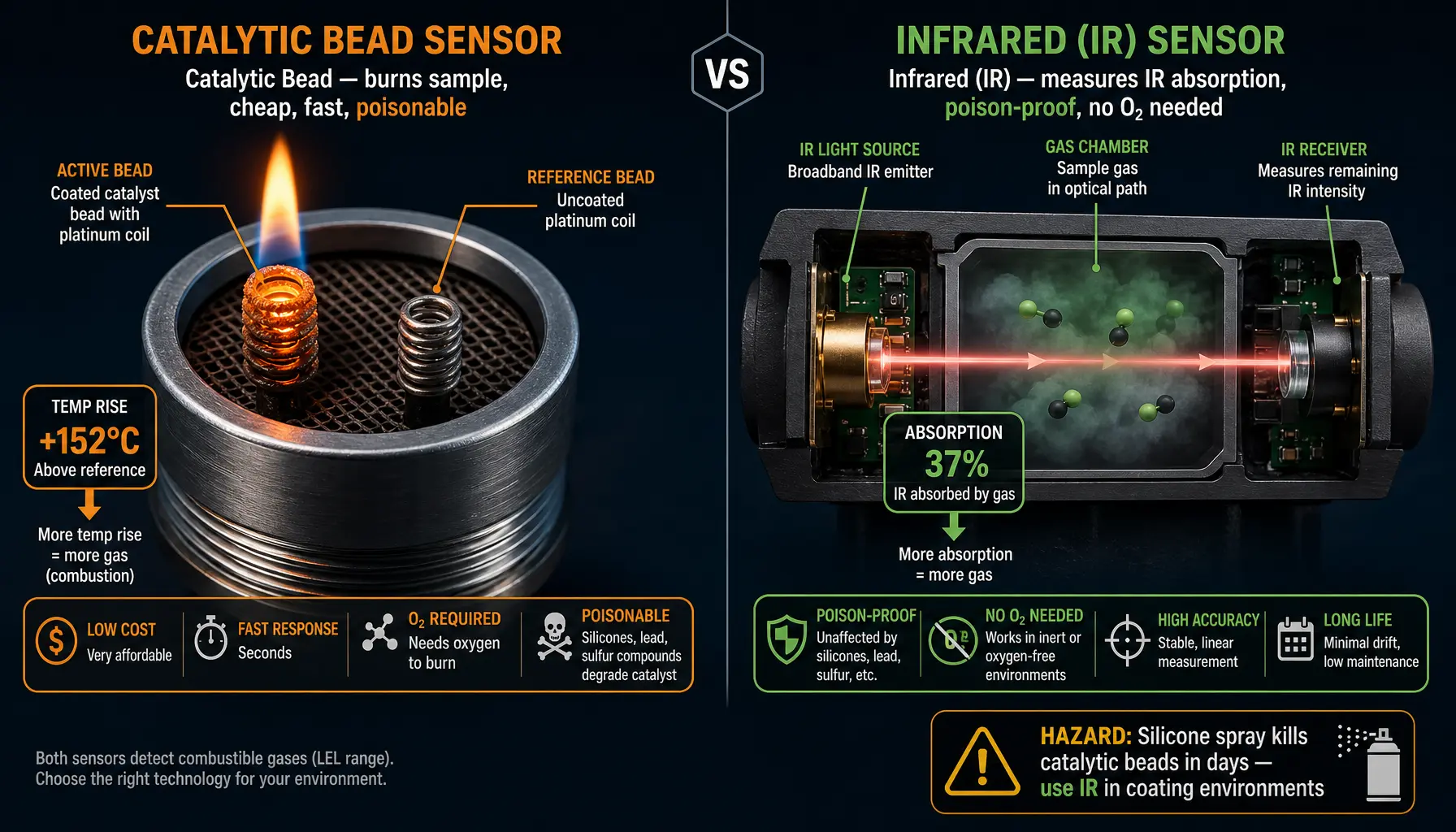
I break down all four sensor families in the full gas detector sensors guide, but the short version: catalytic bead sensors burn a sample on a heated coil and measure the temperature rise — cheap, fast, poisonable. Infrared heads measure how much IR light the gas absorbs; they shrug off silicone, H2S, and heat that kills catalytic beads, cannot be poisoned, but cost more and drift as the window fouls. If your facility sprays silicone release agents, I push infrared every time.
Fixed or Portable: Which First?
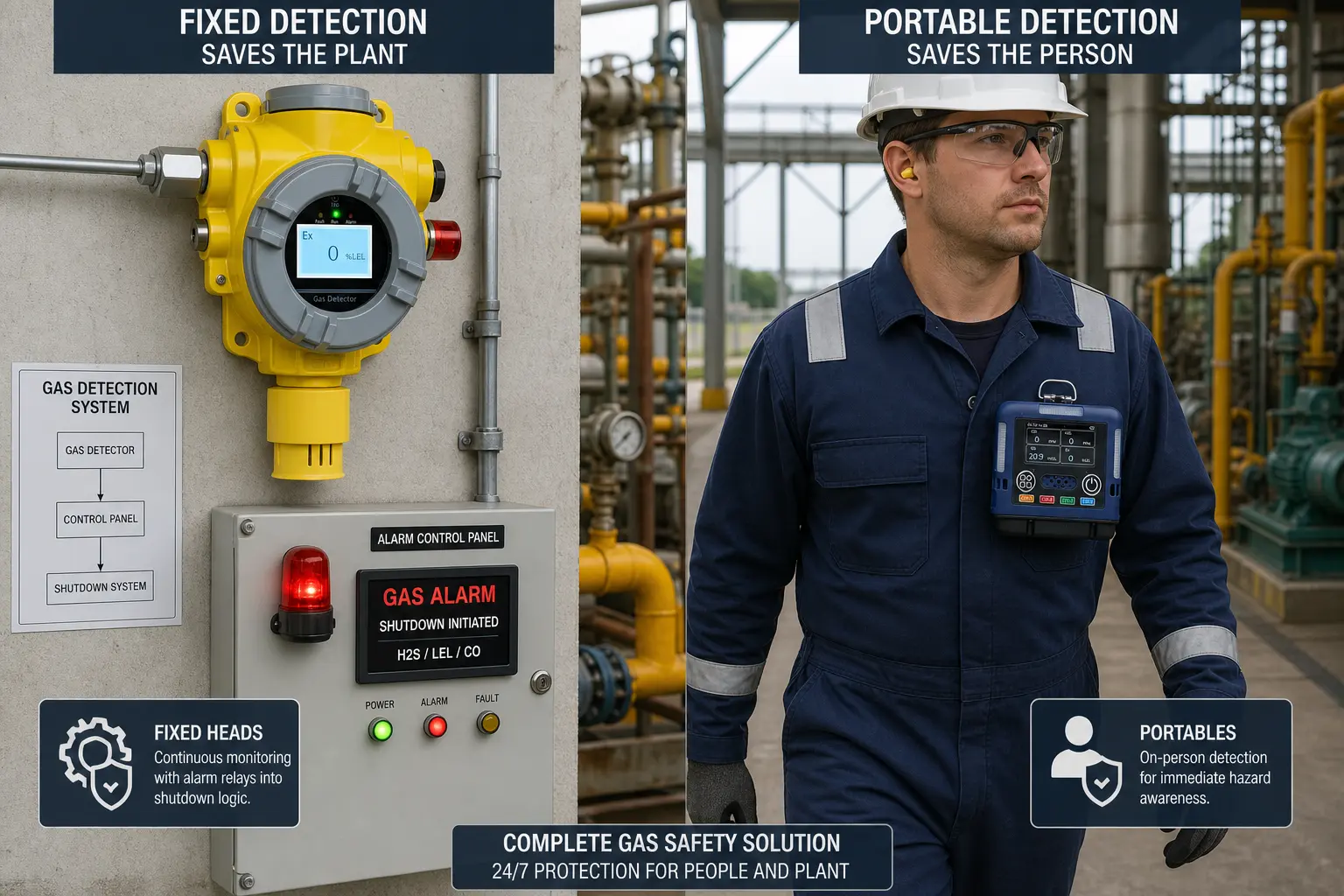
Fixed heads with alarm relays wired into shutdown logic save the plant; portables save the person. A fixed head at head height tells the panel what the bay reads, but not the mechanic inside the tank that his atmosphere just changed. Standard practice in every facility I audit: fixed on the process, a portable multi-gas unit on the people — the classic 4-gas monitor layout, O2/LEL/CO/H2S — cross-checked at shift handover. The full fixed vs portable tradeoff has its own article, but the rule is: if people work where a leak is possible, you need both.
| Criteria | Fixed detectors | Portable detectors |
|---|---|---|
| Duty | Continuous, zone-wide monitoring | Point-in-time, follows the person |
| Power | 24 VDC loop, UPS-backed | Internal battery, 8–12 h typical |
| Alarm output | Relays → sirens, beacons, shutdown logic | Buzzer, LEDs, vibration |
| Cost shape | Higher install cost, low per-point running cost | Low entry cost, recurring calibration and consumables |
| Typical home | Pump houses, compressor stations, loading bays | Confined space entry, leak surveys, maintenance crews |
| Calibration | In-situ, quarterly typical | Bench or in-situ, monthly typical, daily bump test |
Certifications: ATEX, IECEx, UL — What They Actually Buy You
A combustible gas detector that is not certified for the zone it sits in is a liability with a display. The certificate proves the housing will not ignite the very gas it watches: ATEX in Europe, IECEx internationally, UL in North America. Earning one means units get dropped, baked, drowned, and over-pressured by a notified body. Gas group and temperature class matter as much as the zone — T4 means surface temperature under 135 °C, fine for methane, wrong for carbon disulfide, which auto-ignites near 90 °C.
2014. Ruwais, Abu Dhabi. I was commissioning fixed heads on a condensate loading jetty, and the spec demanded IECEx Ex d IIC T4 on every junction box and sensor head. A sales engineer from a well-known European brand tried to pass off a Zone 2 “safe area” unit with a repainted rating plate; the inspector caught it in ten minutes and the whole lot went back. Buy the certificate, not the story — and match the nameplate zone to your hazardous area classification, which in the chemical world traces back to documents like NFPA 497.
Industry Applications for Combustible Gas Detectors
Every industry swears its problem is unique. It is not — same flammable gas physics, different coveralls. But the patterns differ enough that I can tell you what I have actually installed.
Oil & Gas and Chemical Plants
Refineries and chemical complexes run the biggest fixed networks I touch — two hundred-plus points on a mid-size site, mostly catalytic bead heads on pump seals, flanges, and loading racks, wired to a panel that ties gas alarms into shutdown logic; the OT139 8-in-1 gas detection alarm does that in one enclosure. The failure mode I see most is placement, not sensor failure. I once found a benzene unit with eleven detectors at 1.8 meters off the deck because that is where the electricians’ ladders reached. Benzene vapor pools at the deck; those heads were sampling the clean zone.
Repositioned to 300 millimeters and the system started earning its keep.
Natural Gas Utilities and Energy Storage
City gate and compressor stations are methane territory, where I usually spec infrared heads because station air fouls catalytic beads in weeks. Battery energy storage is the new kid: a thermal runaway vents hydrogen and carbon monoxide before any flame appears, so a hydrogen-capable LEL head inside a BESS container buys the ten minutes of early warning a sprinkler cannot. I have spec’d more energy storage gas detection in the last three years than in the previous fifteen. For outdoor utility work — pipeline right-of-ways, valve pits — a handheld laser methane detector (TDLAS) covers in hours what catalytic bead crews take days to walk.
Mining, Marine, and Wastewater
Coal mines have been my hardest classroom: firedamp is methane, explosive in the 5–15% window, and dust kills sensors young; mining certification is its own track. Marine work is simpler chemistry — engine-room fuel lines, purifiers, LNG fuel systems — but salt air eats connectors, and I budget spare heads the way shipyards budget paint. Wastewater is the one nobody expects: digester gas runs 55–65% methane, and a biogas pump station needs the same LEL discipline as a gas plant. I ran an Otywell G60 through 30 days on a wastewater pump station outside Shenzhen, mounted in a junction box with a breather, and the catalytic bead held calibration the whole stretch.
That unit had no business being that stable in that humidity.
Installation, Use, and Maintenance: Field Notes
Half of any combustible gas detector’s performance is decided on the day it is mounted, and installers rarely read the manual the way certifying bodies wrote it. Lighter-than-air gases — methane, hydrogen — go high; heavier-than-air vapors — propane, butane, gasoline — pool at the floor; mounting height is a gas property, not a preference. And a detector protects the zone it actually samples: a catalytic bead reads the air within a meter of its sintered filter, not the whole room.
Response Time and Environmental Factors
T90 is the spec everyone quotes and nobody verifies. A head that takes twelve seconds to scream at 30% LEL in a ventilated hall is slower than the dilution. Cold, humidity, and coatings slow sensors further; silicone vapor is the classic catalytic bead killer, and one coating pass of a silicone release agent silences heads for weeks. If your facility sprays anything, assume the sensors are dead until you bump test.
Calibration and Bump Tests (Short Version)
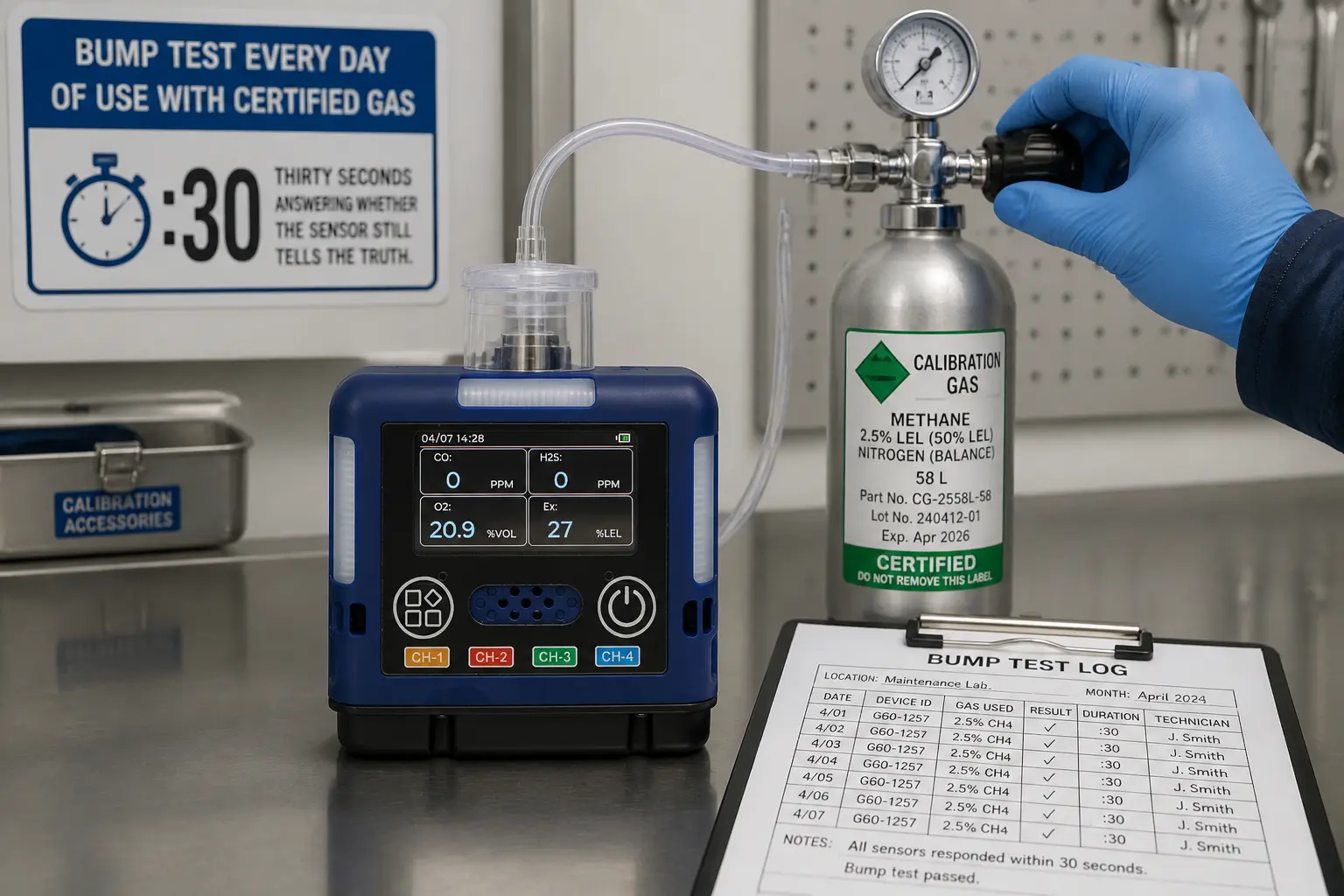
Calibration deserves its own article; the field version is short. Bump test every day of use with certified gas — the routine in our confined space gas detector buying guide — and run full calibration monthly to quarterly by sensor type and duty; document every check, because auditors love the gap between logbook and truth. A bump test is thirty seconds with a cylinder at a known concentration, and it answers one question: is this head still lying to me? The Zibo mismatch at the top of this article? A morning bump test would have caught it.
Frequently Asked Questions About Combustible Gas Detectors
What is a combustible gas detector and what does it detect?
A combustible gas detector measures flammable gases or vapors in air and alarms before the mixture reaches the concentration needed to ignite. It detects anything that burns — methane, propane, hydrogen, butane, gasoline vapor — and reports in percent LEL, the fraction of the lower explosive limit. It does not measure oxygen or toxic gases; those need separate sensors, which is why multi-gas portables combine an LEL channel with O2, CO, and H2S in one unit.
What does 100% LEL mean on a combustible gas detector?
100% LEL is the lower explosive limit itself — the concentration at which the mixture is just rich enough to burn: 5% methane by volume, 2.1% propane, 4% hydrogen. Ranges are scaled 0–100% LEL, and your alarms belong well below the top; 10% LEL is the classic action line for confined space entry, with typical alarms at 20% and 40% LEL. Above 100% LEL the mixture is too rich to ignite, but never read that as safe — fresh air dilution passes it back down through the explosive window.
How often should a combustible gas detector be calibrated?
Bump test every day the detector is used; full calibration monthly to quarterly depending on sensor type, environment, and duty. Catalytic bead sensors drift with contamination and poisoning; infrared heads drift less but fog as the optical window fouls. Fixed systems typically get in-situ calibration quarterly, while confined-space portables run a 30-day cycle with a daily bump test. If the unit lives in a dirty environment — silicone vapors, dust, salt air — shorten every interval.
Can one combustible gas detector detect all flammable gases?
Not accurately. A catalytic bead head responds to almost anything that burns, but its calibration gas matters: calibrate with methane and readings on other fuels follow the instrument’s built-in response curve, which can be off by tens of percent. Infrared heads are gas-specific by filter wavelength, so a methane head may ignore propane entirely. If you handle mixed fuels, recalibrate for the specific gas when duty changes, or pick a unit with per-gas settings.
Where should I install fixed combustible gas detectors?
Mount at the height the gas dictates: lighter-than-air gases like methane and hydrogen go high; heavier-than-air vapors like propane and butane go low, near the floor or deck. Place heads within a meter or two of likely leak points — pump seals, flanges, valve manifolds, loading arms. Keep them clear of ventilation inlets, steam vents, and wash-down zones, and wire the alarm relay into shutdown logic, not just a panel beep.
The Bottom Line
The decision is not which brand to buy; it is which questions you answer first — the gas, the range, the response time, the environment, the certificate, fixed or portable. Answer those honestly and the detector almost picks itself. Answer them wrong and no nameplate will save you.
Get the LEL discipline right and a combustible gas detector becomes the boring, reliable piece of kit it should be — the one that sits in the corner, never fires, and earns its purchase price the one time it does. Get it wrong and you are the Zibo story, the Tianjin berth bill, or the incident report nobody wanted to write.
I work with Otywell now, so you should know that; the selection logic above is the same one I used long before the logo was mine. If you want to run your facility’s gases through this checklist, the G60 4-in-1 multi-gas detector, the G40 multi-gas detector, and the fixed gas detector line are where I would start looking, and the spec sheets are public

WeChat
Scan the QR Code with wechat