 Henan Otywell Electronic Technology Co., Ltd

A hydrogen selenide gas detector inside a ventilated cabinet has a different job from one watching an operator area or abatement outlet. Mark each inlet on the process drawing, then record the event it must catch, the concentration at which action is needed, and where its alarm goes.
Hydrogen selenide (H2Se) can be present in gas supply and process systems. Its toxicity makes low-concentration monitoring a priority well before a flammable atmosphere develops. の Asia Industrial Gases Association’s hydrogen selenide code of practice identifies storage, operator areas, ガスキャビネット, fume hoods, process rooms, and abatement exhaust as primary monitoring locations. The location determines what the instrument must measure and how quickly someone must know.
Use a point schedule to compare the complete detector and sampling arrangement with each monitoring task. A product’s gas label, adjustable alarm, or range beginning at zero says little about performance at the concentration where action is required.
Walk the route from cylinder to abatement outlet
A cylinder feeds the process through a ventilated cabinet. Gas released at a connection could enter the cabinet exhaust, escape into the work area, or follow another route as doors and airflow change. Each inlet covers a particular route. The point schedule must account for the others.
At the cabinet door and cylinder connection
Mark the cylinder valve, pigtail, レギュレーター, changeover assembly, and other connections on the cabinet drawing. Show the direction of cabinet exhaust and the candidate detector inlet. During a cylinder change, the cabinet door or access panel may be open. The point schedule should say whether that operating state changes the route from a connection to the inlet.
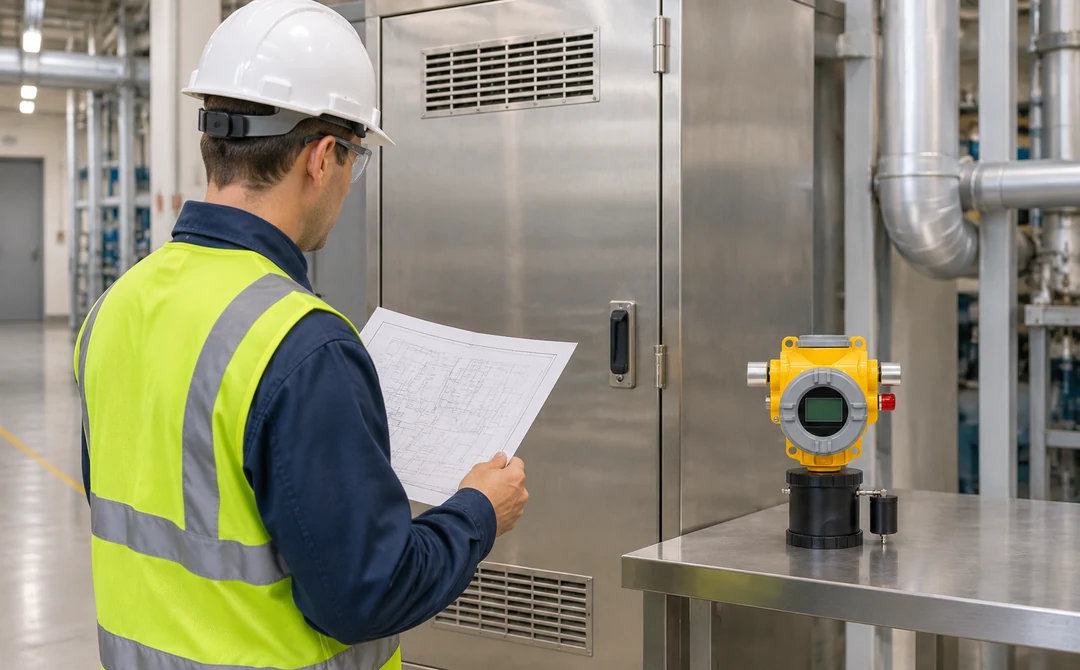
The NIOSH Pocket Guide for hydrogen selenide lists a relative gas density of 2.80. Density is useful background, but a cabinet’s extraction flow, 障害物, and release direction govern whether gas reaches a particular inlet. Give the installation team a marked release-path drawing instead of a mounting height copied from another site.
For a diffusion instrument, the sensing face has to be in air that could carry the release. With a pumped arrangement, the sample inlet can sit at a selected location while the detector is mounted where it can be serviced. The tubing then becomes part of the detection system and must be included in inspection and response testing.
人々が働く場所
Cabinet exhaust monitoring shows what enters that exhaust. Work-area monitoring addresses gas that may reach people outside the cabinet. Put the likely operator position, access route, fume hood, process enclosure, and room exhaust on the same drawing. Look for a release path that could reach a person without passing the cabinet sample point. A portable check records conditions when it is performed; the area remains unobserved between checks unless another system watches it.

Airflow can change when a hood sash moves, a cabinet door opens, or ventilation runs in another operating mode. If those changes redirect a plume away from the planned inlet, the location needs another review. A reading taken only from an exhaust duct cannot stand in for the air an operator may breathe nearby.
Beyond the abatement stage
At the abatement outlet, the concern is H2Se remaining after treatment or appearing during a breakthrough. Record whether the sample comes from before or after the equipment, what mixture and conditions it will contain, and who receives an abnormal result. A nearby work-area detector measures the air at its own inlet; outlet monitoring needs a sample from the outlet stream.
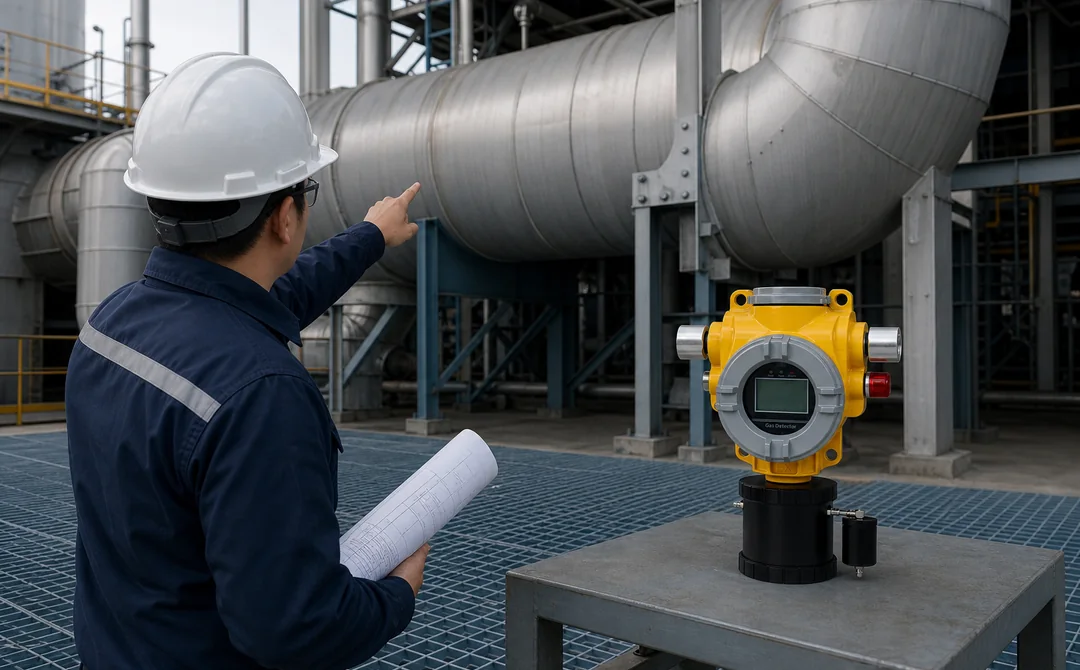
Process and workplace points may have very different expected concentrations. Record the measuring range and low-end requirement for each point separately. If the outlet sample needs conditioning, establish that the treatment does not remove or change H2Se before measurement. The AIGA code also calls for monitoring abatement performance and reviewing the ventilation air balance as part of the life-safety system.
| Point on the route | Event to identify | Who needs the result | Coverage question |
|---|---|---|---|
| Gas cabinet or storage connection | Release at a valve, fitting, or supply connection | Local responders and the assigned control location | Can gas reach the inlet with the door closed and during relevant access? |
| Operator or process area | H2Se entering an occupied or accessible space | People in the area and the responsible operator | Do ventilation and normal work patterns create an unmonitored route? |
| Abatement outlet | Residual gas or treatment breakthrough | Process and abatement operators | Is the sample taken from the intended stream without changing it? |
At each stop, prove the measurement task
Add a decision concentration and time basis to each point before comparing instruments. The NIOSH Pocket Guide lists a NIOSH recommended exposure limit and an OSHA permissible exposure limit of 0.05 時間加重平均としての ppm for H2Se. その IDLH value is 1 ppm. These values serve different purposes; the site still needs to set alarm conditions for its own actions and verify that the chosen detector performs at those conditions.
Time-weighted exposure assessment needs a measurement and recording method that supports that averaging period. An immediate leak warning has a different response task. Write the intended action beside each proposed alarm level so the supplier can test the right question.
Ask for performance at the useful low end
A published range such as 0–1 ppm or 0–5 ppm describes the span a product is intended to display. Display resolution tells you the size of a step on the screen. Neither establishes the lowest concentration that the installed instrument can detect reliably. Ask for the detection limit, error or repeatability near the decision concentration, zero behavior, relevant interference, 校正方法, and the test conditions for the exact H2Se configuration being offered.
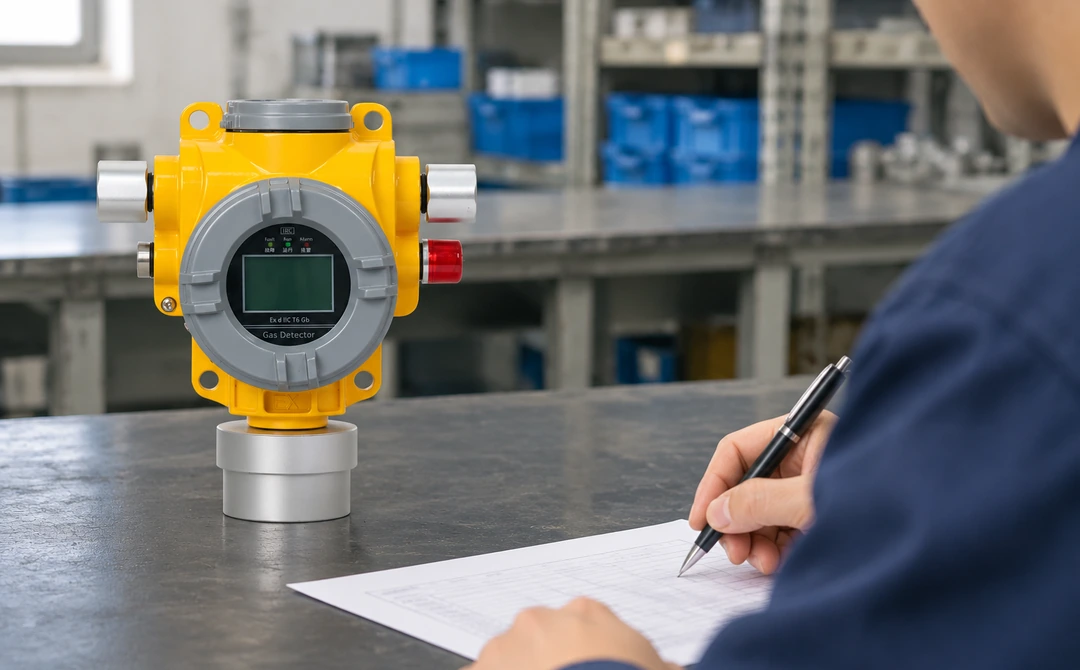
A sensor-cell specification applies under its stated electronics and laboratory conditions. Once that cell is installed behind a different circuit, 入口, フィルター, or sample line, the supplier must establish performance for the finished instrument. Its programmable alarm can only act on concentrations the instrument can measure dependably.
If the verified low end sits above the concentration at which your point requires action, revise the detector configuration or the measurement method. Keep the point’s purpose and decision level visible in the supplier comparison.
Match the method to the job
Continuous fixed monitoring is appropriate when an unattended point must report a change or fault. Diffusion sensing depends on gas reaching the installed sensing face. Pumped sampling brings gas from a defined inlet to a detector elsewhere, making the line, ポンプ, and flow status part of the measurement. A continuous low-concentration system that uses a tape or another collection method brings its own sampling interval and consumables. A manual colorimetric tube provides a reading during a deliberate spot test; it cannot provide a continuous warning between tests.
A detector tube’s range, sampling strokes, and interferences belong to that particular tube. A tube chosen for a high-concentration check may have a detectable limit above the level needed for a workplace question. A continuous system advertised with a ppb range also needs evidence for the full sampling cycle and alarm response.
| 監視タスク | Method to evaluate | Evidence needed before selection | What can fail silently? |
|---|---|---|---|
| Fixed point reached by local airflow | Diffusion detector with an H2Se-specific channel | Low-end performance for the assembled unit and point placement | Air movement carries a release around the sensing face |
| Defined cabinet or process sample inlet | Fixed pumped detector | Whole-system low-end response, tubing suitability, 輸送時間, and flow-fault behavior | Blocked, leaking, or unsuitable sample line |
| Continuous low-level or abatement observation | Method validated for the stream and required interval | 検出限界, sample cycle, sample treatment, alarm and consumable faults | Lost flow, exhausted consumable, or altered sample |
| One planned check at a named point | Portable instrument or an H2Se detector tube, if its range fits | Target-gas calibration or tube instructions, low-end capability, and sampling procedure | No observation between checks |
Otywell platforms to evaluate for the point schedule
Otywell’s current pages describe these fixed detection and sampling platforms. For an H2Se project, the quotation still needs to identify the target-gas configuration and document its low-end and installed response performance.
 Fixed point platformTCB2-F Point Type Four Gas DetectorA fixed detector platform with selectable gas channels, local sound and light indication, and listed control-system output options. Confirm the ordered sensing and output versions for the selected point.View product details
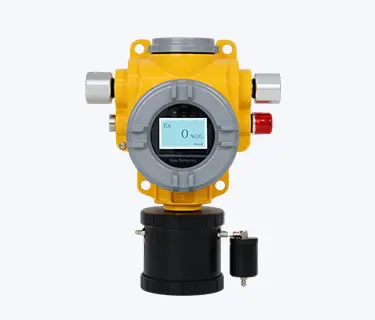 Pumped sample platformTCB2-B Pump-Suction Point-Type Gas DetectorA fixed unit with an integrated pump, local sound and light indication, and listed signal-output options. Confirm the target inlet, sample line, ordered gas channel, and signal version.View product details
The published pages do not list an H2Se sensor or finished-instrument detection limit for either platform. Confirm those details, including response time, in the offered configuration and its test documents.
Count the path from inlet to alarm
For a pumped point, gas travels from the installed inlet through tubing, fittings, and any filter or treatment stage before the sensing element can respond. A response-time value for a bare sensor does not include sample transport and alarm processing. Document the actual line length and material, ポンプの流れ, moisture controls, and the alarm destination. Test the complete route under the conditions for which the point is specified.
At a diffusion point, the equivalent question is whether the credible release reaches the sensing face. At an abatement outlet, ask what happens to H2Se in the sample treatment and whether the instrument is compatible with the stream. If a line or treatment step can suppress or delay the sample, the design needs revision and another test.
Rehearse one release and one failure before sign-off
Commissioning starts at the inlet that will remain in service. Using an approved test procedure, follow the response through the detector, local warning, receiving controller, and assigned action. Record the gas and displayed unit, test condition, alarm threshold, elapsed response, remote indication, and final action. If the test stops at the detector display, the rest of the path remains unverified.
- Sample reaches the installed inlet
- Detector measures and reports it
- Alarm reaches the assigned receiver
- The specified action is demonstrated
Where a controller collects several points, keep its tag and input schedule aligned with the ordered detector outputs. の Otywell guide to gas alarm controller selection explains how to map a detector’s signal, アラーム, 故障, and assigned action before commissioning. A relay, 4–20 mA option, or RS485 option on a product page is a connection capability; the actual connection and action have to be specified and tested.
Now remove the sample or the power
次, test how the system reports a failure. On a pumped point, simulate the specified low-flow or blocked-line condition using the manufacturer’s procedure. The detector and receiving system should show a distinct fault; a normal-looking zero reading would conceal the loss of sample. Include the fault states that apply to the selected method, such as sensor failure, loss of communication, and exhausted tape or other consumable. Record who receives each fault and what action follows.
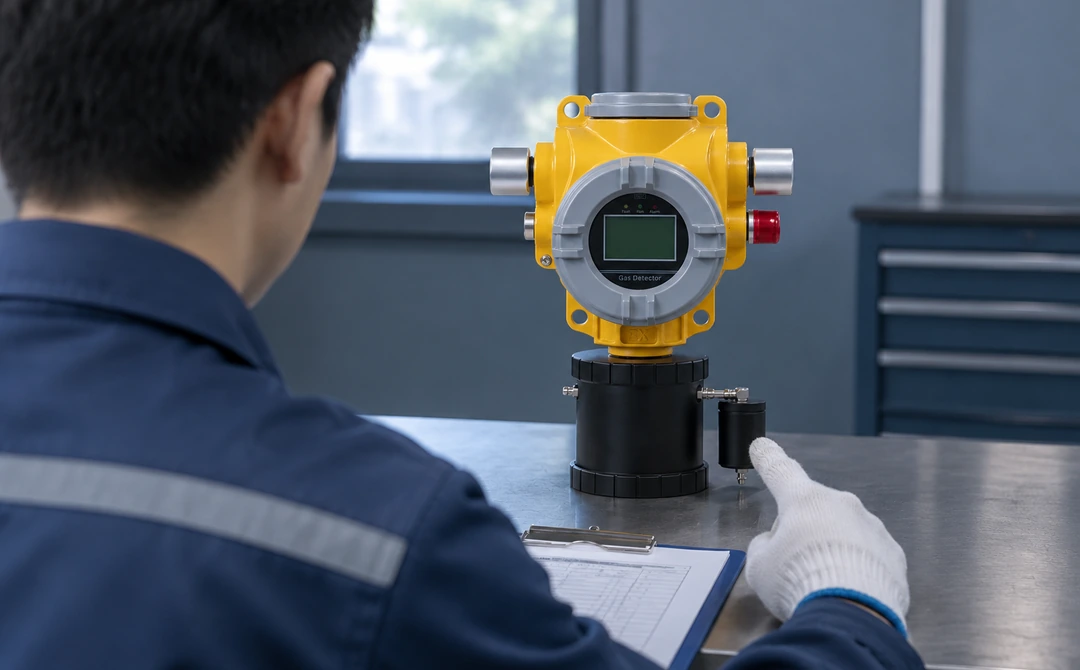
AIGA calls for a backup power source for the H2Se monitoring system. The actual backup arrangement, changeover behavior, and restoration sequence have to be defined for the site and demonstrated at handover. If the power or signal failure is invisible to the assigned operator, the detection path is incomplete even if the sensor passed a bench check.
Use the handover sheet as the purchasing brief
Send the point schedule with the request for a custom H2Se configuration, then keep the completed version after commissioning. Each row connects a proposed gas channel to a named location, required reading, and assigned action. The supplier can answer against those details, and the installation team can test the same ones.
| Record for each point | ご注文の前に | 引き渡し時 |
|---|---|---|
| Purpose and location | Release source, 入口, operator or process area, gas-cabinet or abatement duty | Installed point and airflow route match the drawing |
| 測定 | H2Se range, useful low end, error, 時間ベース, 干渉, 校正方法 | Supplied version and test documents match the required task |
| サンプリング | Diffusion or pumped inlet, line materials, treatment, flow and response target | Test from actual inlet; sample and flow faults recognized |
| Alarm and fault | Thresholds, 受信機, 出力, action, loss-of-signal and power behavior | 地元, リモート, 故障, backup-power and final-action tests recorded |
For an H2Se project quotation: send the point schedule with the concentration and time basis required at each location. Ask for the named sensor and finished-instrument test data, target-gas calibration approach, sampling-path details, and the alarm and fault sequence for the offered configuration.
Questions about H2Se detector selection
Hはできますか2S detector be used for H2Se?
Hydrogen sulfide and hydrogen selenide are different gases. An H2S channel cannot be treated as an H2Se measurement without evidence for the target gas, 較正, and interference in the supplied instrument.
Does a 0–1 ppm H2Se range prove detection at 0.05 ppm?
いいえ. That range states the nominal display span. Ask for the assembled instrument’s detection limit, error, and alarm performance near the required concentration under its stated test conditions. の 0.05 ppm value in the NIOSH/OSHA entry is a time-weighted exposure limit, not a ready-made instantaneous alarm setting.
Hはできますか2Se detector tube replace a fixed alarm?
A tube produces a reading during a manual check and has no continuous alarm between checks. Its useful range and interferences also depend on the exact tube and sampling procedure. Use it only for a point and concentration it can actually measure.
Why monitor an abatement outlet separately?
The outlet point reports on gas remaining after treatment or a possible breakthrough. Its sample stream, concentration range, and recipient differ from a work-area leak warning. Specify and verify the outlet sample path on its own terms.
What needs testing on a pumped H2Se system?
Test from the installed inlet through the full sample line to the alarm and assigned action. Include flow or blocked-line faults, signal and power failures, the receiving-system indication, and the backup arrangement specified for the site.

微信
QRコードをWeChatでスキャンします