 Henan Otywell Electronic Technology Co., Ltd

Choose a sulfur dioxide detector by defining the job first. Personal exposure monitoring, continuous area protection, leak investigation, and process analysis need different instruments. Once the objective is clear, match the measurement range, sensor, sampling method, alarms, environmental limits, and approvals to the site.
For most workplace safety applications, an electrochemical SO2 sensor is the usual starting point. It does not follow that every electrochemical instrument is interchangeable. Range, resolution, cross-sensitivity, response time, enclosure protection, data logging, and calibration support can make one detector suitable and another a poor fit.
Sulfur dioxide, written as SO2, is not hydrogen sulfide, written as H2S. Both contain sulfur, but their hazards, sensor channels, calibration gases, and typical sources are different. An H2S monitor should never be assumed to detect SO2.
Safety note: This article supports detector comparison but does not set a site alarm policy. Detector type, quantity, location, alarms, respiratory protection, and emergency actions must follow the applicable regulations, site risk assessment, industrial hygiene program, and manufacturer instructions.
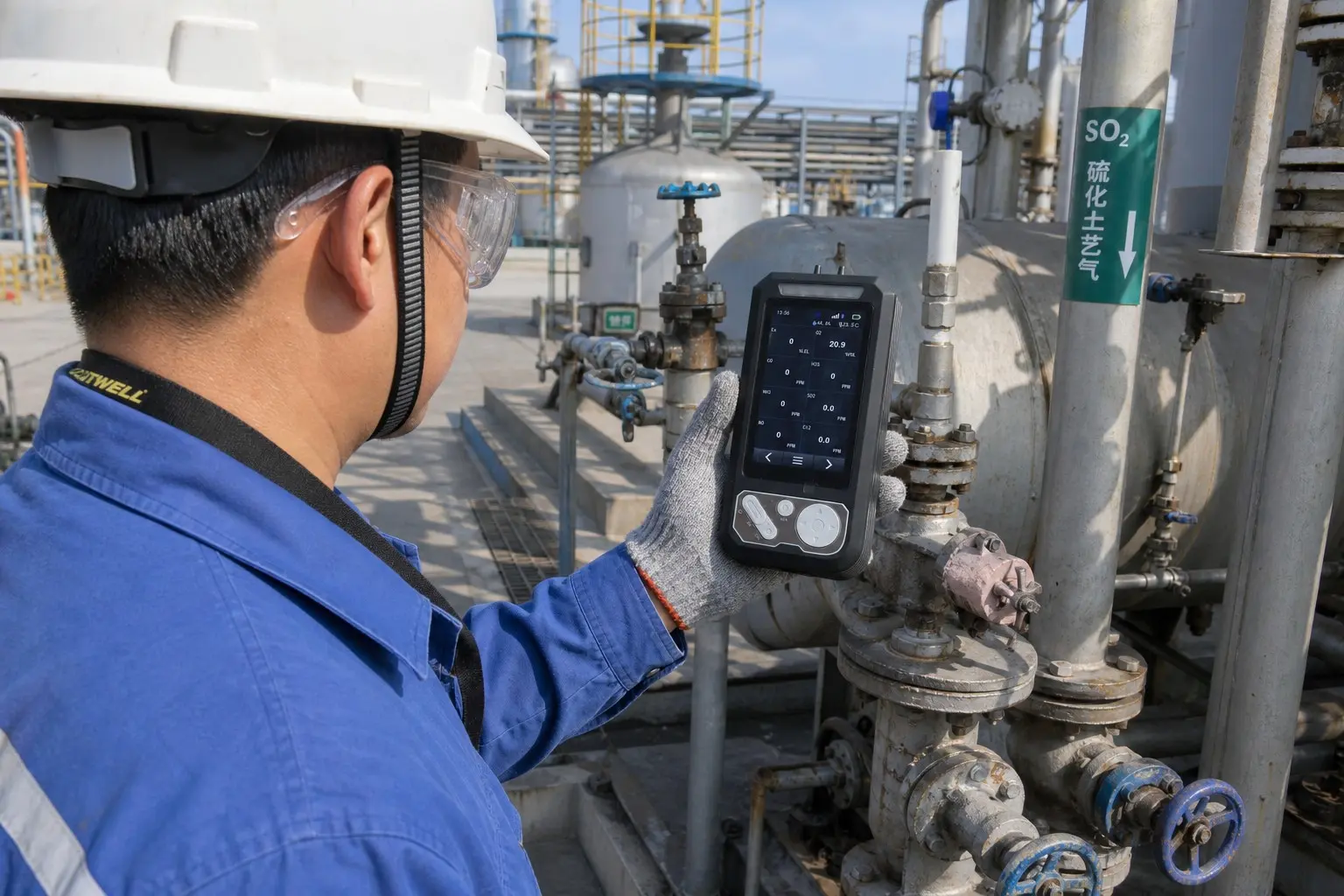
What does a sulfur dioxide detector measure?
A sulfur dioxide detector measures airborne SO2 and normally reports the concentration in parts per million. Some occupational or environmental documents also use milligrams per cubic meter. According to the NIOSH Pocket Guide entry for sulfur dioxide, 1 ppm equals 2.62 mg/m³ at the reference conditions used for the conversion.
SO2 is a colorless, nonflammable gas with a sharp, irritating odor. It can irritate the eyes, nose, throat, and respiratory system. Odor is not a dependable safety method. Sensitivity differs between people, background smells can mask it, and a worker may already need to respond by the time the odor is recognized.
The same NIOSH entry lists a recommended exposure limit of 2 ppm as a time-weighted average and 5 ppm as a short-term limit. It lists the OSHA permissible exposure limit as 5 ppm time weighted average and the NIOSH immediately dangerous to life or health value as 100 ppm. These numbers have different definitions and legal roles. They are reference values, not a ready-made low and high alarm pair for every facility.
SO2 has a relative gas density of about 2.26 compared with air. In still conditions it tends to move downward, but a real release may be warm, pressurized, carried by process exhaust, or redirected by ventilation. Density is useful when planning detector placement. It is not enough on its own.
Define the monitoring objective before choosing equipment
A clear objective prevents a common purchasing mistake: asking for an “SO2 monitor” without stating what concentration must be measured, where the sample comes from, and what should happen after an alarm. Start by choosing one of the following jobs.
Personal exposure monitoring
A portable detector worn near the breathing zone warns a worker about the air reaching that person. Typical users include maintenance crews, plant operators, emergency teams, and workers inspecting sulfur handling or combustion equipment. The unit should provide clear audible, visual, and vibration alarms. TWA and short-term exposure functions may be needed when the site’s industrial hygiene program uses them.
Personal monitoring follows the worker. That is valuable when the work route changes, but it does not continuously protect an unoccupied room or automatically start ventilation.
Continuous area monitoring
A fixed sulfur dioxide gas detector watches a selected location continuously. It may send a 4 to 20 mA or digital signal to a controller, operate local relays, and trigger a horn or beacon. Fixed monitoring is often considered around SO2 storage, transfer points, process equipment, enclosed rooms, or other credible release sources.
Coverage depends on detector position and quantity. One wall-mounted unit cannot be assumed to represent a large room with partitions, several leak points, or complex airflow.
Leak checks and remote sampling
A pumped portable detector can draw gas through a probe and tubing. This helps with valve checks, equipment cabinets, pits, ducts, and points that cannot be approached safely before testing. Tubing length, material, moisture, filters, and flow rate can delay or change the sample, so the manufacturer-approved sampling setup matters.
Process and emissions analysis
Stack gas analyzers, continuous emissions monitoring systems, and reference-grade ambient monitors answer different questions from a workplace alarm. They may use heated sample lines, gas conditioning, dilution, or ultraviolet fluorescence. Do not buy a personal safety monitor for regulatory stack measurements, and do not assume a process analyzer provides suitable worker alarms.
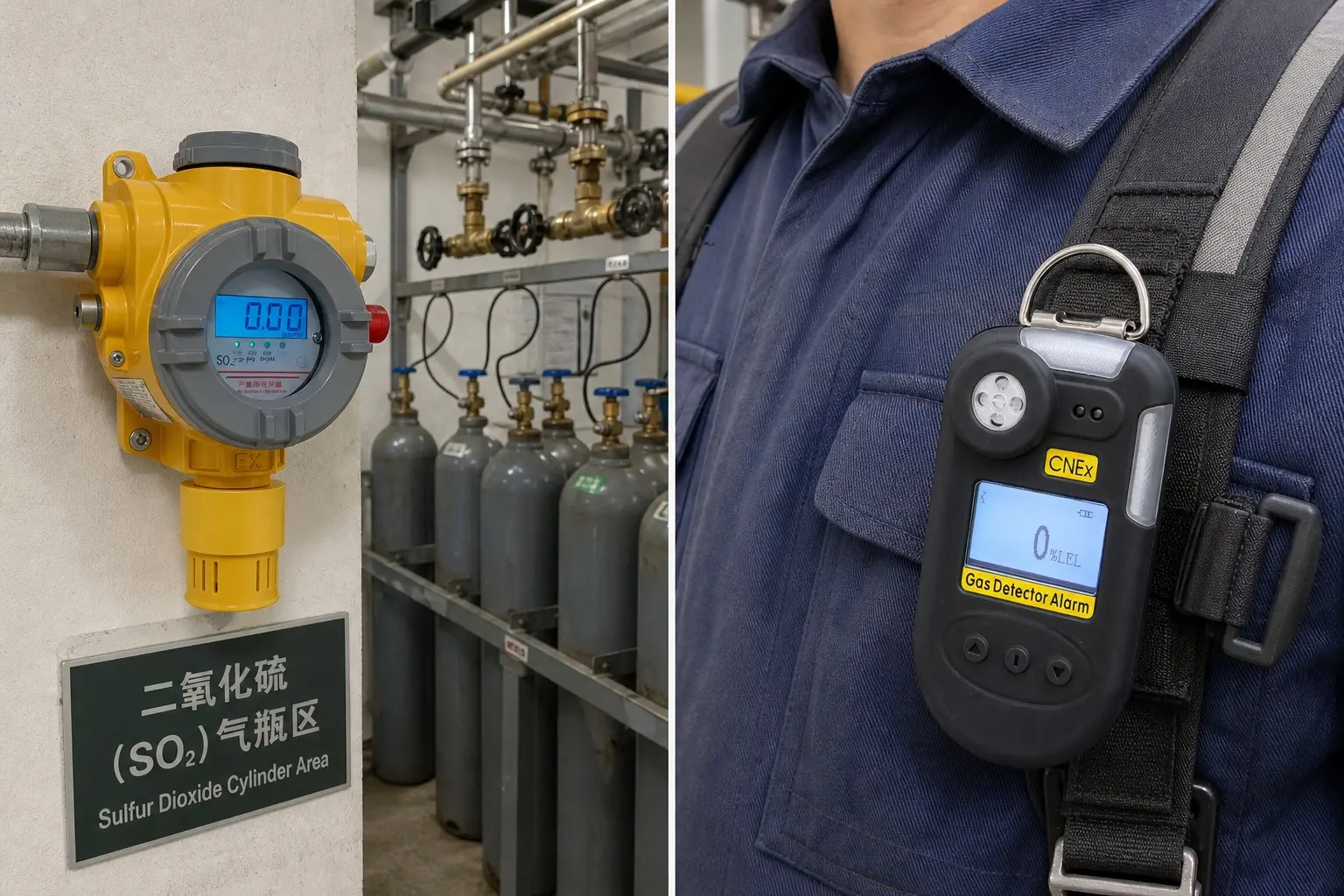
Fixed vs portable sulfur dioxide detector
Many sites need both formats. A fixed system can identify a release and notify the control room while a portable unit helps a worker check conditions during entry, maintenance, or investigation. Our broader fixed vs portable gas detector guide explains how the two formats fit into a layered monitoring program.
| Selection point | Fixed SO2 detector | Portable SO2 detector |
|---|---|---|
| Primary role | Continuous monitoring of a defined location | Personal protection, surveys, and temporary work |
| Power | Permanent wired supply or an engineered wireless arrangement | Rechargeable or replaceable battery |
| Alarm path | Local alarm plus controller, PLC, DCS, or remote notification | Audible, visual, and vibration warning to the user |
| Sampling | Diffusion at the sensor or a designed sample-draw system | Diffusion or integral pump with probe and tubing |
| Main maintenance concern | Sensor access, wiring, calibration, relays, and complete loop testing | Battery, pump, filter, bump test, calibration, and event records |
Do not choose solely by purchase price. A fixed detector installed where gas never reaches it has little value. A portable unit left uncharged or without current calibration is no better. The monitoring plan has to account for how the instrument will be used every shift.
How SO2 sensor technology affects selection
Electrochemical SO2 sensors
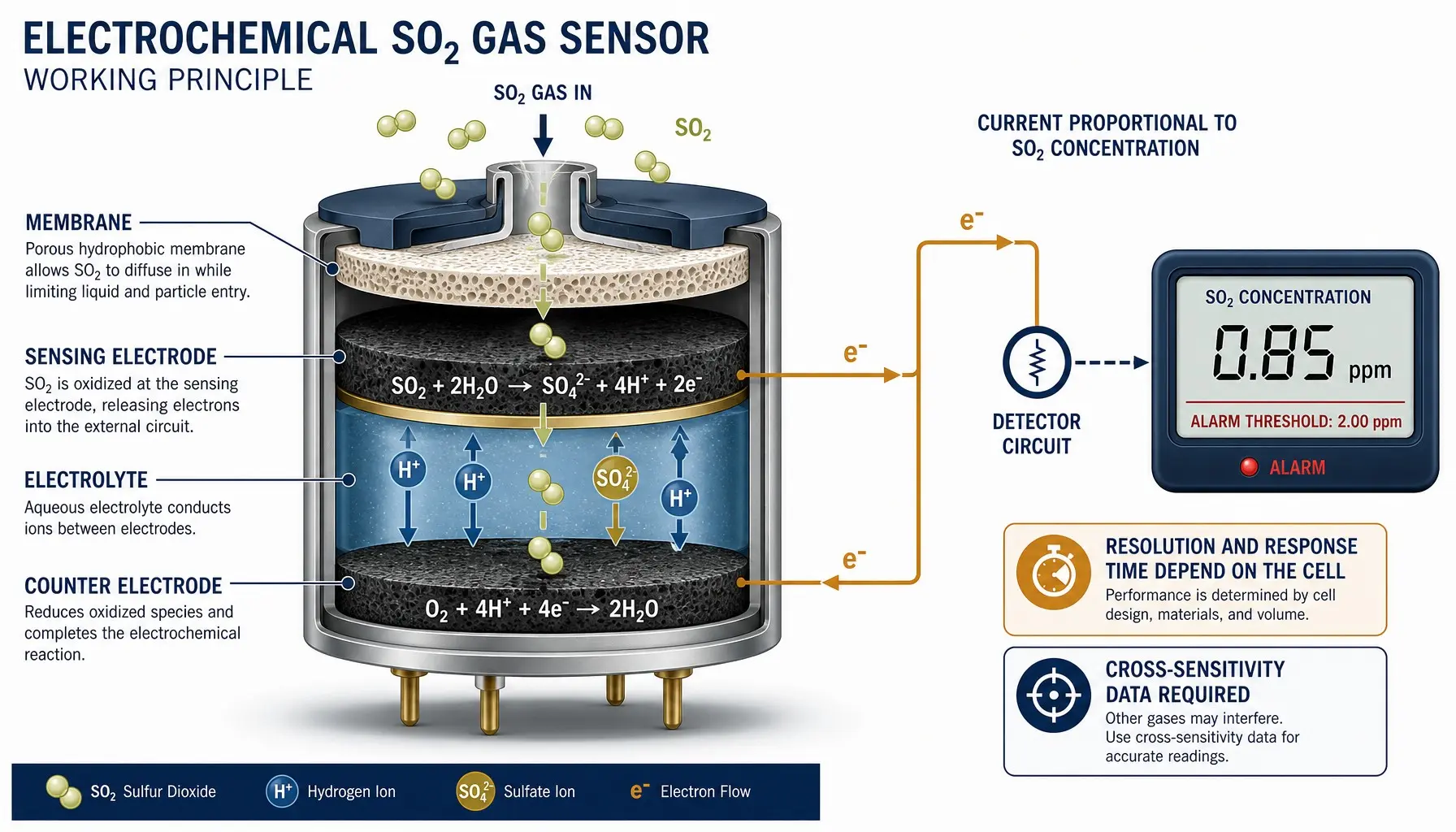
Electrochemical sensors produce an electrical current when SO2 reacts inside the cell. They can provide the ppm-level sensitivity needed for many safety applications and are available in both fixed and portable instruments. Their response can change with temperature, humidity, pressure, sensor age, and exposure to interfering gases.
Compare more than the nominal range. Ask for resolution, accuracy, response and recovery times, expected sensor life, operating limits, and a cross-sensitivity table. A sensor that responds to another gas present in the process may produce a high reading. A negative cross-response can be more troublesome because it may suppress the displayed SO2 value.
Our overview of common gas detector sensor technologies provides additional background on electrochemical and other sensing methods.
Colorimetric detector tubes
A detector tube uses a measured sample volume and a chemical color change to estimate concentration. Tubes can be useful for spot checks, preliminary surveys, or confirmation within their stated range. They do not provide continuous alarms, and the result depends on the correct pump strokes, reading method, temperature correction, shelf life, and interfering gases.
UV fluorescence and process instruments
Ultraviolet fluorescence is widely associated with ambient and emissions SO2 analysis. These instruments may provide low detection limits and detailed data, but they also involve sample conditioning, calibration standards, and maintenance that differ from a compact industrial alarm. Selection must follow the actual measurement purpose.
Choose the right sulfur dioxide detector range
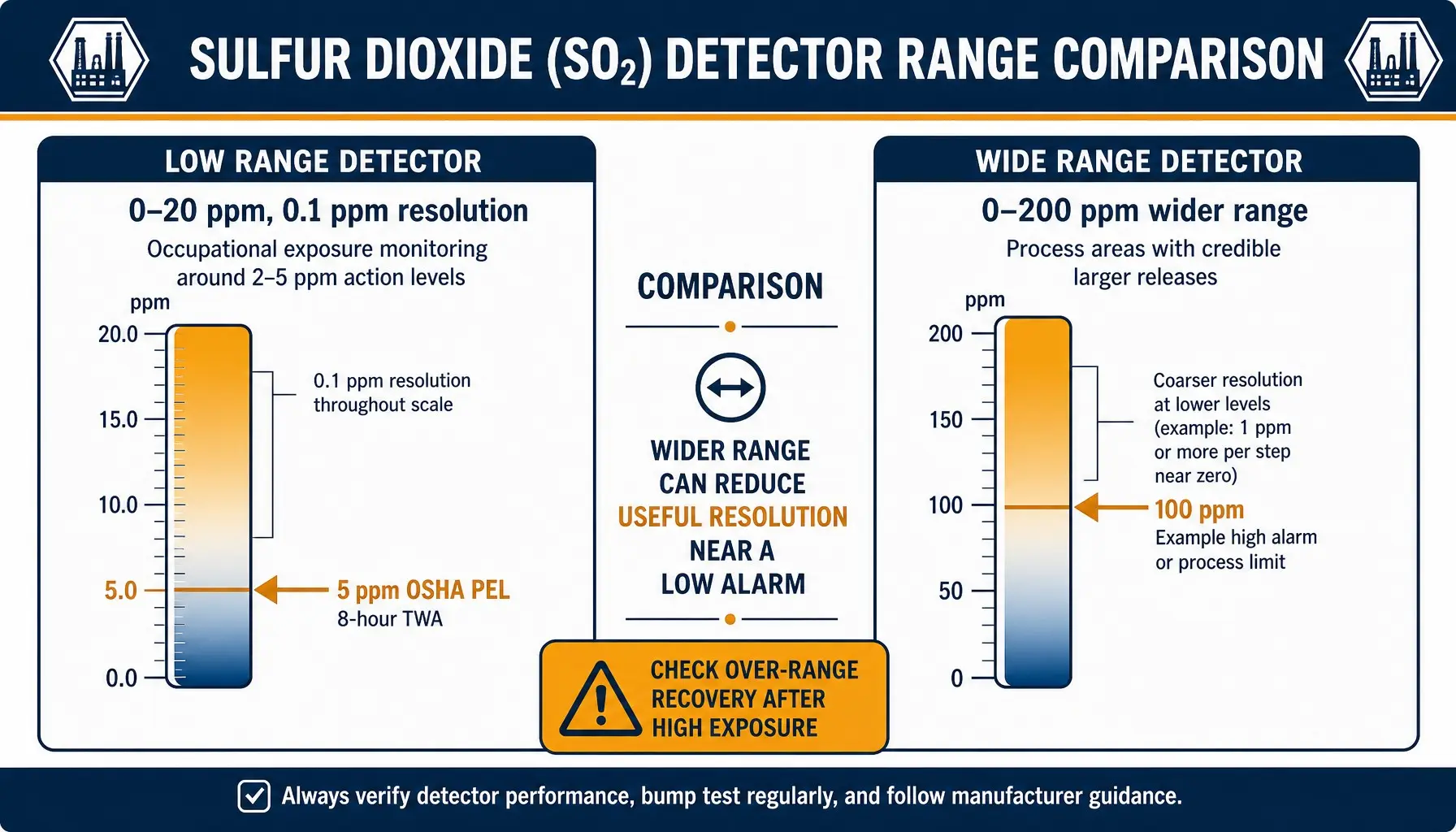
The expected concentration and required action should determine the range. A low ppm detector can provide useful resolution around occupational monitoring levels. A wider range may be needed near a process where a larger release is credible. Choosing the widest available range can make small changes harder to see and may reduce useful resolution around a low alarm.
Review the standard range, optional ranges, resolution, full-scale accuracy, and over-range behavior together. If the detector displays 0 to 20 ppm at 0.1 ppm resolution, it serves a different objective from an instrument intended to follow hundreds of ppm in a process sample. The instrument must also recover safely after exposure above its normal range.
| Requirement | Question to ask |
|---|---|
| Low-level resolution | Can the display and sensor show a meaningful change near the site’s action level? |
| Maximum credible release | Will the detector go over range, and how is that condition indicated? |
| TWA and STEL | Does a portable unit calculate the exposure metrics required by the site? |
| Alarm adjustment | Who can change alarms, and are changes logged or password protected? |
| Recovery | What inspection or calibration is required after a high exposure? |
Plan sulfur dioxide detector placement
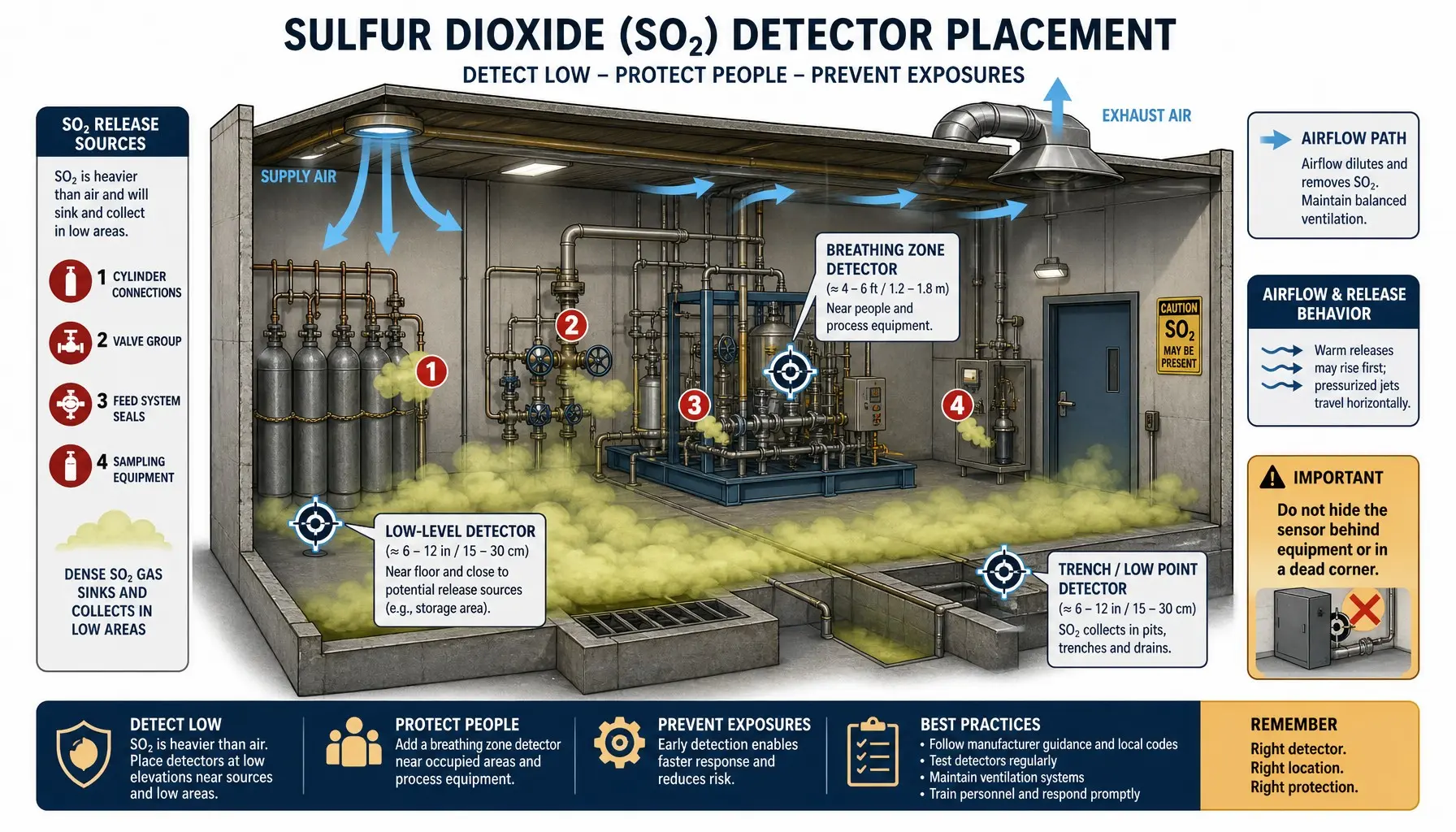
Because SO2 is denser than air, low areas deserve attention, especially around a low-pressure release in relatively still air. That is only the first step. The release source, temperature, pressure, room airflow, exhaust, equipment layout, and worker position determine where gas can actually reach a sensor.
Begin with credible release points such as valves, cylinder or tank connections, feed systems, process seals, sampling equipment, and enclosed transfer areas. Trace the likely gas path under normal ventilation and after a ventilation failure. Warm gas may initially rise. A pressurized jet can travel horizontally. Outdoor wind can make one point detector unreliable for a large open area.
- Do not hide the sensor behind equipment, inside a dead corner, or against a surface that blocks gas movement.
- Avoid direct supply air that can dilute the sample before it reaches the detector.
- Check pits, trenches, sumps, and low enclosures only when the release analysis shows SO2 could enter them.
- Consider a worker’s breathing zone when the objective is exposure monitoring.
- Keep the detector accessible for inspection, gas application, and sensor replacement.
- Protect the sensor from water spray, condensation, dust, and corrosive deposits without blocking diffusion.
A complex room may need more than one detector or an engineered sample-draw system. Smoke visualization, ventilation testing, dispersion analysis, or input from a qualified industrial hygienist can help when the gas path is uncertain.
Build alarm settings around site actions
Exposure limits and alarm settings are related but not identical. The OSHA chemical data page for sulfur dioxide provides regulatory and physical-property references. A qualified person must determine which limits apply to the workforce, jurisdiction, task, and work schedule.
A portable monitor may include instantaneous low and high alarms plus TWA and STEL functions. A fixed detector may activate a local horn, send a controller signal, notify a control room, start ventilation, or initiate an approved process response. Each threshold needs a written action and a responsible person.
Document what happens when the detector reports a fault, calibration is overdue, communication fails, or power is lost. Also check alarm delay, latching, reset access, relay state, and remote display. During commissioning, test the full cause-and-effect sequence rather than stopping after the detector beeps.
Check cross-sensitivity and the operating environment
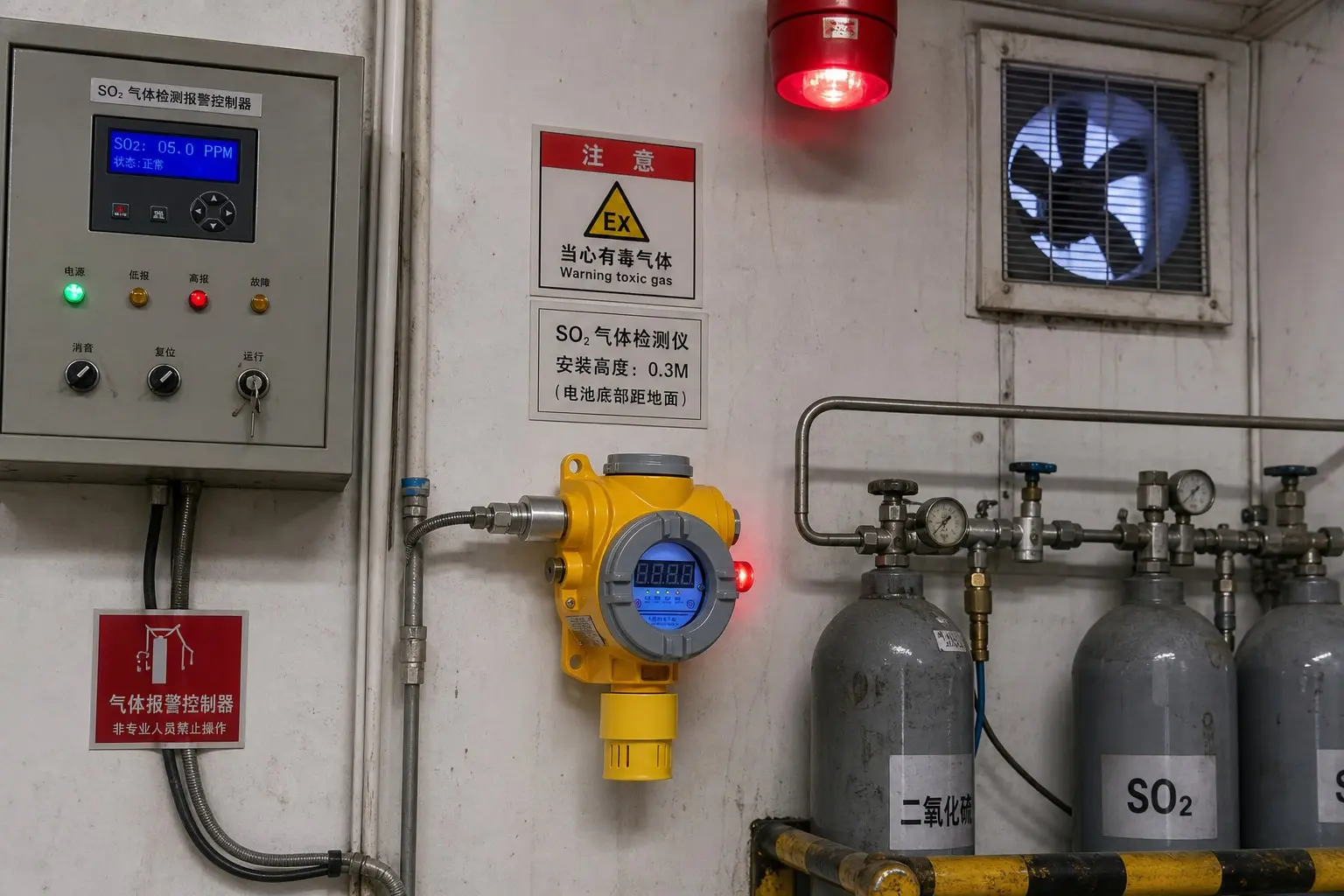
An SO2 sensor does not operate in isolation. List other gases and vapors expected during normal work, cleaning, maintenance, startup, and an upset. Ask the supplier for documented cross-sensitivity data for the exact sensor. Do not transfer a table from another model simply because both use electrochemical technology.
Temperature and humidity limits need equal attention. Rapid humidity changes can disturb some electrochemical readings. Condensation can block a diffusion path or damage components. SO2 is water soluble and can form acidic solutions on wet surfaces, so enclosure materials, filters, and corrosion resistance matter in damp installations.
For classified areas, verify the complete hazardous-location approval, including gas group, temperature class, protection method, and installation requirements. IP ratings address dust and water ingress; they do not replace explosion-protection certification.
Plan bump testing, calibration, and records
A bump test applies SO2 test gas to confirm that gas reaches the sensor and that the detector responds and alarms. Calibration compares the reading with a known concentration and adjusts the instrument when required. A successful self-check does not prove that the sensor responds to gas.
SO2 calibration needs compatible equipment. Use the cylinder concentration, balance gas, regulator, flow rate, tubing, and calibration cap specified by the detector manufacturer. Reactive gases can be affected by unsuitable tubing or regulators. Check the calibration gas expiration date and follow its storage instructions.
- Inspect the housing, inlet, filter, battery or power, display, and fault status.
- Confirm the detector gas, range, units, and alarm configuration.
- Apply the specified SO2 test gas at the correct flow.
- Record response time, reading, alarm operation, and recovery.
- For fixed systems, test remote indications, relays, ventilation, and control actions.
- Record the detector ID, gas cylinder, result, technician, date, and corrective work.
There is no single calibration interval for every SO2 detector. Follow the manufacturer and site program, then consider sensor age, exposure history, environmental severity, regulatory requirements, and failed bump tests.
Where sulfur dioxide monitoring is used
The U.S. EPA overview of sulfur dioxide sources identifies fossil fuel combustion at power plants and industrial facilities as major sources, with other sources including metal extraction and high-sulfur fuels used by ships and heavy equipment.
Workplace monitoring can also be relevant in oil refining, pulp and paper operations, chemical production, sulfur-containing material handling, food preservation processes that use SO2, and maintenance around combustion or flue-gas equipment. The right detector depends on whether SO2 is stored, intentionally used, generated by a process, or present only during an abnormal condition.
Single-gas personal monitoring
When the task needs a compact instrument dedicated to SO2, the Otywell G10 single-gas detector can be configured for sulfur dioxide. Confirm the requested range, alarms, approval, and operating conditions before ordering.
Fixed continuous monitoring
For permanent area monitoring, the Otywell TCB2-F fixed gas detector lists an SO2 configuration and industrial signal options. Detector quantity, placement, controller compatibility, and hazardous-area requirements still need a site-specific review.
Pumped multi-gas work
If the job requires SO2 alongside other gases or remote sampling, the Otywell OT139 pumped multi-gas detector supports configurable gas channels that include sulfur dioxide. Confirm the full gas combination because sensor compatibility, pump flow, and available channels can affect the final configuration.
Sulfur dioxide detector selection checklist
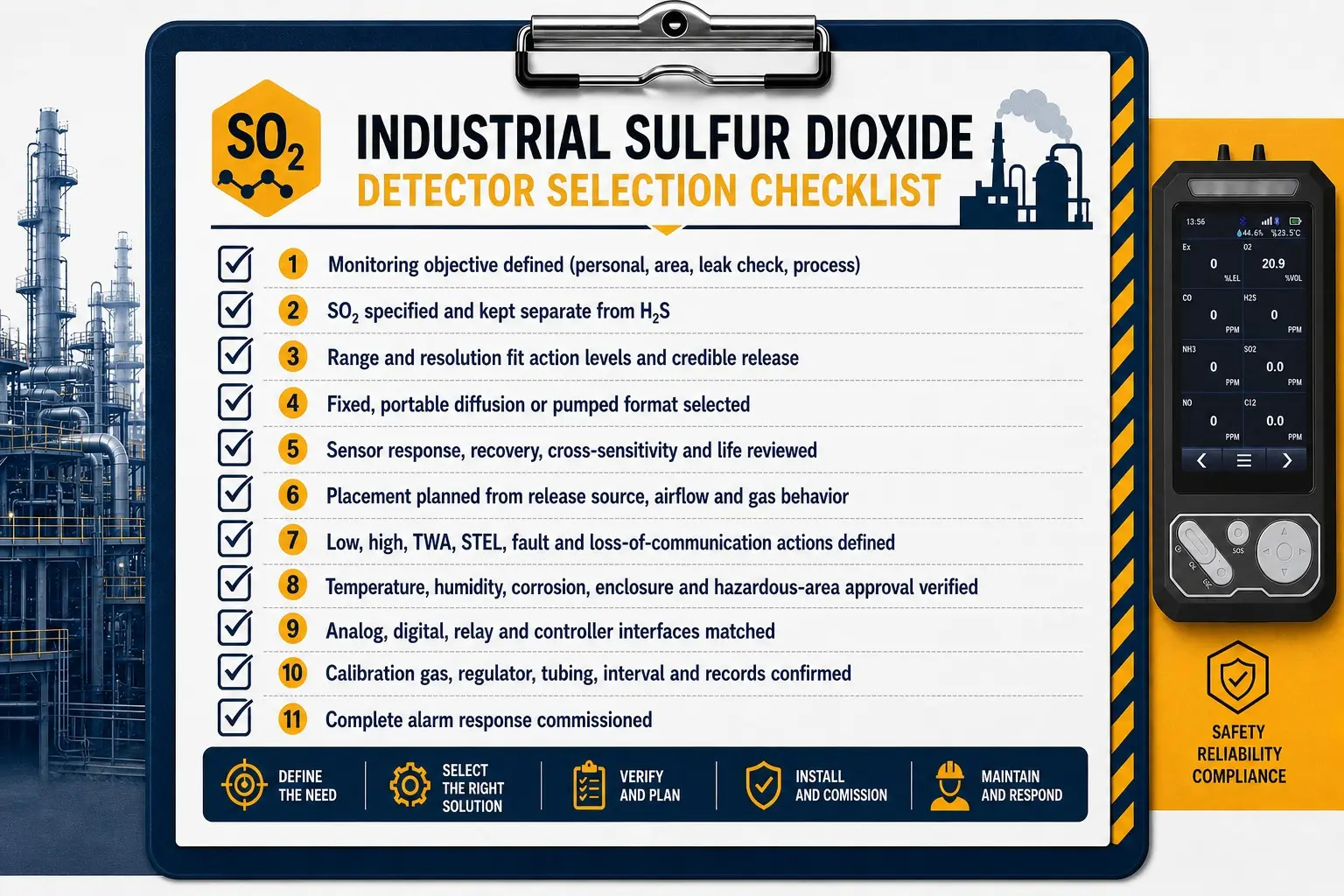
- Define whether the goal is personal exposure, area monitoring, leak checking, or process analysis.
- Specify SO2 and keep it separate from H2S and other sulfur compounds.
- Select a range and resolution that fit the action levels and credible release.
- Choose fixed, portable diffusion, portable pumped, or a combined arrangement.
- Review sensor response, recovery, cross-sensitivity, expected life, and over-range behavior.
- Plan placement from the release source, airflow, gas behavior, and worker location.
- Define low, high, TWA, STEL, fault, communication-loss, and power-loss actions.
- Verify temperature, humidity, condensation, corrosion, enclosure, and hazardous-area approval.
- Match analog, digital, relay, and controller interfaces to the site system.
- Confirm calibration gas, regulator, tubing, test interval, records, and spare sensor supply.
- Commission the complete detector and alarm response before relying on it.
Frequently asked questions
What does a sulfur dioxide detector measure?
It measures airborne SO2, usually in parts per million. Workplace safety detectors commonly use electrochemical sensors, while emissions and ambient monitoring may use different analytical methods and sample systems.
Where should an SO2 detector be installed?
Install it where gas from a credible release is likely to reach the sensor. Low areas may matter because SO2 is denser than air, but release pressure, temperature, ventilation, obstructions, and worker position must also be assessed.
Is sulfur dioxide heavier than air?
Yes. Its relative gas density is about 2.26 compared with air. That does not mean every sensor belongs at floor level. Warm releases, pressurized jets, process exhaust, and ventilation can change the initial gas path.
What is the difference between SO2 and H2S?
SO2 is sulfur dioxide, a nonflammable respiratory irritant associated with combustion and several industrial processes. H2S is hydrogen sulfide, a toxic and flammable gas found in different processes. They require separate sensor and calibration specifications.
Can a standard four-gas monitor detect sulfur dioxide?
Usually not unless it has been specifically configured with an SO2 sensor. A standard four-gas monitor often measures oxygen, carbon monoxide, hydrogen sulfide, and combustible gas. Check the installed sensors rather than relying on the enclosure or product family name.
How often should an SO2 detector be calibrated?
Use the manufacturer’s interval and the site’s written program. Exposure history, sensor age, environmental conditions, regulations, and bump-test results may justify additional testing. Calibrate after a failed test or other event identified in the instructions.
Choose the detector around the real task
A suitable sulfur dioxide detector begins with a precise monitoring objective. Range, sensor, placement, alarms, environmental protection, outputs, and maintenance must all support that objective. Comparing only price and maximum range leaves too many practical questions unanswered.
Before requesting a quotation, prepare the expected SO2 range, fixed or portable format, other gases present, sampling method, installation conditions, required approvals, alarm functions, quantity, and communication outputs. That information helps the supplier recommend a configuration that matches the work instead of guessing from the gas name alone.
Prev: How to Choose an Industrial Hydrogen Gas Detector
Next: Sewer Gas Detection Equipment for Manholes and Wastewater Sites
 Author: Jack Niu
WeChat
Scan the QR Code with wechat