 Henan Otywell Electronic Technology Co., Ltd

A portable gas detector sounds in a place where nobody can find a leak. The reading drops after the worker moves away, so the alarm gets blamed on the instrument. That conclusion may be wrong. The detector could have caught a short release, exhaust plume, cleaning vapor, or gas that affected a different sensor.
Treat every alarm as a real hazard until the area has been assessed. Stop work, move to a safe location, and follow the site’s alarm response procedure. Troubleshooting comes later. Muting the horn and carrying on is not troubleshooting.
Gas detector false alarms are usually traced to one of four sources: a real but intermittent gas event, sensor cross-sensitivity, environmental or sampling problems, or an instrument that needs maintenance. The alarm record, gas channel, location, timing, and nearby work often reveal more than another quick reset.
Safety rule: Do not zero, open, test, or service a detector in a potentially hazardous atmosphere. Move to a known-safe location and use the approved site procedure.
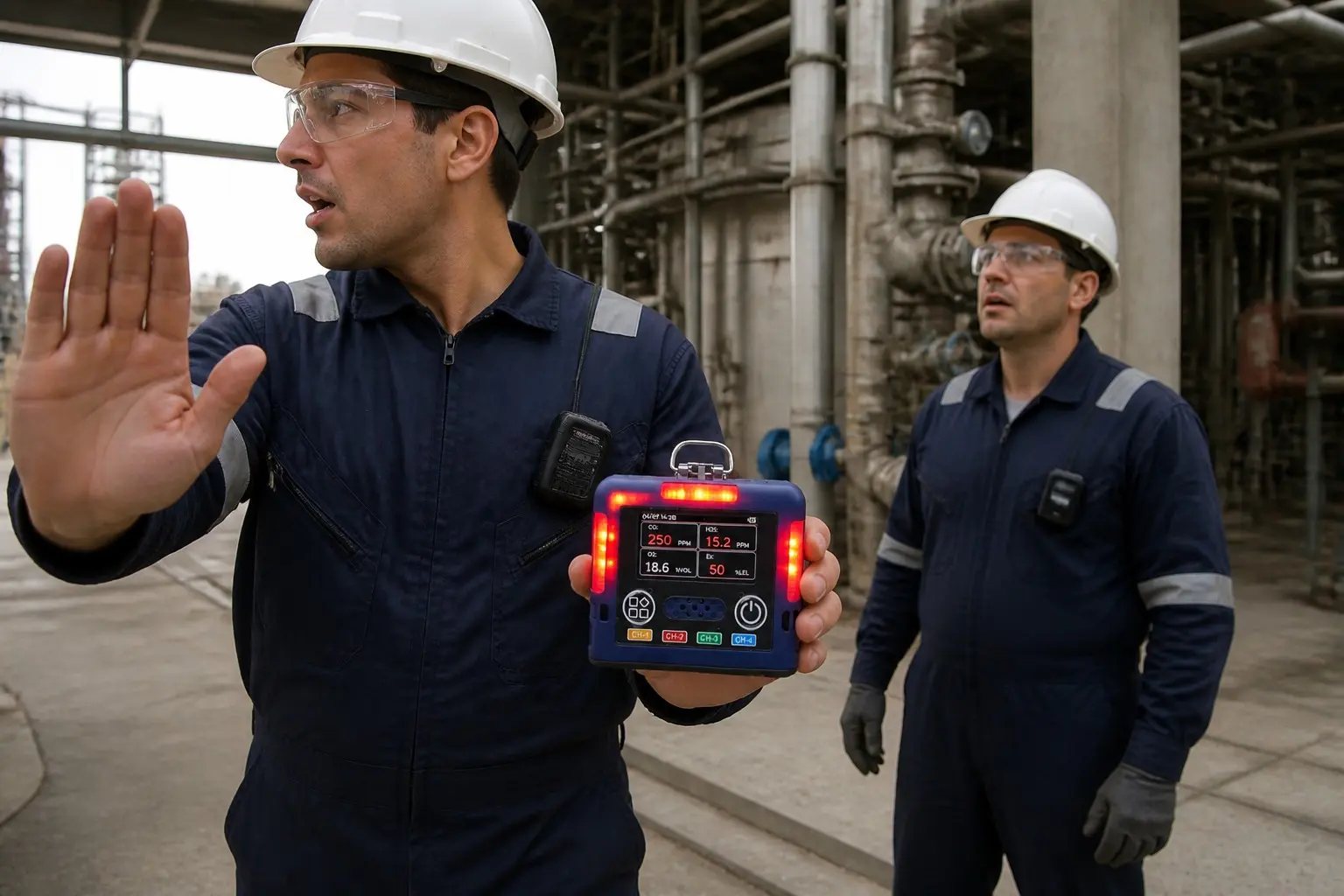
What should you do when a gas detector alarms?
- Stop the task and follow the site’s evacuation or isolation procedure.
- Move to a known-safe area without removing protective equipment early.
- Note the gas channel, displayed value, alarm type, time, and location.
- Report nearby work such as charging, cleaning, welding, venting, or chemical transfer.
- Keep the detector’s peak reading and event log. Do not clear them before they are reviewed.
- Allow a qualified person to confirm the atmosphere and inspect the instrument.
A detector that returns to zero in fresh air has not proved that the earlier alarm was false. A small release may have stopped. A worker may have walked out of a vapor plume. Ventilation may have changed the concentration before a second reading was taken.
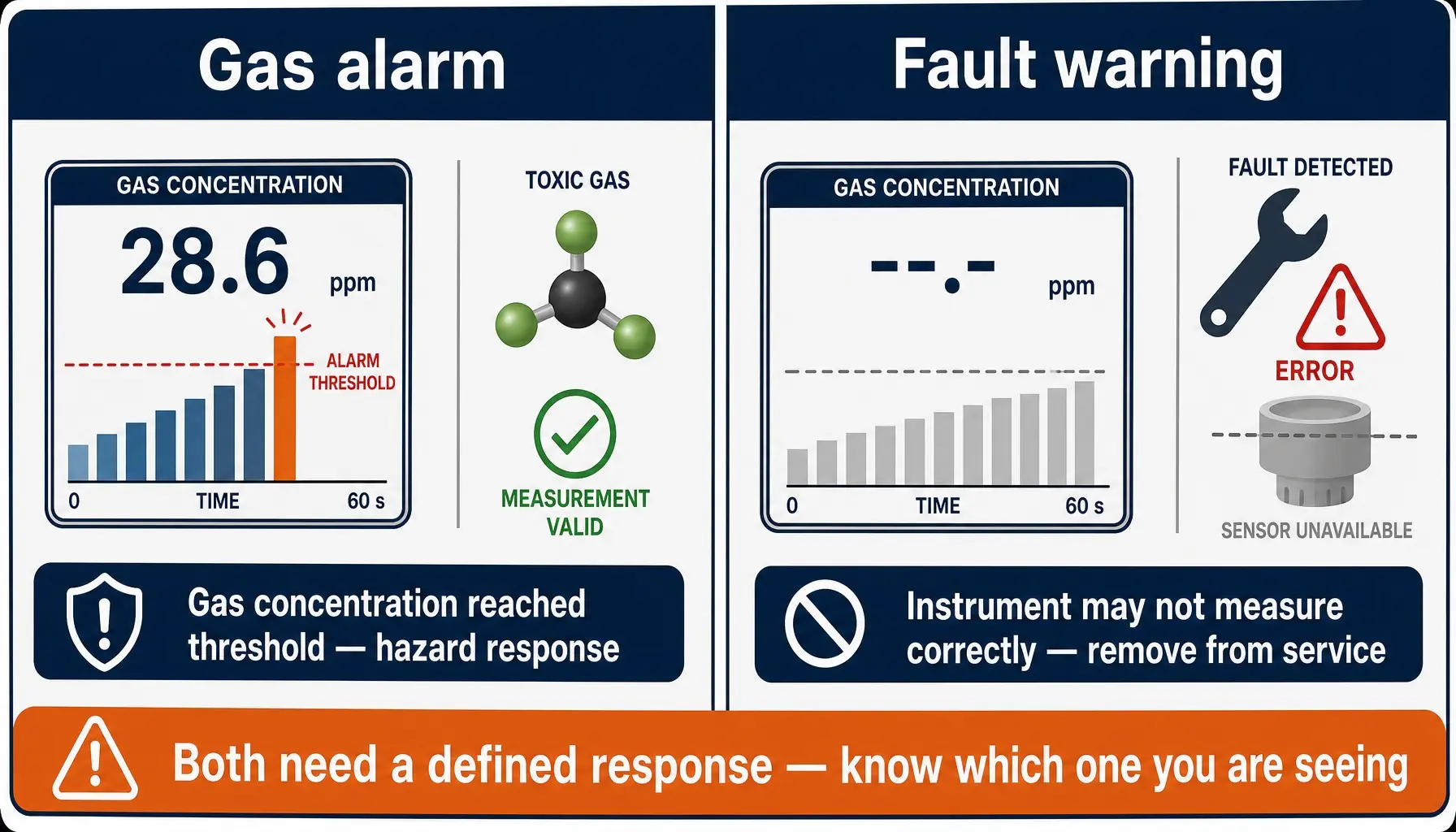
Gas alarm, fault alarm, or maintenance warning?
The word “alarm” covers several different events. A gas alarm reports a concentration or exposure calculation. A fault warning reports that the detector may not be able to measure correctly. Workers need to recognize both.
| Indication | What it usually means | First response |
|---|---|---|
| Low gas alarm | The current reading reached the first configured threshold. | Follow the written site response. Do not treat “low” as “safe.” |
| High gas alarm | The reading reached a higher instantaneous threshold. | Leave or isolate the area as required. High alarms may latch. |
| STEL or TWA alarm | The calculated exposure average reached its configured limit. | Follow the exposure response procedure and preserve the worker’s history. |
| Oxygen alarm | Oxygen moved below the low setting or above the high setting. | Leave the area. Do not assess combustible readings without checking oxygen. |
| Over-range | The concentration exceeded the sensor’s display or measurement range. | Treat it as a serious exposure and inspect the sensor before reuse. |
| Pump, sensor, battery, or calibration fault | The instrument cannot complete part of its measurement or warning function. | Remove it from service until the fault is corrected. |
Alarm setpoints should come from the hazard assessment, applicable exposure limits, manufacturer instructions, and the site’s response plan. The UK Health and Safety Executive notes that a flammable gas alarm must be set low enough to protect people but high enough to avoid unnecessary alarms. Its guidance on selecting and using flammable gas detectors also discusses faults, environmental limits, and alarm settings.
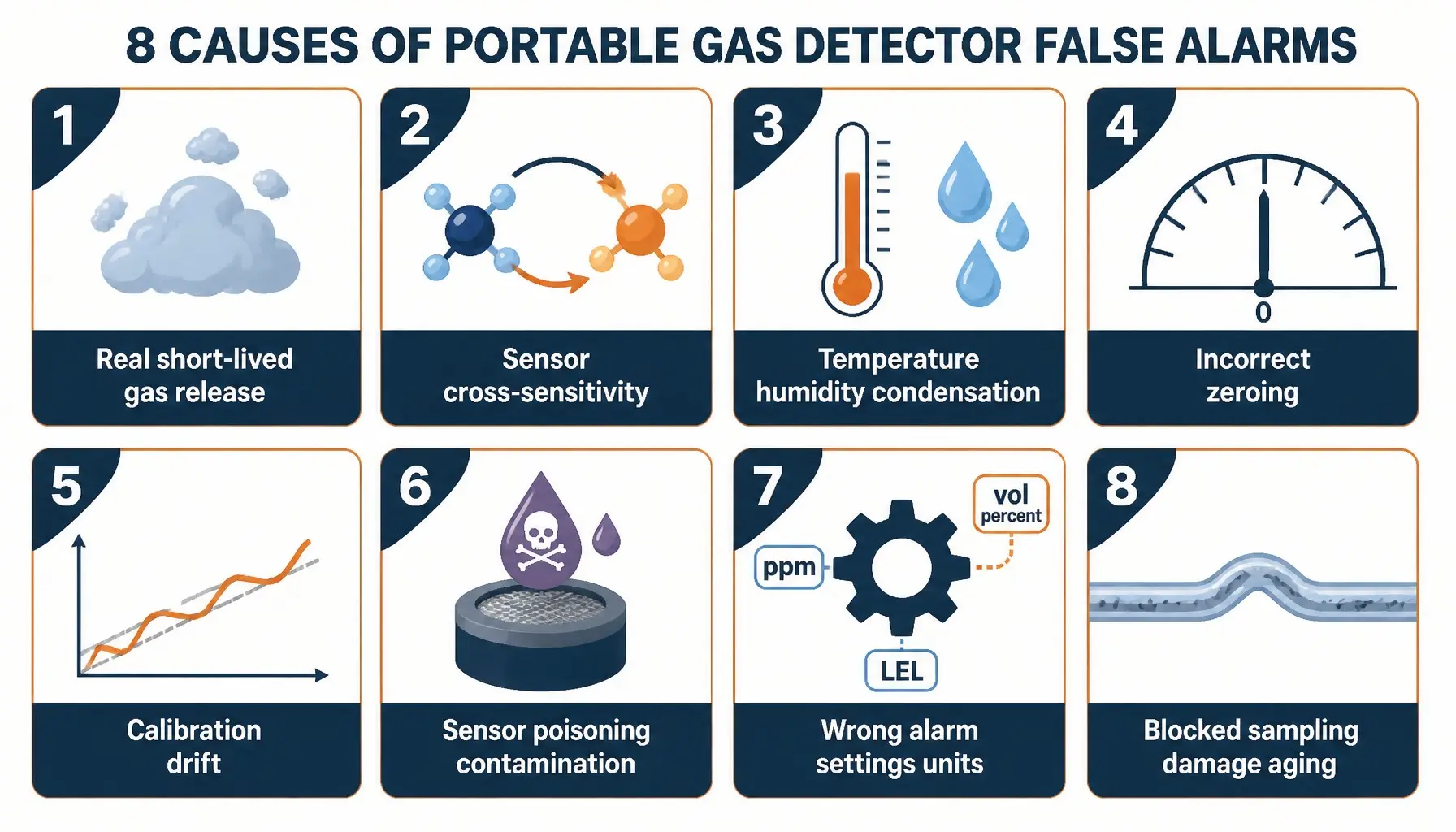
Eight causes of gas detector false alarms
1. A real but short-lived gas release
Intermittent process events are easy to miss during a follow-up inspection. A relief valve may lift briefly. A forklift may pass the monitor. A worker may open a sample point, tank, or chemical container. Exhaust can drift across an outdoor work area and disappear when the wind changes.
Compare the detector timestamp with process logs, work permits, ventilation changes, vehicle movement, washdown, and maintenance activity. Repeated alarms at the same time or location usually deserve an investigation of the process before an investigation of the sensor.
2. Sensor cross-sensitivity
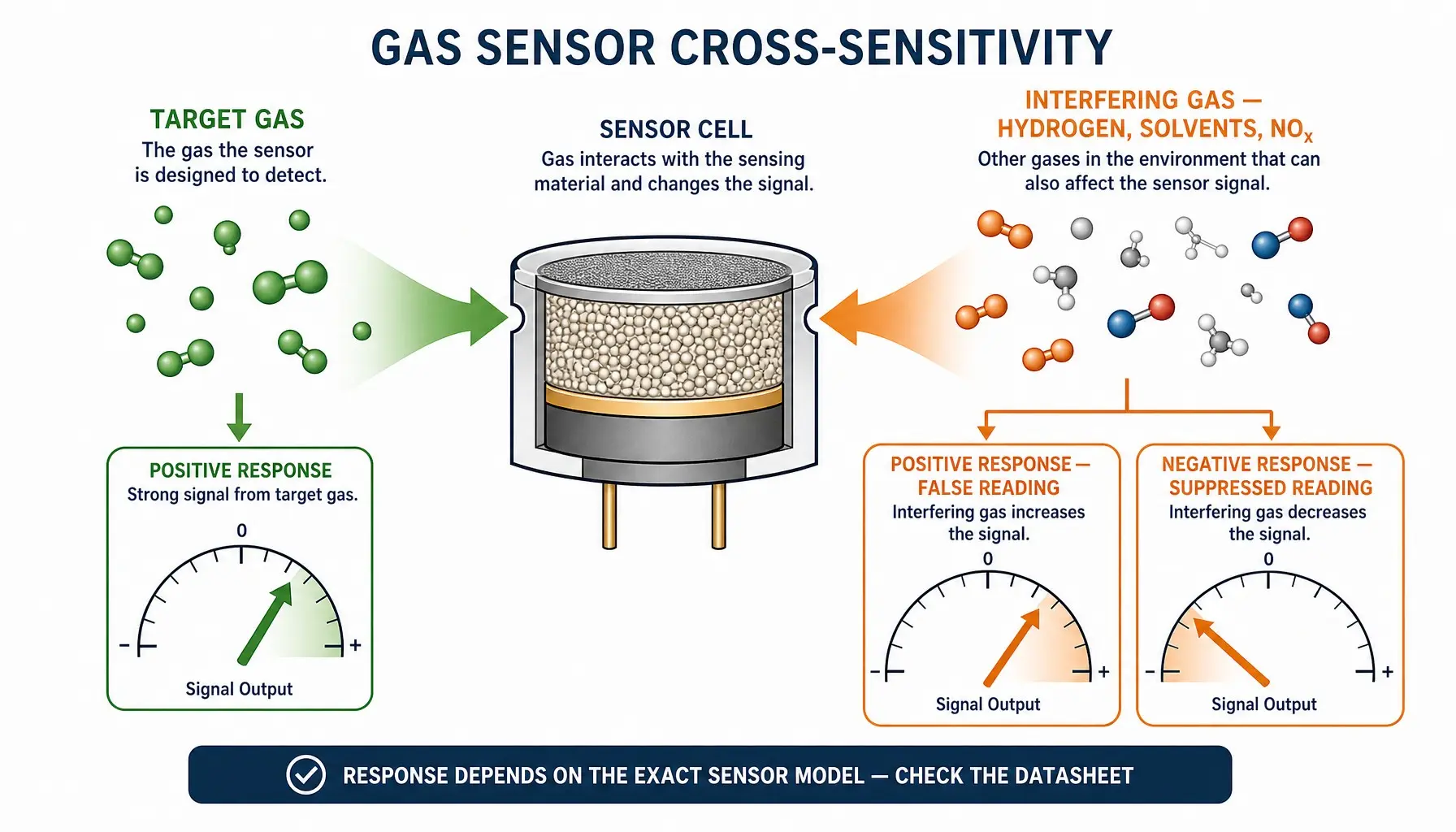
A gas sensor is selective, but it is rarely exclusive. Some electrochemical CO sensors respond to hydrogen. Other toxic sensors can react to sulfur compounds, nitrogen oxides, alcohols, or solvents. The amount and direction of the response depend on the exact sensor, not only the gas name printed on the detector.
Cross-sensitivity can produce a positive reading when the target gas is absent. It can also suppress a reading. That negative response is harder to notice because the display may look reassuring. MSA’s published electrochemical sensor cross-sensitivity data shows why the sensor model and interfering gas both matter.
Do not apply a correction factor from another brand or sensor family. Check the current datasheet for the installed sensor and confirm the result with a method suitable for the suspected gas.
3. Temperature, humidity, and condensation
A detector carried from an air-conditioned control room into hot, wet air may need time to stabilize. Steam, washdown, heavy rain, or a sudden temperature change can form condensation on the inlet or sensor. The resulting spike may be temporary, but water can also block the sample path or damage a filter.
Move the instrument to a safe area, inspect it, and let it reach the surrounding temperature. Do not use heat guns or unapproved drying methods. If water entered the detector or sample line, follow the manufacturer’s service instructions.
4. Incorrect zeroing
Zeroing tells the detector what the baseline should be. If the instrument is zeroed near exhaust, a process vent, solvent storage, or a sewer opening, the baseline may already contain the gas being measured. Later readings can then be shifted up or down.
Use air known to be clean or approved zero air. “It smells clean” is not evidence, especially for gases such as carbon monoxide. If the zero source is uncertain, stop and verify it before changing the instrument.
5. Calibration drift
Sensor response changes with age, exposure, storage, temperature, humidity, and contamination. A drifting sensor may still respond to gas, yet display the wrong concentration. A bump test can confirm response and alarm operation, but it does not establish accuracy. The difference is explained in our bump test vs calibration guide.
OSHA advises employers to follow the manufacturer’s test and calibration procedures and to verify portable direct-reading monitors before each day’s use. The agency’s guidance on calibrating and testing direct-reading monitors lists drift, harsh conditions, high gas exposure, and sensor poisons among the causes of unreliable readings.
6. Sensor poisoning or contamination
Catalytic combustible sensors can lose sensitivity after exposure to certain silicone, sulfur, lead, and halogenated compounds. Toxic electrochemical sensors may be affected by solvents or corrosive gases. Dust, paint, oil, tape, and dirty filters can stop gas from reaching the sensor at all.
These problems do not always create an obvious fault message. The detector may start normally and show zero. A response test with suitable gas is the practical way to find a blocked or unresponsive channel. Our overview of gas detector sensor types explains the different failure modes of catalytic, electrochemical, infrared, and PID sensors.
7. Wrong alarm settings or units
A low threshold may create frequent alarms, but increasing it without a hazard review can expose workers to more gas. First confirm the channel, unit, time basis, and source of the setpoint. Ppm, percent by volume, and percent LEL are not interchangeable labels.
Also check whether a change was made in the detector, docking software, or fleet template. Alarm settings should be controlled and recorded. Workers should not edit them simply to stop a nuisance alarm.
8. Blocked sampling, damage, or an aging sensor
A cracked tube can dilute a remote sample. A kinked hose or saturated filter can trigger a pump fault. Drops and vibration can loosen parts or shift readings. Low batteries, incomplete warm-up, and an aging sensor can add their own symptoms.
Inspect the complete sampling path, not only the display. A pumped instrument includes the probe, tubing, connectors, filter, pump, and sensor inlet. One damaged part can change the result.
How to troubleshoot a suspected false alarm
Work through the detector in a fixed order. Randomly zeroing, recalibrating, and swapping sensors destroys useful evidence and may hide the original cause.
- Preserve the event. Save the gas channel, reading, peak value, alarm type, location, time, instrument ID, and user.
- Check the work around it. Compare the timestamp with maintenance, cleaning, charging, venting, vehicle movement, and process changes.
- Review the alarm type. Separate a concentration alarm from a pump, battery, calibration, over-range, or sensor warning.
- Inspect the instrument in a safe area. Check the enclosure, sensor openings, filters, tubing, probe, connectors, pump, battery, and signs of water or impact.
- Allow it to stabilize. Give the detector time to adjust after a large temperature or humidity change.
- Verify the zero source. Zero only in confirmed clean air or with the approved zero gas.
- Perform a bump test. Use the correct challenge gas, regulator, adapter, flow, and instrument test mode.
- Calibrate when required. Perform a full calibration if the detector fails the response or accuracy criteria after the setup has been checked.
- Cross-check the atmosphere. Use a second known-good instrument, detector tube, or other approved method suited to the gas.
- Quarantine unresolved equipment. A detector with unstable readings or repeated failures stays out of service until a qualified person repairs or replaces it.
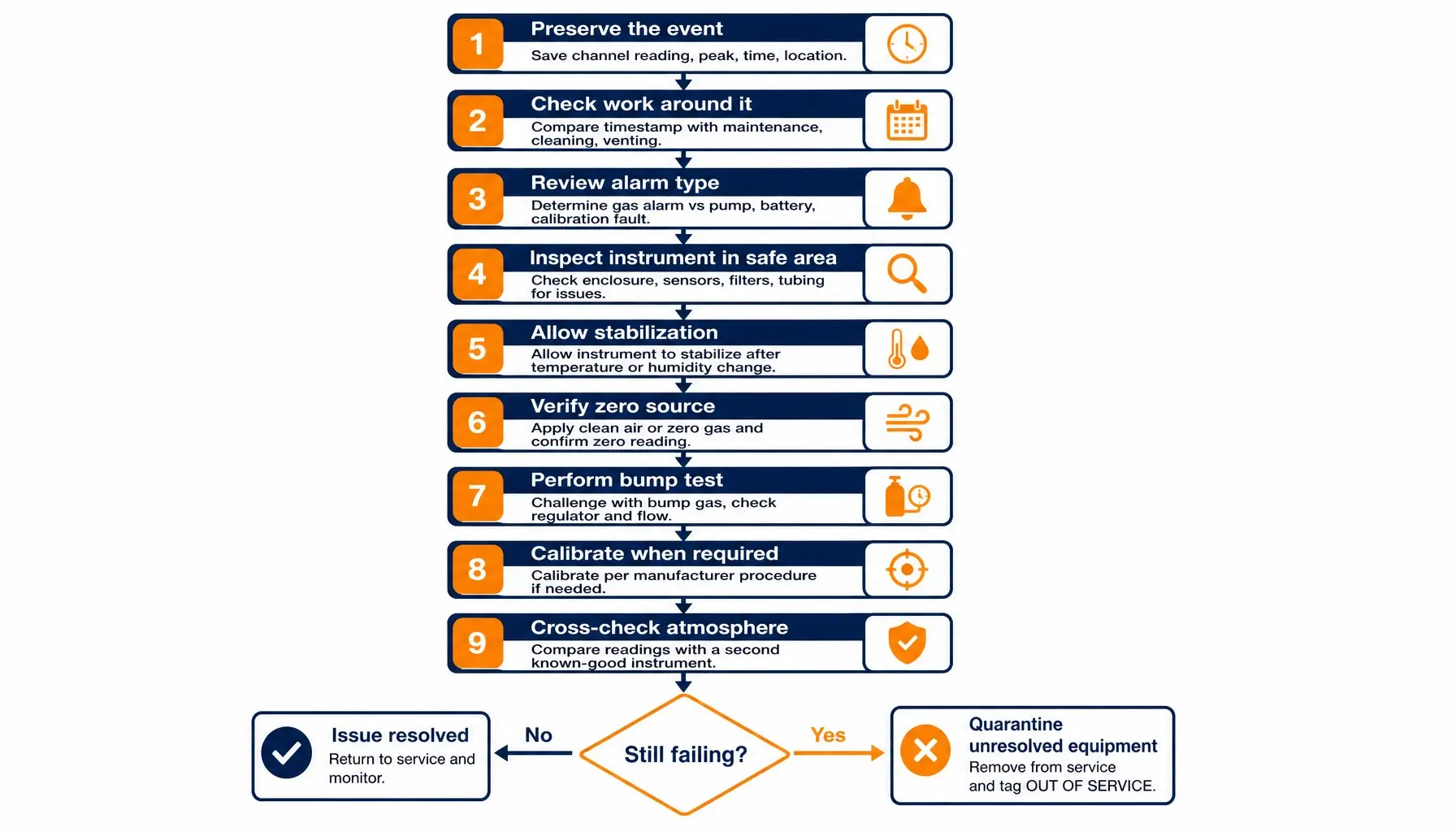
False alarm troubleshooting table
| Observed pattern | Possible cause | Check | Corrective action |
|---|---|---|---|
| CO channel alarms near battery charging | Hydrogen response on some CO sensors, or a real CO source | Check the exact sensor datasheet and verify with another suitable method | Control the gas source or select a low-hydrogen CO sensor if the application requires it |
| Reading spikes after moving into humid air | Condensation or rapid environmental change | Inspect the inlet and allow the detector to stabilize in a safe area | Dry or service it as instructed and review filters or water protection |
| Detector will not return to zero | Contamination, drift, wrong zero source, or sensor damage | Verify clean air, inspect the inlet, then check with test gas | Calibrate, service, or replace the sensor as required |
| Pump fault appears during remote sampling | Blocked filter, kinked tube, water, or damaged connection | Inspect the full sampling path | Replace the affected filter, tube, probe, or connector |
| Alarm repeats at one time or location | Intermittent process release or nearby activity | Compare logs with work and process records | Investigate and control the source before changing detector settings |
| Detector passes a bump test but readings look wrong | Calibration drift or unsuitable test criteria | Run the manufacturer’s calibration check | Perform full calibration if the reading is outside tolerance |
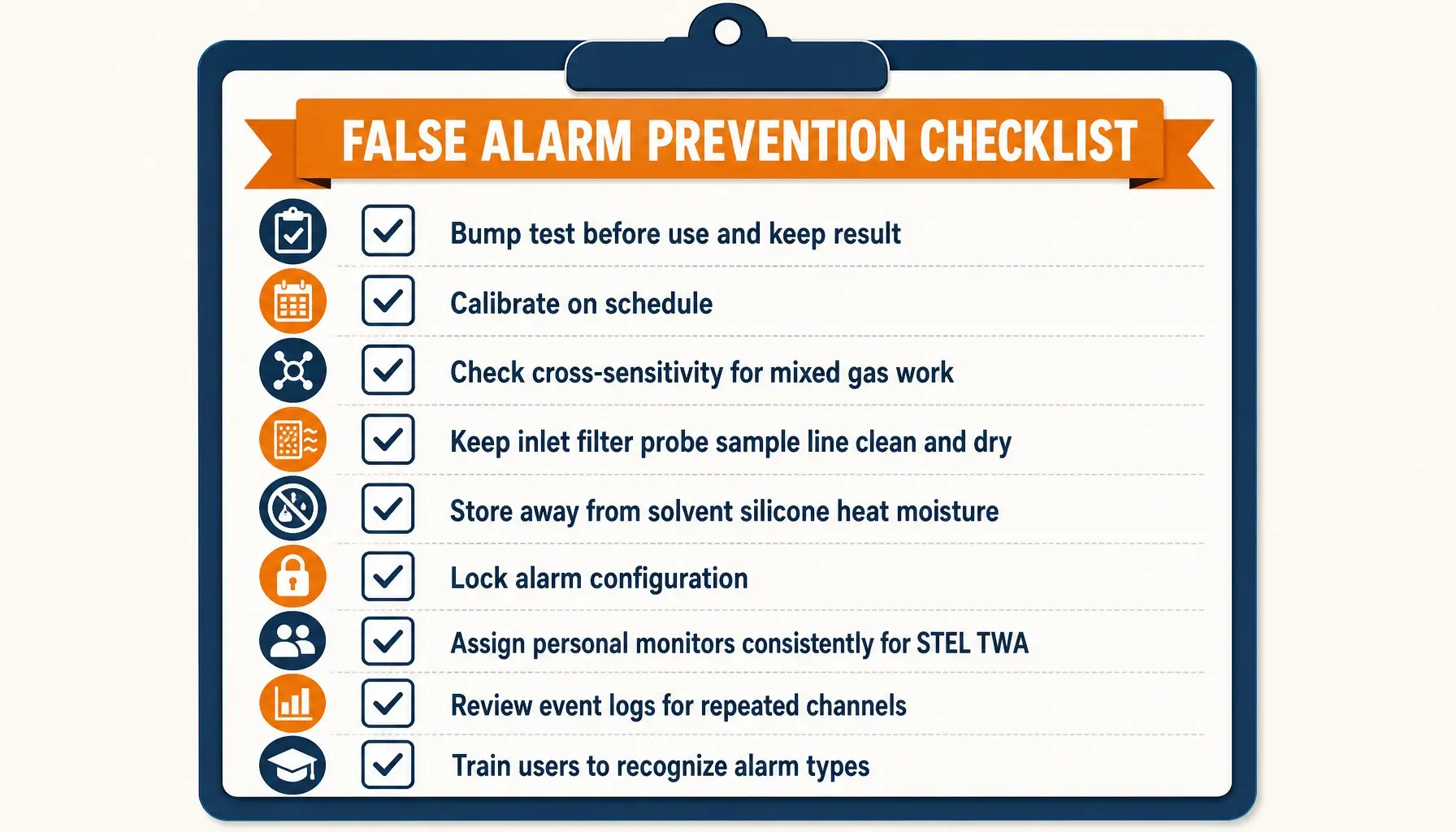
How to prevent repeat false alarms
- Perform the required pre-use bump test and keep the result.
- Calibrate according to the instrument manual and the site’s written schedule.
- Check sensor cross-sensitivity before selecting a detector for mixed-gas work.
- Keep the inlet, filter, probe, and sample line clean and dry.
- Store detectors away from solvent vapor, silicone products, high heat, and moisture.
- Lock alarm configuration when the instrument supports access control.
- Assign personal monitors consistently when STEL and TWA records are used.
- Review event logs for repeated channels, locations, instruments, and work activities.
- Train users to recognize gas alarms, exposure alarms, and instrument faults.
Detector selection matters as much as maintenance. A standard four-gas monitor is useful for oxygen, combustible gas, CO, and H2S, but it does not identify every solvent or toxic vapor. The four-gas monitor selection guide explains where that configuration fits and where another sensor may be needed.
When should the sensor or detector be replaced?
Remove the instrument from use when it cannot meet the manufacturer’s response or accuracy criteria. Repeated calibration failure, a slow response to test gas, unstable zero, physical damage, water entry, or an end-of-life warning all require service.
Repeated calibration is not a repair. If the sensor cannot hold its response, find the cause. It may be aged, poisoned, damaged, or wrong for the application. For combustible hazards, sensor technology also affects poisoning resistance, oxygen dependence, and response to different fuels. See the combustible gas detector selection guide before replacing one sensor type with another.
Frequently asked questions
Can humidity cause a gas detector false alarm?
Rapid humidity changes and condensation can disturb some sensors or block the gas path. Move to a safe area, let the detector stabilize, inspect the inlet, and follow the manufacturer’s test procedure before returning it to service.
Why does a CO detector alarm near battery charging?
Some CO sensors respond to hydrogen, which may be present around certain battery charging processes. Do not assume this is the cause without checking the exact sensor datasheet and confirming that there is no real carbon monoxide source.
Should a detector be recalibrated after every alarm?
Not automatically. Follow the instrument manual. Calibration or a calibration check is commonly required after an over-range exposure, failed bump test, unusual reading, sensor replacement, or suspected damage. Preserve the event record before changing the instrument.
Can a detector pass a bump test and still be inaccurate?
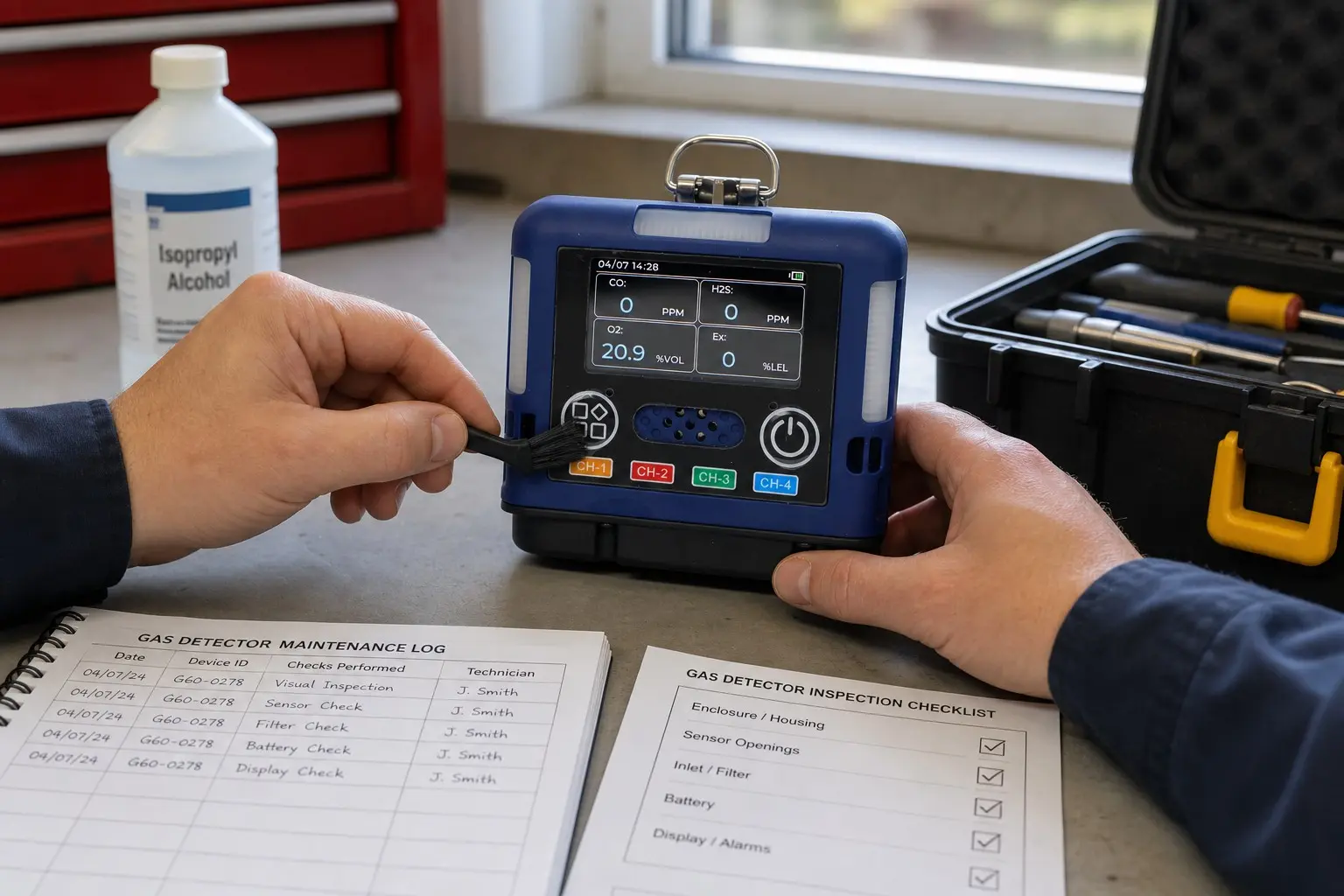
Yes. A bump test confirms that the sensor responds and the alarms operate. A calibration check compares the displayed value with a known gas concentration and tests accuracy.
Why does the alarm continue after the worker reaches fresh air?
The detector may use a latching high alarm, or it may be reporting accumulated STEL or TWA exposure. It may also need time to clear gas from the sample path. Check the alarm type and follow the reset procedure in the manual.
Can workers change gas detector alarm settings?
Only when the site’s authorization and change-control procedure allow it. An alarm that seems inconvenient may be tied to an exposure limit or emergency action. Changing the threshold without review can make the monitoring program inconsistent.
A field rule worth keeping
An unexplained alarm is an investigation, not proof of a bad detector. Make the area safe, preserve the event, check the work that was happening, then test the instrument in a controlled setting. If the cause remains uncertain, keep the detector out of service.
Quick check: respond to the alarm, save the reading, inspect the sampling path, verify the zero source, bump test with suitable gas, calibrate when required, and quarantine any instrument that still behaves unpredictably.
Need a portable or fixed detector for a difficult gas mixture or operating environment?

WeChat
Scan the QR Code with wechat