 Henan Ottywell Electronic Technology Co., Ltd

Le premier espace de permis que j'ai jamais signé était une fosse de vannes en fonte, trois mètres de profondeur, coincé entre une route très fréquentée et une conduite de gaz. Le surveillant d'entrée m'a remis un détecteur quatre gaz qui, quand j'ai vérifié les dossiers, n'avait pas été testé depuis neuf jours. J'ai posé des questions à ce sujet. Il haussa les épaules et dit, “C'était bien hier.”
Nous avons quand même pompé l'espace, pris les lectures, descendu. Rien ne s'est mal passé ce jour-là. Je n'ai jamais oublié le haussement d'épaules, cependant. La plupart des programmes de surveillance n'échouent pas dans l'équipement, et ils n'échouent pas dans la norme. Ils échouent dans l'écart entre “nous avons un moniteur” et “nous avons vérifié ce qu’il nous dit.”
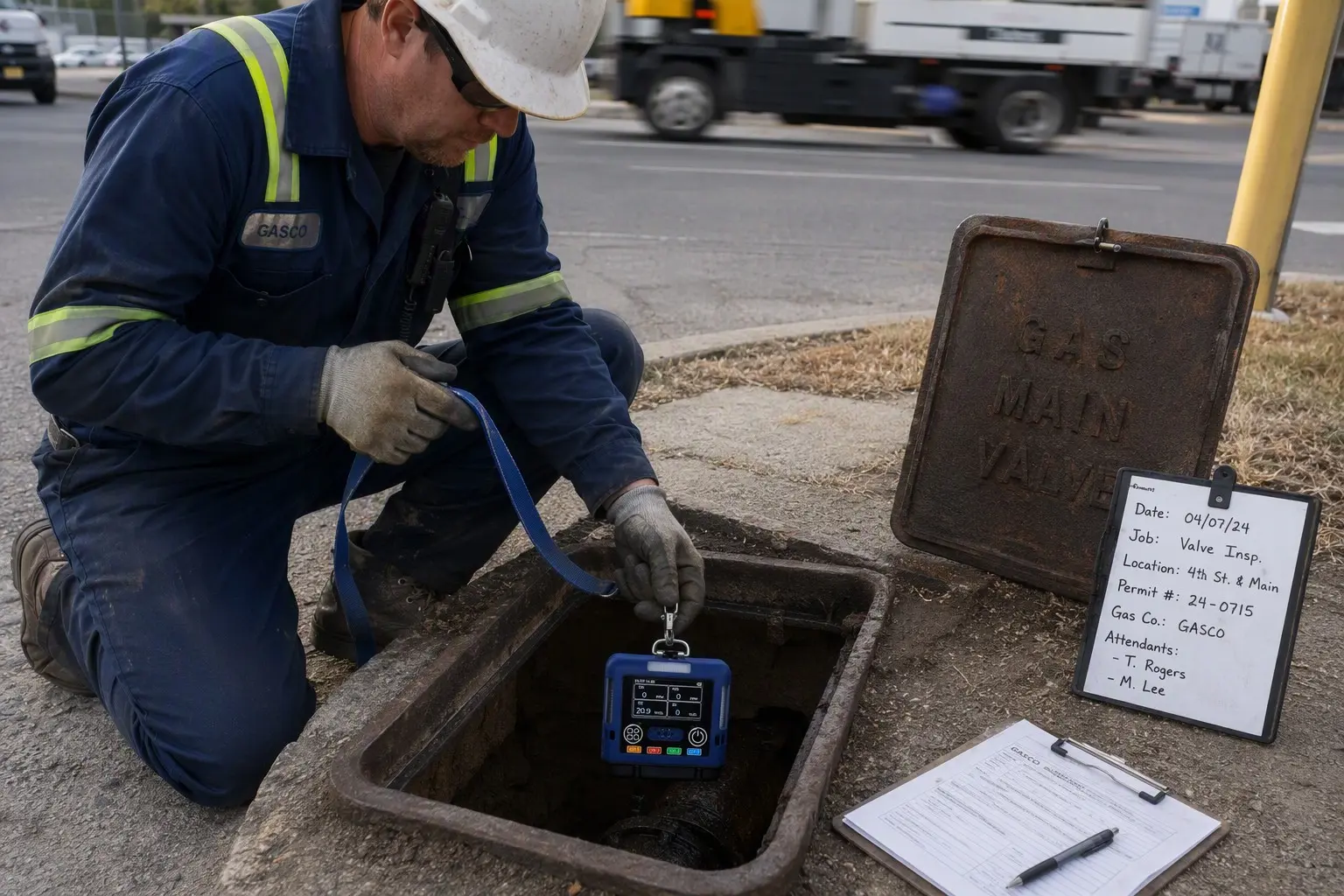
Si vous êtes ici parce que votre équipage travaille dans des tanks, égouts, coffres-forts, silos, ou des fosses, tu sais déjà que les espaces confinés tuent tranquillement. Ce que vous n'avez peut-être pas, c'est une réponse claire à ce à quoi ressemble une surveillance conforme des gaz dans les espaces confinés au cours d'une journée de travail normale..
Voici la version courte. Testez de l’extérieur avant que quiconque n’entre, dans le bon ordre, à tous les niveaux, et continuez à surveiller pendant que les gens sont à l'intérieur. Faites-le avec un moniteur que vous avez vérifié le jour même.
La surveillance des gaz dans les espaces confinés consiste à mesurer et à suivre en continu l'atmosphère à l'intérieur d'un espace confiné soumis à autorisation., généralement pour l'oxygène, gaz combustible, et gaz toxiques, avant et pendant l'entrée, comme l'exige l'OSHA 29 CFR 1910.146.
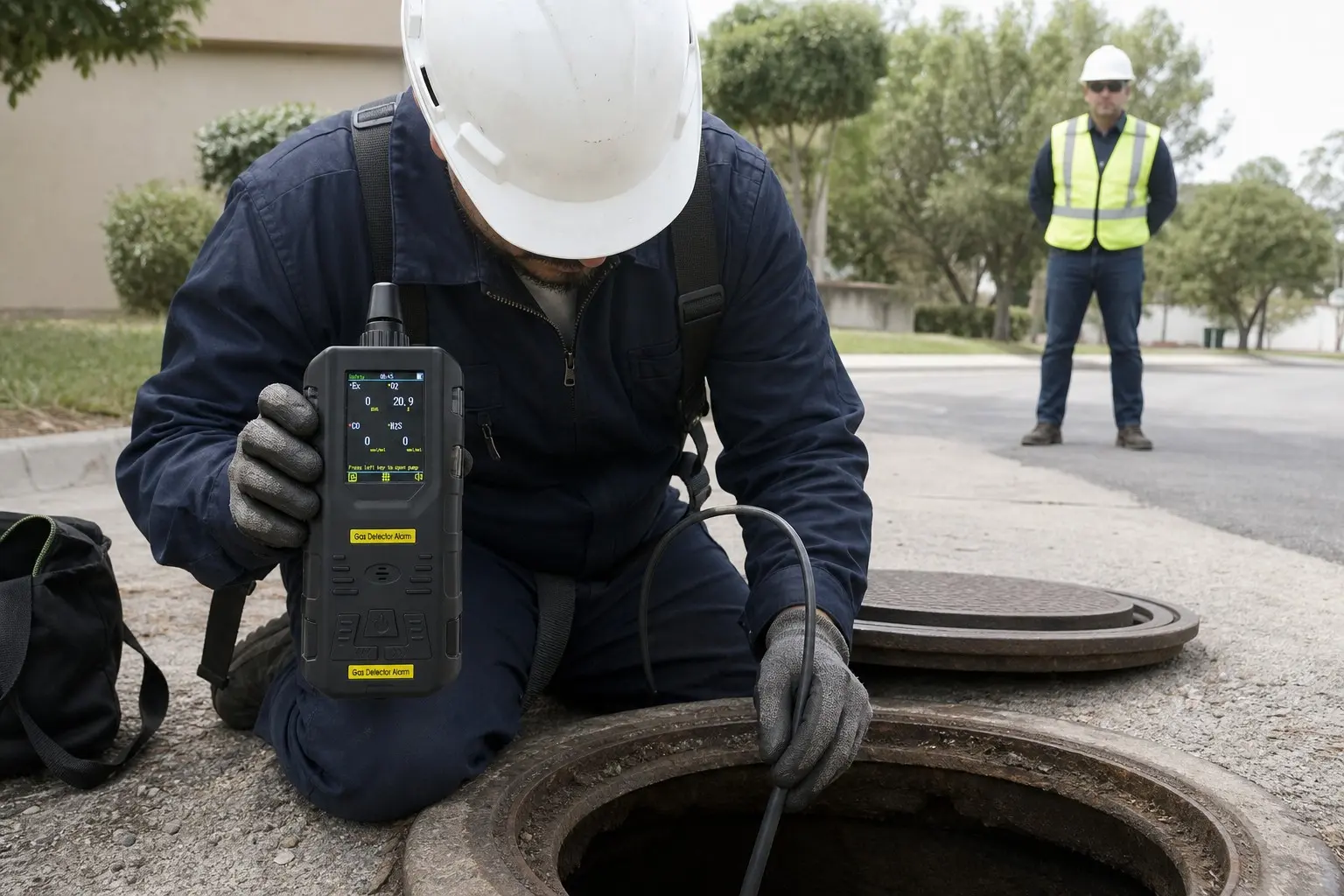
Pourquoi la surveillance des gaz dans les espaces confinés ne peut être ignorée
Les dangers atmosphériques sont la principale cause de décès dans les espaces confinés, et ils sont presque toujours invisibles. Un tank peut paraître parfaitement inoffensif et rester 16% oxygène. Un égout peut sentir mauvais et contenir suffisamment de sulfure d'hydrogène pour laisser tomber un ouvrier en quelques secondes. Le méthane peut s'accumuler dans la moitié supérieure d'une chambre forte tandis que l'air à hauteur de taille est propre.. Tu ne peux pas voir, odeur, ou entendre quelque chose, c'est pourquoi le moniteur fait le vrai travail.
L'OSHA estime approximativement 2.1 aux États-Unis, des millions de travailleurs pénètrent chaque année dans des espaces confinés soumis à autorisation. La norme relative aux espaces confinés de l’agence existe parce que pénétrer dans un espace non testé est si souvent fatal. Les décès dans les espaces confinés ont tendance à se produire en chaîne: un travailleur entre, une seconde entre pour aider, parfois un tiers. Les sauveteurs représentent une grande part des décès dans les espaces confinés, ce qui vous indique à quelle vitesse ces situations tournent mal.
La réponse de l'OSHA est directe. Avant qu’un employé entre dans un espace autorisé, l'atmosphère interne doit être testée avec un appareil calibré, instrument à lecture directe. Les appels au jugement ne sont pas admissibles, et ni l'un ni l'autre “c'était bien hier.” Un essai, avec un instrument de travail, avant l'entrée.
Tout le reste dans cet article concerne la réalisation correcte de ce test..
Quels gaz surveillez-vous dans un espace confiné?
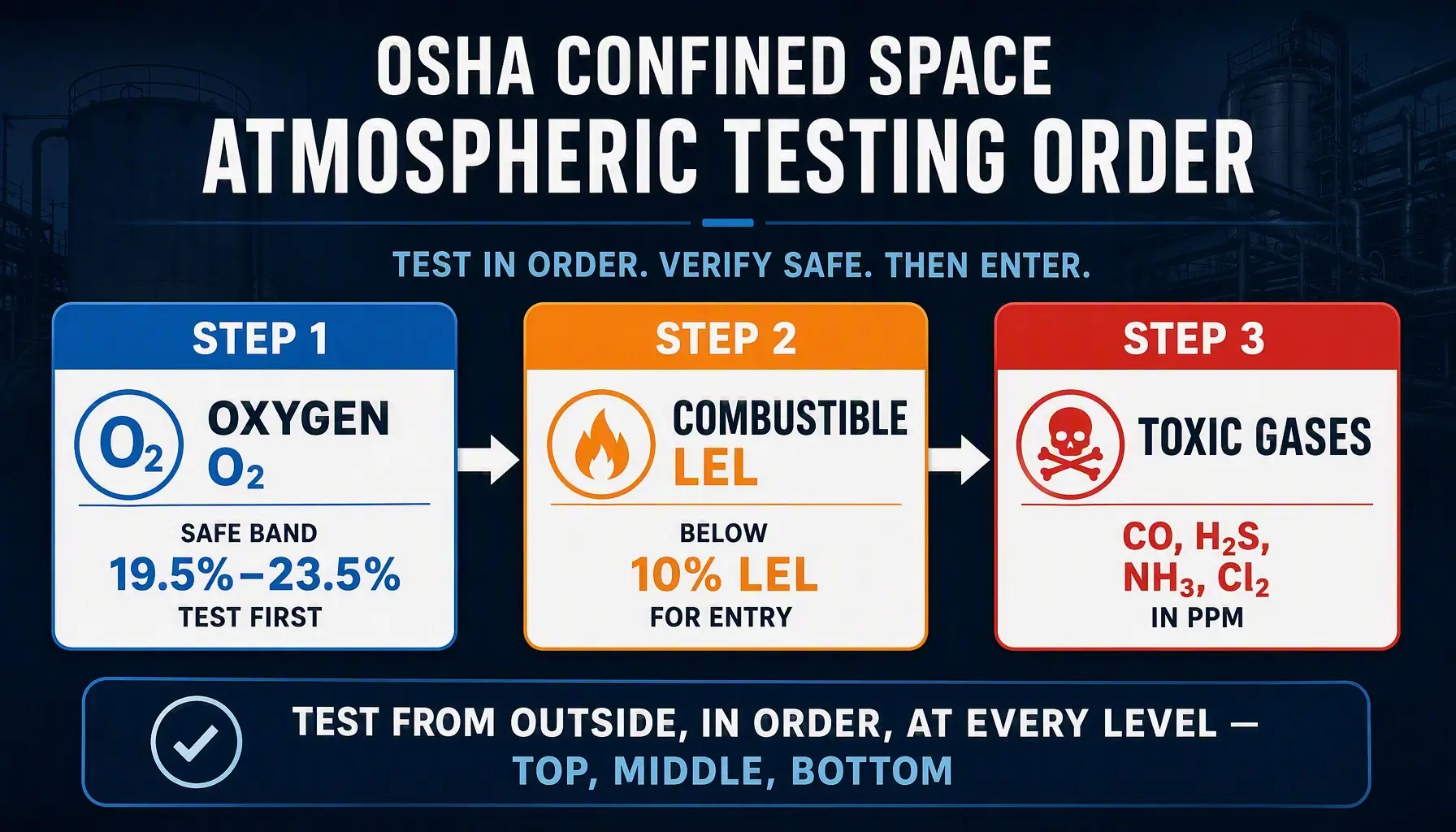
L'Annexe B de l'OSHA à 1910.146 précise l'ordre des tests: l'oxygène d'abord, puis des gaz combustibles, puis des gaz toxiques. La commande n'est pas une formalité.
Oxygène (O₂). L'air normal est 20.9% oxygène. Pour l'entrée dans un espace confiné, la bande de sécurité acceptée est 19.5% à 23.5%. Ci-dessous 19.5% vous êtes en territoire de carence en oxygène, où le jugement glisse en premier et la conscience passe en second. Au-dessus de 23.5% vous avez une atmosphère enrichie en oxygène, où des matériaux qui couvent normalement décident de brûler violemment. L'oxygène est testé en premier pour une raison pratique: la plupart des capteurs de gaz combustibles ont besoin de suffisamment d'oxygène pour produire une véritable lecture, donc une lecture d'oxygène morte ou faussée empoisonne tout après.
Gaz combustibles. Les mesures de gaz inflammables sont exprimées en pourcentage de la limite inférieure d'explosivité., ou LIE. La plupart des programmes pour espaces confinés traitent 10% LIE comme plafond d'entrée. Au dessus de ça, l'espace est aéré et testé à nouveau avant que quiconque n'y entre. Méthane, propane, vapeur d'essence, hydrogène: ils apparaissent tous sur la chaîne LEL. Si vous voulez connaître les mécanismes de mesure de la LIE, notre guide du détecteur de gaz combustible entre dans les détails.
Gaz toxiques. C’est ici que l’histoire de l’espace décide de ce que vous mesurez. La configuration standard à quatre gaz couvre le monoxyde de carbone et le sulfure d'hydrogène. Si votre espace se trouve à proximité d’une réfrigération à l’ammoniac, dosage du chlore, ou échappement diesel, vous devez également ajouter ces capteurs. Voici les substances toxiques courantes avec leurs limites d'exposition. Considérez ce tableau comme un point de départ, pas le dernier mot: les limites changent, et votre programme doit toujours vérifier les valeurs actuelles de l'OSHA et du NIOSH.
| Gaz | Source typique dans des espaces confinés | PEL OSHA | IDLH |
|---|---|---|---|
| Monoxyde de carbone (CO) | Combustion, générateurs, soudage | 50 ppm (8-M. TWA) | 1,200 ppm |
| Sulfure d'hydrogène (H₂S) | Eaux usées, pétrole, décomposition | 20 plafond ppm | 100 ppm |
| Ammoniac (NH₃) | Réfrigération, engrais | 50 ppm (8-M. TWA) | 300 ppm |
| Chlore (Cl₂) | Traitement de l'eau, usines chimiques | 1 plafond ppm | 10 ppm |
| Dioxyde de soufre (SO₂) | Émissions industrielles | 5 ppm (8-M. TWA) | 100 ppm |
| Dioxyde d'azote (NON₂) | Échappement diesel, soudage | 5 plafond ppm | 20 ppm |
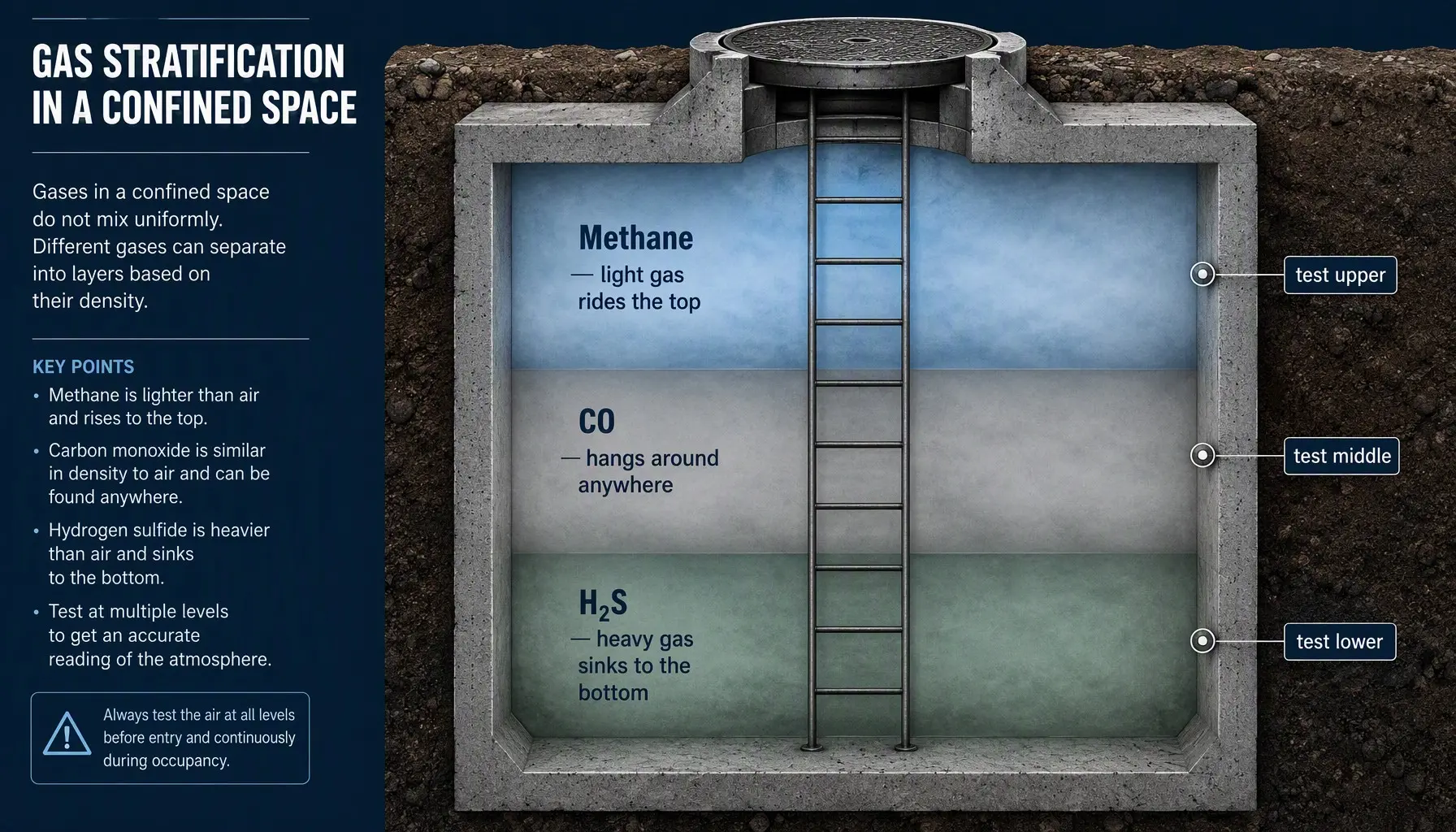
Maintenant, la partie que les gens sautent. Les gaz ne se mélangent pas uniformément dans un espace confiné. Le méthane et d'autres gaz légers arrivent en tête. Le sulfure d'hydrogène et les vapeurs plus lourdes coulent au fond. Le monoxyde de carbone traîne partout où bon lui semble. Une lecture prise à hauteur de poitrine ne vous dit rien sur le dessus du réservoir ni sur le fond de la fosse., c'est pourquoi des tests appropriés échantillonnent la partie supérieure, milieu, et niveaux inférieurs de l'espace, à chaque fois.
Exigences de l'OSHA pour la surveillance des gaz dans les espaces confinés
Le noyau réglementaire est 29 CFR 1910.146, et l'annexe B de la norme donne les procédures pour les essais atmosphériques. Voici ce que la norme exige réellement, en langage clair.
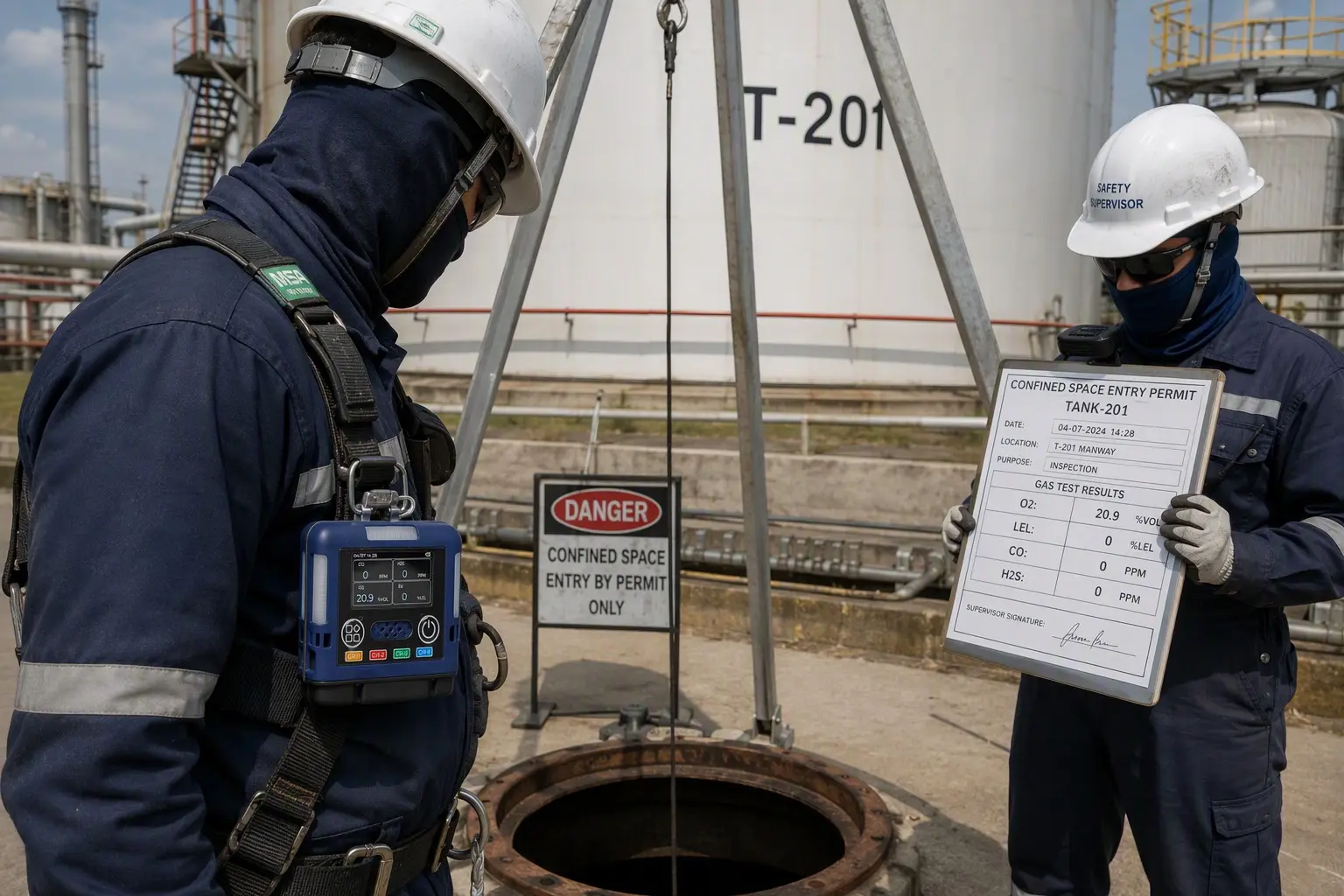
Tests avant l'entrée. L’atmosphère doit être testée avant l’entrée de tout employé, avec un calibré, instrument à lecture directe, et les résultats doivent être enregistrés sur le permis d'entrée.
Tests d'évaluation vs. tests de vérification. Les tests d'évaluation ont lieu en premier, avant que l'espace soit préparé, pour découvrir quels dangers sont réellement présents. Les tests de vérification ont lieu après la ventilation et la préparation, pour confirmer que l'espace répond désormais aux conditions d'entrée sûre écrites sur le permis. Ce sont deux étapes différentes. Les traiter comme tel est une erreur courante, et c’est le genre d’erreur qui apparaît dans un audit comme “ambiance non vérifiée.”
Surveillance continue ou périodique. Si les conditions peuvent changer pendant que les gens sont à l'intérieur, la norme attend de vous que vous continuiez à surveiller. Soudage, nettoyage chimique, mouvement de matière, même un changement de ventilation peut déplacer l'atmosphère en cours de travail. S'il y a une chance que les conditions changent, le participant reste connecté à un moniteur en direct, pas seulement dans un presse-papiers.
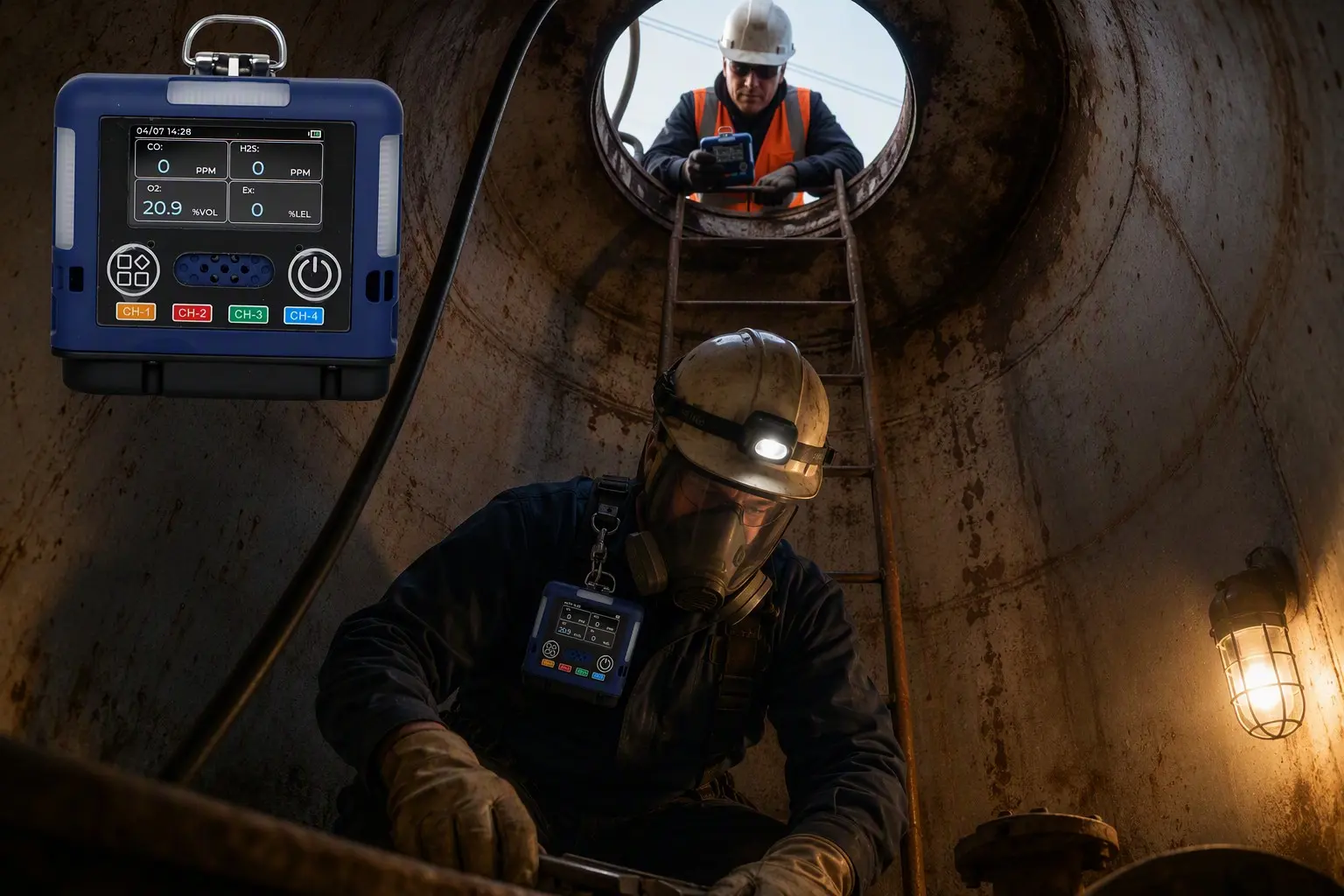
Retester après ventilation. Aérer un espace ne le rend pas automatiquement sécuritaire. L'atmosphère doit être retestée après ventilation, avant de rentrer, à chaque fois. J'ai vu des équipages ventiler vingt minutes, faire une seule lecture au passage d'homme, et appelle ça bien. Cette lecture couvrait environ un pied d'un réservoir de douze pieds.
Documentation. Les relevés vont sur le permis, à côté des niveaux d'entrée acceptables. Si ce n'est pas écrit, du point de vue d’un inspecteur, cela ne s’est pas produit.
Vous n'avez pas besoin de mémoriser les numéros de sous-section pour exécuter un programme conforme, mais vous avez besoin du texte de la norme à portée de main. Lier le complet 1910.146 norme et son annexe B, qui couvre les procédures d'essais atmosphériques, dans vos documents de procédure afin que l'équipage puisse les vérifier.
Comment tester un espace confiné: Procédure étape par étape
Voici la procédure que j'utilise sur place. Il correspond directement à l’annexe B de l’OSHA., et c'est la partie que j'imprimerais et que je collerais sur le tableau des permis.
- Confirmez le type d'espace. S'agit-il d'un espace confiné soumis à permis ou d'un espace sans permis? Le permis porte la liste des dangers et les conditions d'entrée acceptables. S’il n’y a pas de programme de permis en place, arrêtez-vous ici et construisez-en un avant toute autre chose.
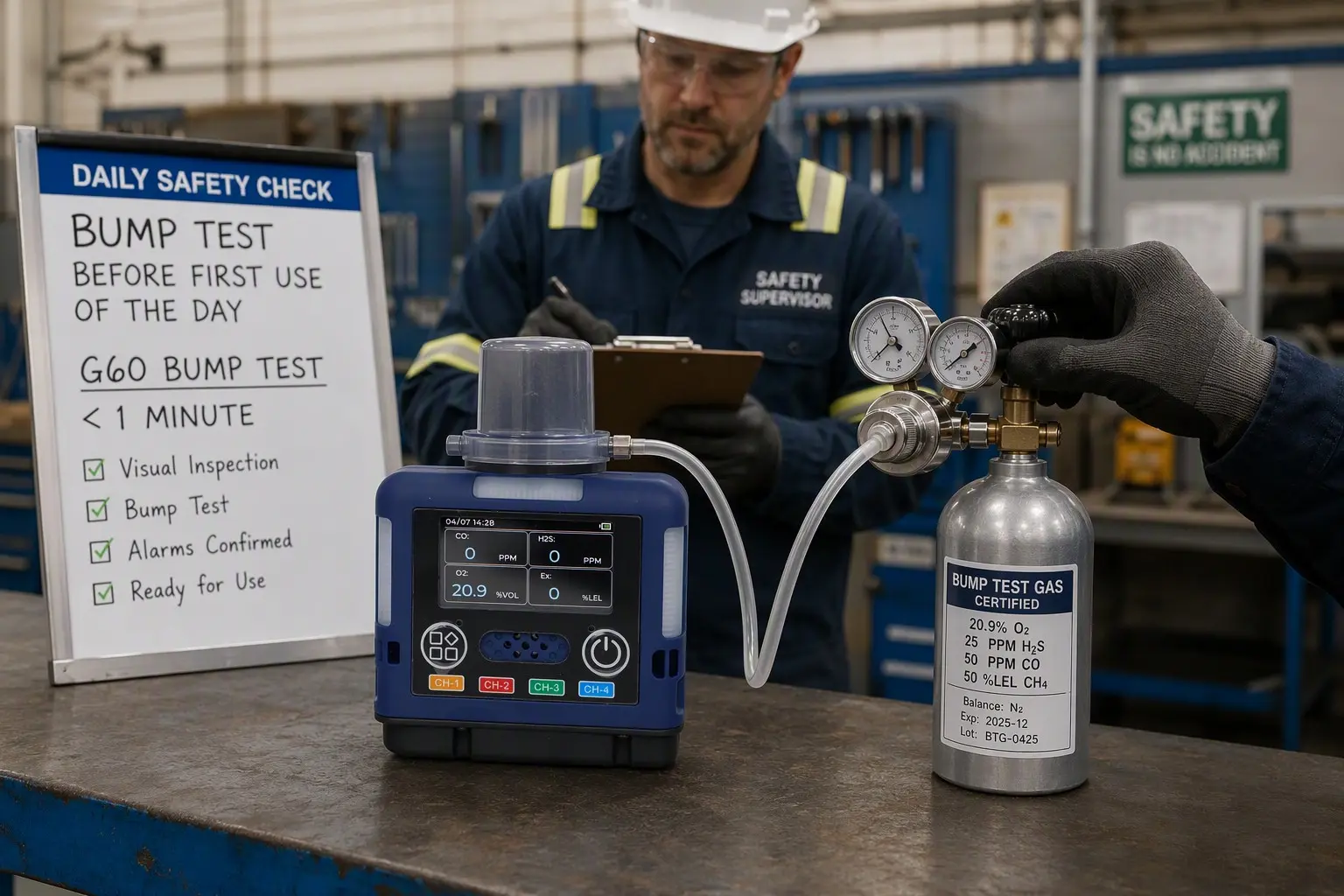
- Vérifiez l'instrument ce matin-là. Test fonctionnel ou vérification complète de l'étalonnage avant la première utilisation de la journée. Un moniteur qui échoue au test ne va pas dans l'espace, aucune exception.
- Test de l'extérieur. Personne n'entre jusqu'à ce que le test initial soit effectué depuis l'extérieur de l'espace. Utilisez un moniteur de type pompe avec une ligne d'échantillonnage ou une sonde abaissée dans l'espace. Ce n'est pas facultatif.
- Tester dans l'ordre. L'oxygène d'abord, puis les combustibles (Lel), puis des toxiques. Cet ordre existe pour une raison: chaque lecture après l'oxygène dépend de la réalité de la lecture d'oxygène.
- Échantillonnez chaque niveau. Haut, milieu, bas. Si l'espace est profond, échantillonnez à des intervalles d'environ quatre pieds pendant que vous travaillez. La stratification est la règle, pas l'exception.
- Laisser aux capteurs le temps de répondre. Un moniteur retiré au bout de deux secondes lit l'air à l'ouverture, pas l'air en bas. Regardez les chiffres se stabiliser. Les longues lignes d'échantillonnage nécessitent plus de temps pour que l'air atteigne réellement les capteurs..
- Écrivez-le. Enregistrez les lectures sur le permis avant l’entrée, avec le temps. C'est l'étape de documentation, et ce n'est pas négociable.
- Continuez à surveiller pendant l’entrée. Surveillance continue pendant que les gens sont à l'intérieur, et retester après les changements de ventilation, pauses, ou tout ce qui pourrait changer l'atmosphère.
C'est toute la procédure. Ce n'est pas compliqué, et les espaces qui blessent les gens sont ceux où quelqu'un a décidé que l'une des huit étapes ne s'appliquait pas à lui.
Quel moniteur de gaz pour espaces confinés devriez-vous utiliser?
La question de l’équipement est plus simple que la plupart des gens ne le prétendent, à condition de partir de la liste des dangers au lieu du catalogue de produits.
L'outil standard est un détecteur à quatre gaz: oxygène, Lel, monoxyde de carbone, et du sulfure d'hydrogène. Si ce terme est nouveau pour vous, notre article sur quel 4 le moniteur de gaz est couvre les bases, y compris ce que chaque capteur mesure réellement. Quatre gaz couvrent ce dont la plupart des programmes pour espaces confinés ont besoin, et pour beaucoup d'équipes, c'est toute la flotte.
La plus grande décision est la pompe ou la diffusion. Un moniteur de diffusion échantillonne l'air directement au niveau du capteur, ce qui convient à un travailleur qui le porte sur un harnais. Un moniteur de pompe aspire de l'air à travers une ligne d'échantillonnage, c'est ainsi que l'on teste un espace de l'extérieur avant d'y entrer, et comment échantillonner en profondeur sans laisser tomber personne. Pour les travaux en espace confiné, un modèle de pompe devrait être le modèle par défaut. Nous construisons les deux: le Détecteur quatre gaz Otywell G60 couvre les quatre gaz standards avec une autonomie de vingt heures et un journal de données de 300 000 enregistrements, et le Détecteur de gaz à pompe S311 est conçu spécifiquement pour l'échantillonnage préalable à l'entrée via une ligne d'échantillonnage.
Les capteurs à l’intérieur comptent aussi. Les capteurs à billes catalytiques manipulent les combustibles mais ont besoin d'oxygène pour fonctionner. Les capteurs électrochimiques couvrent la plupart des substances toxiques et sont ceux que vous trouverez dans les canaux CO et H₂S.. Les capteurs infrarouges traitent les gaz combustibles dans des atmosphères pauvres en oxygène où une bille catalytique échouerait. Les détecteurs à photoionisation captent les COV et autres composés volatils. Notre guide des quatre types de capteurs de détecteurs de gaz explique les compromis en détail.
Quand avez-vous besoin de plus de quatre gaz? Ammoniac dans une usine de stockage frigorifique. Chlore à proximité du traitement de l'eau. COV ou produits toxiques spécifiques dans les travaux chimiques. Si votre espace peut contenir quelque chose au-delà de O₂, Lel, CO, et H₂S, vous avez besoin d'un moniteur qui le mesure, et nous avons couvert lorsqu'un détecteur pour espace confiné a besoin de plus de quatre gaz dans un guide séparé.
La logique de sélection complète, y compris la liaison d'alarme sans fil et la détection de chute pour les espaces où le préposé ne peut pas voir l'entrant, vit dans notre guide d'achat de détecteurs de gaz pour espaces confinés. La version courte: faire correspondre les capteurs à la liste des dangers, assurez-vous qu'il peut échantillonner de l'extérieur, et n'achetez pas uniquement sur le prix.
Une autre idée d'équipement. Si un espace voit un travail constant, certaines installations ajoutent une détection de gaz fixe pour la couvrir 24 heures sur 24, avec les unités portables de gestion de l'entrée et de la protection individuelle. Les compromis entre détection de gaz fixe et portable valent la peine d'être lus avant de construire cela.
Test fonctionnel, Étalonnage & Entretien
C'est la partie où la plupart des programmes s'effondrent silencieusement.
Test fonctionnel avant chaque utilisation quotidienne. Un test fonctionnel expose les capteurs à une concentration connue de gaz et confirme que le moniteur le détecte réellement et déclenche réellement une alarme.. Cela prend moins d'une minute avec une bouteille de gaz tampon ou une station d'étalonnage. Si le moniteur ne déclenche pas d'alarme, ça ne va pas dans l'espace, et “ça a alarmé hier” ne compte pas.
Étalonnage complet selon un calendrier. L'étalonnage ajuste les lectures du capteur par rapport aux concentrations de gaz connues, qui corrige la dérive qui se produit avec une utilisation et une exposition normales. La fréquence dépend du fabricant, le type de capteur, et à quel point l'instrument travaille dur. Pour l'entrée dans un espace confiné en toute sécurité, de nombreux programmes calibrent mensuellement ou trimestriellement, et toujours après un test fonctionnel échoué ou un dommage suspecté au capteur.
Tenir les registres. Journaux d'étalonnage, résultats des tests fonctionnels, et les dates de remplacement des capteurs sont les formalités administratives qui vous évitent des ennuis lors d'un audit.. Plus important encore, c'est comme ça que tu sais que le moniteur a dit la vérité. Un capteur qui a été en service pendant quatre ans au-delà de sa durée de vie nominale est un handicap, pas un outil.
J'ai vu des équipes traiter un moniteur qui émet un bip comme un dysfonctionnement et le retirer de l'espace pour “réparer” il. Neuf fois sur dix, le moniteur avait raison et l'ambiance était le problème. Faites confiance à l'instrument, mais seulement après l'avoir vérifié ce matin-là.
FAQ sur la surveillance des gaz dans les espaces confinés
Quel est le niveau d'oxygène OSHA pour l'entrée dans un espace confiné?
La plage de sécurité acceptée est 19.5% à 23.5% oxygène. Ci-dessous 19.5% est un manque d'oxygène; au-dessus de 23.5% est une atmosphère enrichie en oxygène.
Qu'est-ce qu'une LIE sûre dans un espace confiné?
Le gaz inflammable doit rester en dessous 10% de la limite inférieure d'explosivité pour l'entrée. Au dessus de ça, aérez et retestez avant que quiconque entre.
À quelle fréquence un détecteur de gaz pour espace confiné doit-il être calibré?
Test fonctionnel avant chaque utilisation quotidienne. Étalonnage complet selon le calendrier du fabricant, généralement mensuellement à trimestriellement pour l'entrée dans un espace confiné, et après tout échec du test de fonctionnement.
Quels gaz un 4 détecteur de gaz?
Oxygène (O₂), gaz combustible (Lel), monoxyde de carbone (CO), et du sulfure d'hydrogène (H₂S).
Pouvez-vous tester un espace confiné avant d'y entrer?
Oui, et tu dois. Utilisez un moniteur de type pompe avec une ligne d'échantillonnage provenant de l'extérieur de l'espace, et tester l'oxygène, carburants, et toxiques à plusieurs niveaux.
Avez-vous besoin d'une surveillance continue des gaz dans un espace confiné?
Si les conditions peuvent changer pendant le travail, Oui. Soudage, utilisation de produits chimiques, et les changements de ventilation peuvent tous modifier l'atmosphère lorsque les gens sont à l'intérieur.
Construire un programme, Pas une liste de contrôle
Un programme pour espaces confinés n’est pas un classeur sur une étagère. C'est le moniteur que vous avez vérifié ce matin-là, une équipe qui peut donner l'ordre des tests, un superviseur qui écrit les lectures, et un préposé qui continue de surveiller après l'entrée de l'échelle.
Si votre équipe a besoin de trier le côté équipement, le guide d'achat des détecteurs de gaz pour espaces confinés vous explique comment choisir le bon détecteur en fonction du fonctionnement réel de votre équipe, si le préposé peut voir le participant ou non. Si vous souhaitez parler à travers vos espaces spécifiques, Otywell construit systèmes de détection de gaz portables et fixes pour travaux en espace confiné, et nous serons heureux de vous aider à définir la configuration adaptée à votre équipage et à vos dangers..
Test de l'extérieur, en ordre, à tous les niveaux, et continuez à tester pendant que les gens sont à l'intérieur. Faites cela et vous aurez couvert la plupart de ce qui tue réellement des gens dans ces espaces..

Wechat
Scannez le code QR avec WeChat