 Henan Otywell Electronic Technology Co., Limitado

An arsine gas detector specification needs to answer two questions before it can guide a purchase: can the proposed configuration measure at the concentration that matters, and how long will it take to produce a usable alarm at the installed sampling point? A catalog entry marked “AsH3” or “0–1 ppm” does not settle either question.
Arsine (AsH3) is a highly toxic gas used in semiconductor manufacturing; it can also form when arsenic-containing material reacts with hydrogen under certain conditions. Odor is an inadequate warning, according to the NIOSH arsine emergency response card. That makes the measurement task more specific than simply finding a product with the right gas name.
| Claim on the specification | Evidence that resolves it | If evidence is missing |
|---|---|---|
| “0–1 ppm” | Límite de detección, error, deriva, and alarm performance at the decision concentration | Do not assume the low end is usable |
| “Fast response” | Time from the installed inlet to local and remote alarm | Request an end-to-end test |
| “Suitable for gas cabinets” | Release-point and airflow map, selected inlet, sample route | Resolve coverage before selecting a mounting height |
| “Relay or 4–20 mA output” | Alarm and fault states verified through the receiving system | Do not infer an active interlock from an available terminal |
| “AsH3 compatible” | Named sensor and test documents for the offered version | Keep the gas-specific capability unconfirmed |
Claim 1: “The range starts at zero, so it can detect a low-level leak”
A measurement range tells you the span a device is intended to display. no lo hace, por sí mismo, state the smallest concentration it can detect reliably. Resolution is the size of a display step. A 0.01 ppm display step, Por ejemplo, is 10 ppb; it is not proof that a 10 ppb reading has acceptable error. The detection limit, response at the proposed alarm point, repeatability, and zero drift have to be assessed separately.
Write down the concentration and its time basis
El NIOSH Pocket Guide entry for arsine lists a NIOSH recommended exposure limit of 0.002 mg/m3 as a 15-minute ceiling, and an OSHA permissible exposure limit of 0.05 ppm (0.2 mg/m3) as an eight-hour time-weighted average. Using the same page’s conversion of 1 ppm = 3.19 mg/m3, the NIOSH ceiling is approximately 0.63 ppb. These are different exposure measures, with different averaging periods. Neither number is automatically a suitable instantaneous alarm setpoint.
Ask what action a reading is meant to trigger and at what measured level. A low-level exposure assessment, an immediate cabinet leak warning, and a high-concentration emergency indication may call for different methods and alarm logic. The decision concentration should be stated before a supplier chooses a sensor or sets an alarm.
Request performance at that point, not just the range endpoints
For the proposed AsH3 canal, request a stated detection limit and measurement error near the intended decision concentration. Check the conditions attached to those numbers: temperatura, humedad, gas de calibración, gases de fondo, and the instrument version used in the test. A low adjustable setpoint is useful only if the instrument can detect and distinguish a real change at that level.
| Record for each candidate | Question to put to the supplier |
|---|---|
| Decision concentration and time basis | What reading requires what action, and over what period? |
| Range and display resolution | What can this version display? What does one display increment represent? |
| Detection limit and error | What test establishes useful performance at the proposed action level? |
| Zero drift and interference | Could background change or another gas obscure the reading? |
| Alarm setting and evidence | Can the supplied unit alarm at that level under its stated conditions? |
If the required concentration lies below the verified capability of a candidate, lowering its alarm setting will not create sensitivity. Obtain a configuration proven at that level or reconsider the measurement method.
Claim 2: “Fast sensor response means a fast alarm”
A sensor’s T90 is measured at the sensing element under stated test conditions. In a cabinet installation, gas first has to reach the inlet. With pumped sampling it then travels through tubing, may pass a filter or other component, and is measured over the instrument’s sampling and processing cycle. Only after that can an output reach a local alarm or another system.
Follow the sample from the installed inlet
Ask the supplier to identify the starting point for every response-time claim. For a remote inlet, document the actual tubing length and material, flujo de la bomba, guarniciones, filtros, and any route exposed to moisture or contamination. A line may add delay or impair delivery if it is blocked or unsuitable for the gas and installation. The completed design should be tested from the inlet that will remain in service, not only by applying gas next to the detector enclosure.
- Gas reaches selected inlet
- Sample travels and is measured
- Detector processes the result
- Local and remote alarms act
Compare low-level capability with sampling time
Some low-range methods collect a sample over a longer cycle to obtain their stated sensitivity. That tradeoff matters when a buyer compares a ppb-capable system with a device specified by a short sensor response time. Do not compare the lowest published concentration from one method with the fastest response number from another and treat them as one combined performance claim.
| Time component | Pruebas a solicitar |
|---|---|
| Inlet and line | Installed point, tubing route, material, longitud, fluir, and sample transport time |
| Medición | Sample cycle, sensor response, and conditions at the proposed alarm level |
| Signal and action | Tratamiento, relay or communication delay, receiving-system response |
| Complete result | Test from actual inlet to local warning and designated remote action |
When only a bare sensor T90 or a nominal ppb range is available, total alarm time remains unproven. Request a test for the intended line and setpoint before deciding that the system meets the site’s response requirement.
Claim 3: “Mount it low and the gas cabinet is covered”
The NIOSH Pocket Guide lists arsine’s relative gas density as 2.69 comparado con el aire. That property belongs in the placement discussion, but a cabinet’s exhaust, enclosures, obstrucciones, release direction, and operating states affect where a leak plume can reach a detector. A mounting-height rule alone does not show coverage.
Trace a release to a reachable inlet
Mark cylinder connections, valve groups, process interfaces, enclosure openings, and exhaust paths on a cabinet or equipment drawing. Then mark candidate sampling inlets and the air movement under normal operation and relevant fault conditions. Ask which release points could bypass an inlet and whether a technician can reach the installed equipment for testing. The drawing is more useful than a statement that the detector is “near the cabinet.”
Choose the inlet before the detector enclosure
With diffusion, the detector reads the air reaching its installed inlet. With fixed pumped sampling, the inlet can be positioned at a defined point while the sensing unit sits elsewhere. Pumped sampling adds a line that has to remain clear, compatible with the gas, and accessible for inspection. Portable checks can investigate a defined point during maintenance; they do not provide continuous coverage between visits.
| Site detail | Decision to record | How to verify |
|---|---|---|
| Credible release point | Which connection or enclosure area needs observation? | Show it on the cabinet drawing |
| Exhaust and obstructions | Where could gas travel or be carried away? | Review airflow under relevant operating modes |
| Selected inlet | Diffusion at the unit or remote pumped sample? | Check likely gas path and access |
| Blind spot or line failure | What might prevent gas reaching a working sensor? | Test coverage and the line/fault indication |
If the release and airflow drawing is missing, finish that work before committing to a universal installation height. The useful question is whether gas from the defined source can reach the selected inlet in time.
Claim 4: “Alarm outputs mean the safety system is covered”
A detector may provide a relay, salida analógica, or digital signal. Those are connection options. A working alarm chain also needs the receiving system, lógica de alarma, fault behavior, and a test showing that the required action occurs. A relay on a datasheet does not establish that a valve will close, that a control room will see a fault, or that the action has been commissioned.
Keep gas alarms separate from instrument faults
Specify what appears locally and remotely when gas crosses each alarm level. Then work through faults that apply to the chosen design: loss of sample flow, blocked line, falla del sensor, cable or communication failure, loss of power, and an expired tape or other consumable in a system that uses one. A zero concentration display cannot be treated as a healthy state when the sample is no longer reaching the instrument.
Test the full receiving path
Commission the planned chain from a test at the installed inlet through the detector, the receiving controller or PLC/DCS, registro de evento, and the action assigned to that point. Record how a fault is distinguished from a gas alarm and who receives each status. Where a shutdown or valve command is part of the design, test that specific cause-and-effect path rather than assuming the detector’s output terminal performs it.
| Condición de prueba | Indicación local | Remote indication or action | Evidence |
|---|---|---|---|
| Gas alarm at specified level | Reading and audible/visual state as configured | Assigned alarm recipient and action | Point-to-point test record |
| Sampling or sensor fault | Distinct fault status | Fault visible to responsible recipient | Fault simulation and record |
| Power or signal loss | Known local behavior | Defined receiving-system behavior | Loss-of-signal test |
Do not sign off a point whose faults look identical to a normal zero reading or whose required remote action has not been tested.
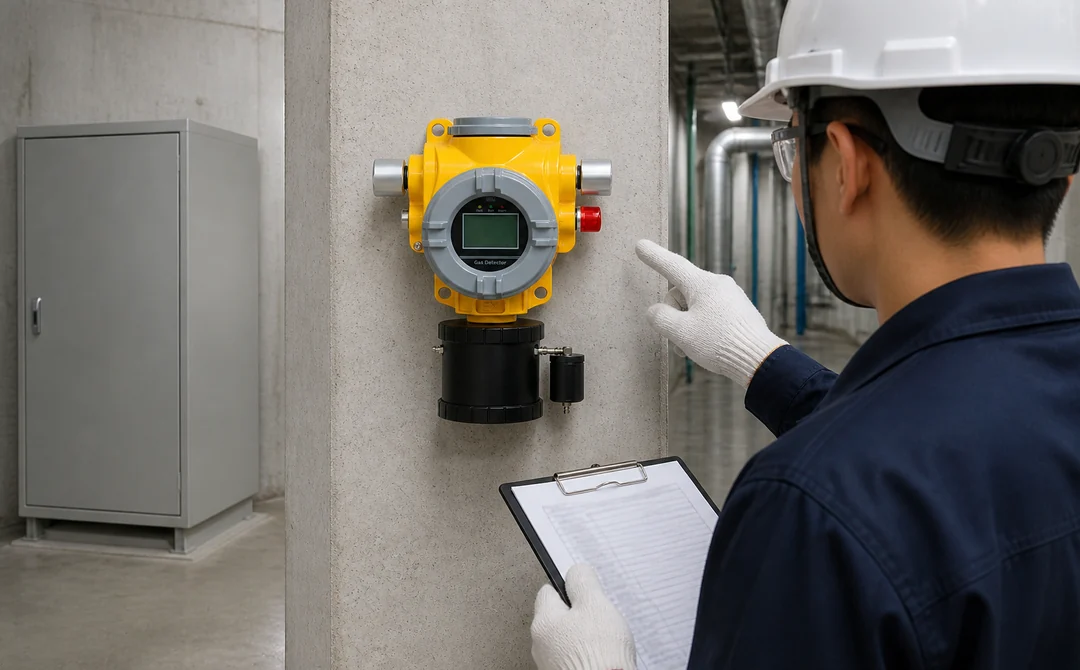
Otywell platforms to evaluate for the monitoring layout
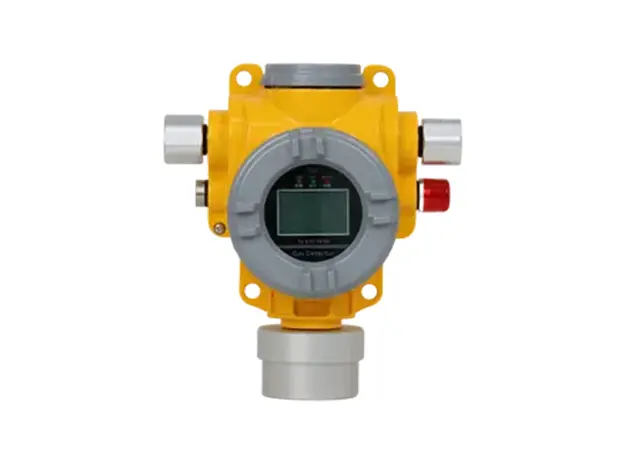
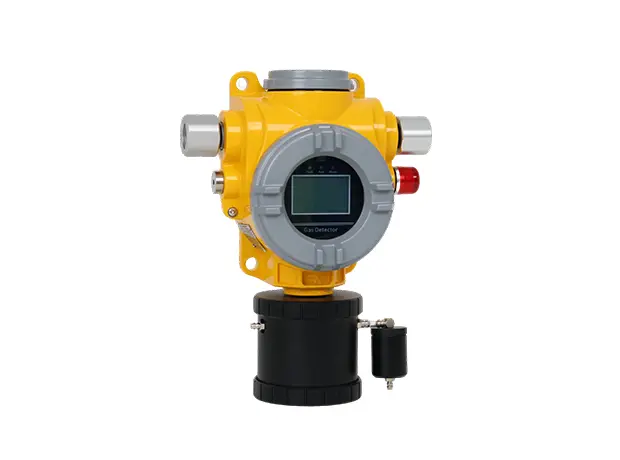
The two product pages below establish fixed-point and pumped-sampling platform options. Neither page establishes a verified AsH3 sensor, ppb detection limit, alarm time, or calibration method for a supplied unit. Ask for these documents against the exact configuration proposed for the cabinet.
Claim 5: “AsH3 compatible” means the supplied version is proven
A configurable detector platform can take different sensors. The relevant claim is narrower: the specified, delivered combination must measure AsH3 at the required level and operate in the chosen installation. A general toxic-gas category, a broad sensor list, or a response to mixed VOCs does not establish AsH3-specific performance.
Name the gas channel and its test conditions
Ask for the AsH3 sensor part number and revision, its measurement method, límite de detección, error near the decision point, and applicable temperature and humidity conditions. Request interference information for gases that could be present at the site, along with the response to over-range exposure and the recovery procedure. The calibration instruction should state the target gas or a documented alternative method, test concentration, fluir, accesorios, and interval for that exact sensor and instrument combination.
Match the evidence to the delivered version
Keep the sensor, sampling path, salidas de alarma y fallo, software or controller configuration, and any required approval in the same equipment schedule. A certificate or performance figure for another sensor, gas, or housing is not proof for the unit being ordered. If a destination market or installation area requires a particular approval, verify that the document covers the actual supplied version.
| Supplier claim | Document to request | Acceptance check | If absent |
|---|---|---|---|
| AsH3 measurement | Named sensor and gas-specific performance data | Compare limit and error with decision concentration | Capability unconfirmed |
| Timely cabinet alarm | Sample route and end-to-end response test | Test from installed inlet to intended recipient | Timing unconfirmed |
| Usable alarm/fault outputs | Cause-and-effect and signal schedule | Simulate gas alarm and applicable faults | System response unconfirmed |
| Maintainable configuration | Calibración, interferencia, service and version documents | Check supplied parts and test method | Do not substitute another configuration’s data |
Send the measurement task with the inquiry
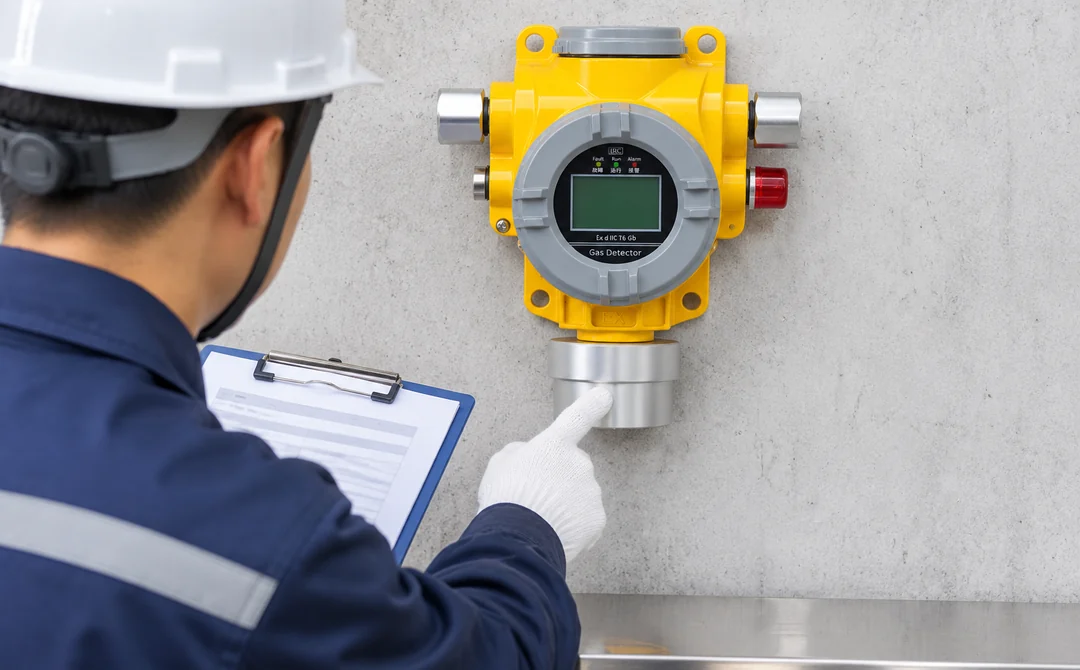
Provide the required concentration and time basis, cabinet or process drawing, possible coexisting gases, proposed inlet and sample-line route, required local and remote alarm behavior, destination market, y acceso para calibración. Ask Otywell to identify the AsH3 sensor and submit performance and service documents for the exact configuration offered.
Arsine gas detector FAQs
Does a 0–1 ppm range prove an arsine detector can alarm at 1 ppb?
No. One ppb is 0.001 ppm. A range starting at zero gives no evidence by itself that the detector has a suitable detection limit, error, and alarm response at 1 ppb. Request those measurements for the complete proposed configuration.
How is display resolution different from detection limit?
Resolution is the displayed increment. Detection limit concerns the smallest concentration the method can distinguish under defined conditions. A finely stepped display can still have uncertainty or drift too large for the intended low-level decision.
Is sensor T90 the same as time to a gas-cabinet alarm?
No. The complete time includes gas reaching the inlet, travel through any line, the measurement cycle, processing, and signal delivery to the local and remote alarm. Test the installed path at the intended alarm level.
Where should an arsine detector sample in a gas cabinet?
Choose the inlet from credible release points and the cabinet’s airflow and exhaust layout. Check the selected point for blind spots and maintenance access. Arsine’s density alone does not establish a universal mounting height.
What faults matter in a pumped arsine sampling system?
Confirm how the system reports low or lost flow, blockage, fallas del sensor, power loss, and communication failure. If the selected method uses a consumable, check its end-of-life status as well. Each applicable fault needs an identifiable local or remote state.
Can a portable arsine detector replace a fixed cabinet monitor?
A portable reading describes the air sampled at that place and time. It cannot by itself provide continuous warning between checks. Specify a fixed system when the task requires unattended cabinet monitoring, and verify the low-end performance of either instrument.
What proof is needed for a custom Otywell AsH3 configuración?
Ask for the named AsH3 sensor, rendimiento de gama baja, interference and calibration data, sample-path and alarm timing, salidas de alarma y fallo, and documents matching the exact delivered version. Platform features alone do not establish gas-specific capability.

Veloz
Escanee el código QR con WeChat