 เหอหนาน Otywell เทคโนโลยีอิเล็กทรอนิกส์ จำกัด, บจ

An industrial carbon dioxide gas detector should match the concentration range, monitoring role and work area. A fixed detector watching a cold room has a different job from a portable instrument used for a tank check, even when both measure CO2.
Start with four questions: Where can carbon dioxide be released? What concentration range is credible? Do workers need continuous area coverage, personal monitoring or remote sampling? What must happen when the instrument alarms? Those answers narrow the choice of range, เซ็นเซอร์, วิธีการสุ่มตัวอย่าง, outputs and accessories.
Carbon dioxide is colorless, odorless and nonflammable. It can come from compressed-gas systems, fermentation, dry ice, refrigeration and other processes. A worker cannot rely on smell to recognize a rising concentration. The NIOSH Pocket Guide for carbon dioxide lists an immediately dangerous to life or health value of 40,000 ppm and identifies respiratory and cardiovascular effects among the hazards of exposure.
Where Carbon Dioxide Can Accumulate at Industrial Sites
The room name alone does not define the monitoring requirement. A brewery may release CO2 during fermentation and tank venting. A cold-storage facility may use CO2 as a refrigerant or receive dry ice. A laboratory may have cylinders, incubators or process equipment. Each source produces a different release pattern and may call for a different detector range.
| Work area | Possible CO2 source | Primary monitoring question |
|---|---|---|
| Brewery or winery | Fermentation, tank venting, carbonation and cylinder systems | Where can process releases reach occupied areas or collect during low ventilation? |
| Cold room or food plant | Refrigeration equipment, dry ice or beverage-gas systems | Which rooms need continuous coverage, and how will alarms be noticed outside the room? |
| Gas storage and distribution | Cylinders, นานาชนิด, หน่วยงานกำกับดูแล, valves and pipe joints | Is the detector intended to identify a local leak, monitor worker exposure or both? |
| ห้องปฏิบัติการ | Incubators, gas cabinets, cylinders and experimental processes | Does the work create normal background CO2, a leak risk or a short high-concentration release? |
| Dry ice handling | Sublimation during storage, transport or cleaning | Can CO2 build up in containers, vehicles, หลุม, coolers or small rooms? |
| Process plant | Purging, blanketing, reaction, transfer or waste streams | Which concentration range and response time fit the release scenario? |
Map the source, the route the gas can take and the positions where people work or enter. That exercise often shows why one instrument type cannot cover every duty. A fixed point may watch a defined room continuously, while a pumped portable instrument can check a remote location through tubing before a worker approaches it.
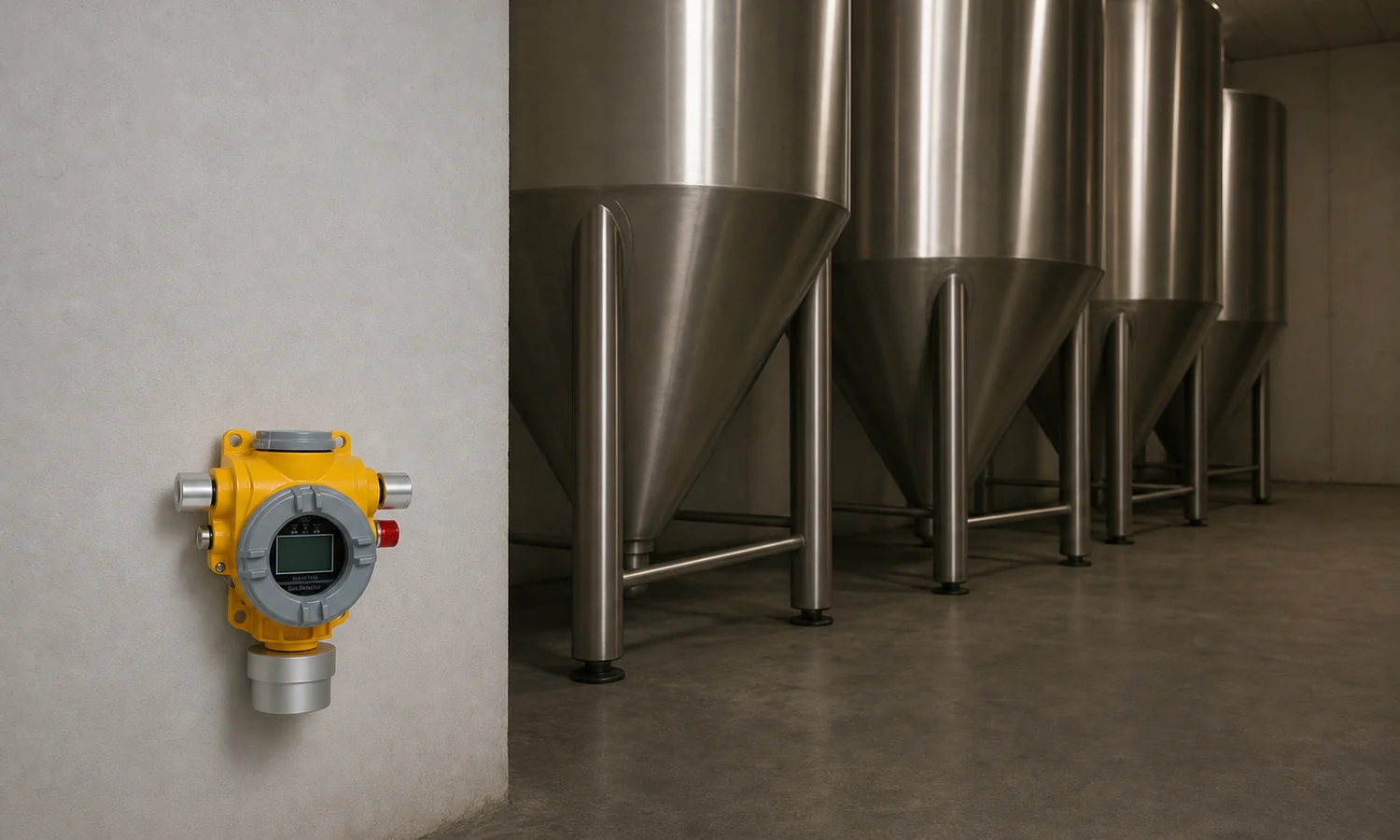
Industrial Safety Detector or Indoor Air Quality Monitor?
CO2 instruments are sold for several purposes. Indoor air quality monitors usually track occupant-generated carbon dioxide as an indicator of ventilation. Industrial safety detectors are selected around process releases, compressed gas, work exposure and alarm response. The screens may show the same unit, but their required range, สิ่งที่แนบมา, outputs and maintenance arrangements can be very different.
ที่ US EPA guidance on indoor CO2 and ventilation says indoor carbon dioxide readings can provide ventilation information but need careful interpretation. That use should not be confused with monitoring a credible industrial release that can move quickly into a percent-by-volume range.
| Feature | Ventilation or IAQ monitor | Industrial CO2 gas detector |
|---|---|---|
| วัตถุประสงค์หลัก | Observe indoor CO2 trends related to occupancy and ventilation | Detect process releases, accumulation or worker exposure conditions |
| Typical decision | Review ventilation performance | Warn personnel, activate local alarms or send a signal to a control system |
| Range question | Often focused on normal occupied-building concentrations | May require ppm, 1%ฉบับที่, 5%VOL or a higher application-specific range |
| การติดตั้ง | Office, classroom or occupied-building location | Industrial area selected around sources, การไหลของอากาศ, access and worker positions |
| Outputs | แสดง, logging or building ventilation signal | Local alarms, รีเลย์, 4-20 มิลลิแอมป์, RS485 or controller communication as specified |
Select the Required CO2 Measurement Range
Range is one of the first specification decisions. Carbon dioxide may be expressed in parts per million or percent by volume. The conversion is straightforward:
- 5,000 ppm equals 0.5%VOL.
- 10,000 ppm equals 1%VOL.
- 30,000 ppm equals 3%VOL.
- 100,000 ppm equals 10%VOL.
The range needs to cover the concentrations that matter to the planned response without making the useful part of the scale unnecessarily coarse. ก 0 ถึง 5,000 ppm instrument and a 0 to 10%VOL instrument answer different questions. The first gives more attention to lower concentrations. The second can follow a much larger release but may offer less detail at the low end, depending on the sensor and display resolution.
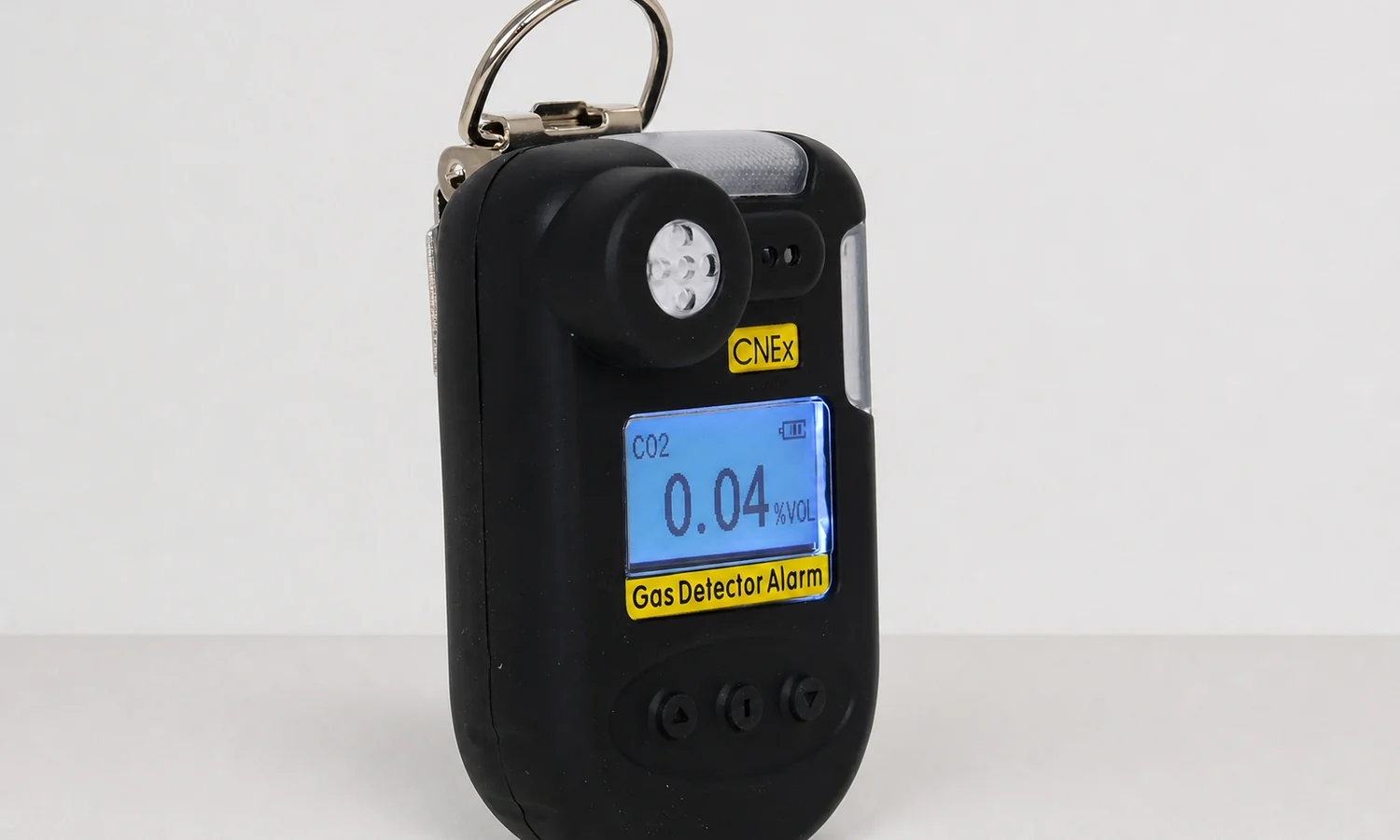
Use exposure values as reference points, then define alarms for the site and the action attached to each alarm. OSHA Table Z-1 lists a carbon dioxide 8-hour time-weighted average of 5,000 ppm. NIOSH lists 5,000 ppm as a time-weighted average, 30,000 ppm as a short-term value and 40,000 ppm as IDLH. The underlying values and units can be checked in the OSHA Table Z-1.
Also check how the manufacturer states accuracy. A percentage of full scale, a percentage of reading and a fixed ppm tolerance produce different uncertainty at the same displayed value. Ask for the specification at the temperatures and pressures expected on site. If one detector must cover normal background and a possible high-concentration release, compare its low-end resolution with its over-range behavior. In some applications, separate instruments or sensing points give a clearer result than forcing one range to serve every measurement task.
Why NDIR Is Commonly Used for CO2 Detection
NDIR stands for nondispersive infrared. The sensor passes infrared energy through a measurement path and observes absorption at wavelengths associated with carbon dioxide. The optical arrangement, path length and signal processing determine how the sensor handles its selected range.
For procurement, the sensor label is only the starting point. Compare the complete instrument specification:
- Full-scale range and resolution
- Accuracy statement and the conditions attached to it
- เวลาตอบสนอง
- อุณหภูมิในการทำงาน, humidity and pressure range
- Zero and span procedure
- Warm-up time and fault indication
- Expected service life and replacement arrangement
Temperature changes, การควบแน่น, dust and pressure can affect a measurement system. In a cold room or washdown area, the enclosure and sampling arrangement may matter as much as the sensing principle. สำหรับเครื่องตรวจจับแบบสูบ, also check the tubing material, sample flow, กรอง, water trap and time needed for gas to reach the sensor.
Choose Fixed, Portable or Pump-Suction Monitoring
Fixed carbon dioxide detector
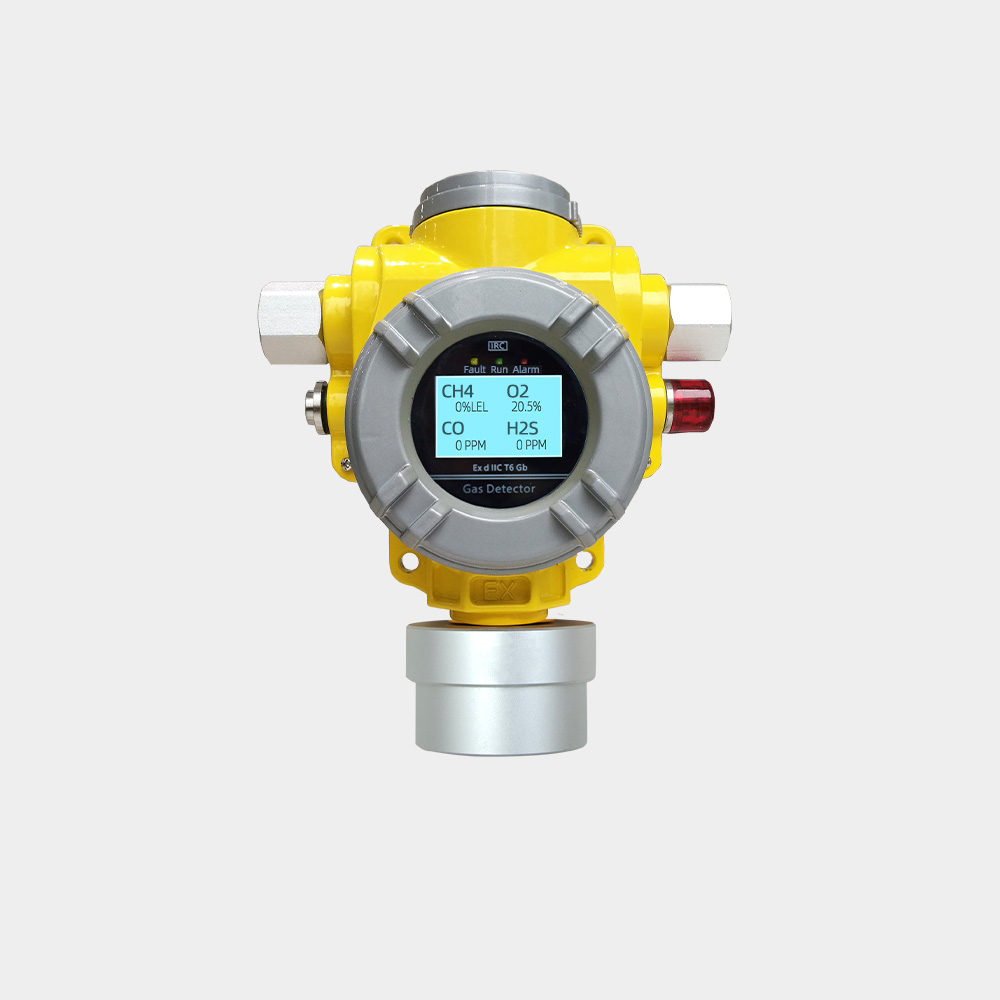
A fixed detector provides continuous monitoring at a defined point. It can connect to a controller, สัญญาณเตือน, ventilation command or plant system when the specified version supports the required outputs. The quotation should identify the power supply, ประเภทสัญญาณ, cable arrangement, local display, alarm devices and controller compatibility.
Portable diffusion detector
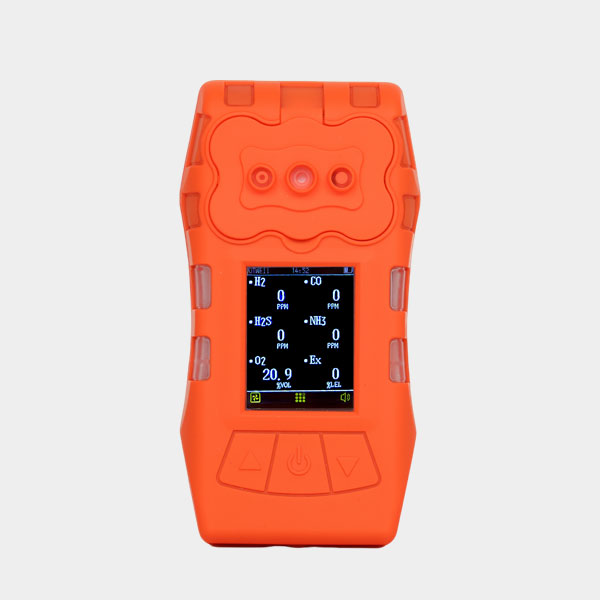
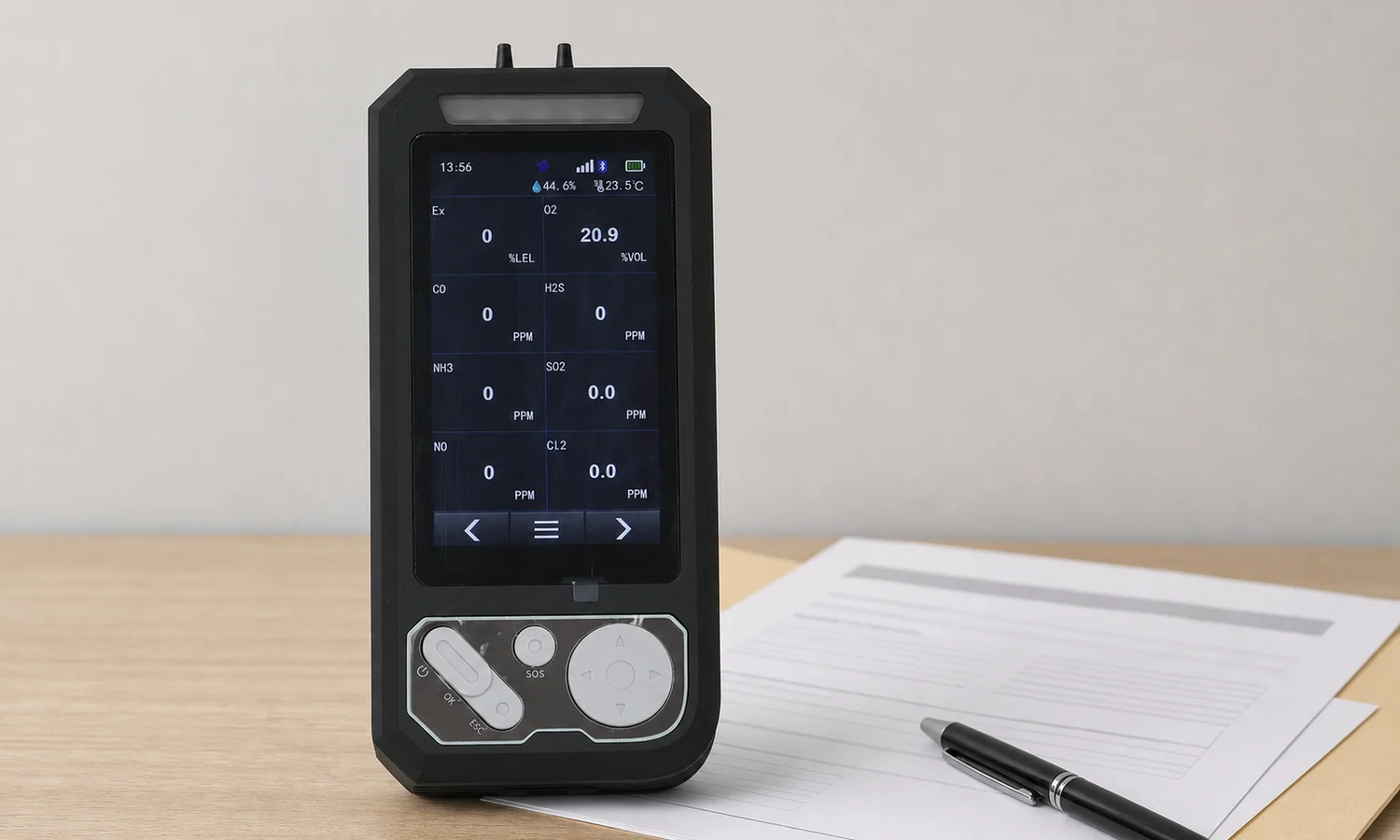
A diffusion instrument measures the atmosphere that reaches its sensor naturally. It can be useful for personal monitoring, mobile checks and work that moves between locations. Its specification should cover the exact CO2 range, battery arrangement, alarm presentation, data logging and environmental limits.
Pump-suction detector
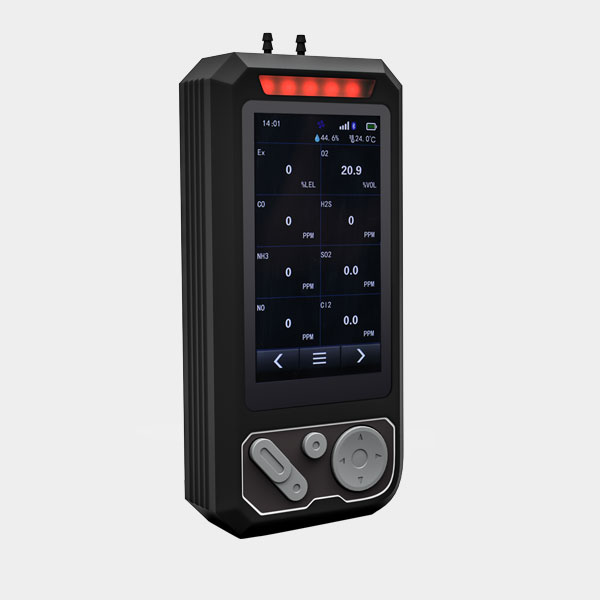
A built-in pump draws gas through a probe or sample line. This format is useful when the measurement point is not safely or conveniently reached by the operator. Sampling adds new variables: line length, internal diameter, material compatibility, ไหล, blockage detection, filters and transport delay.
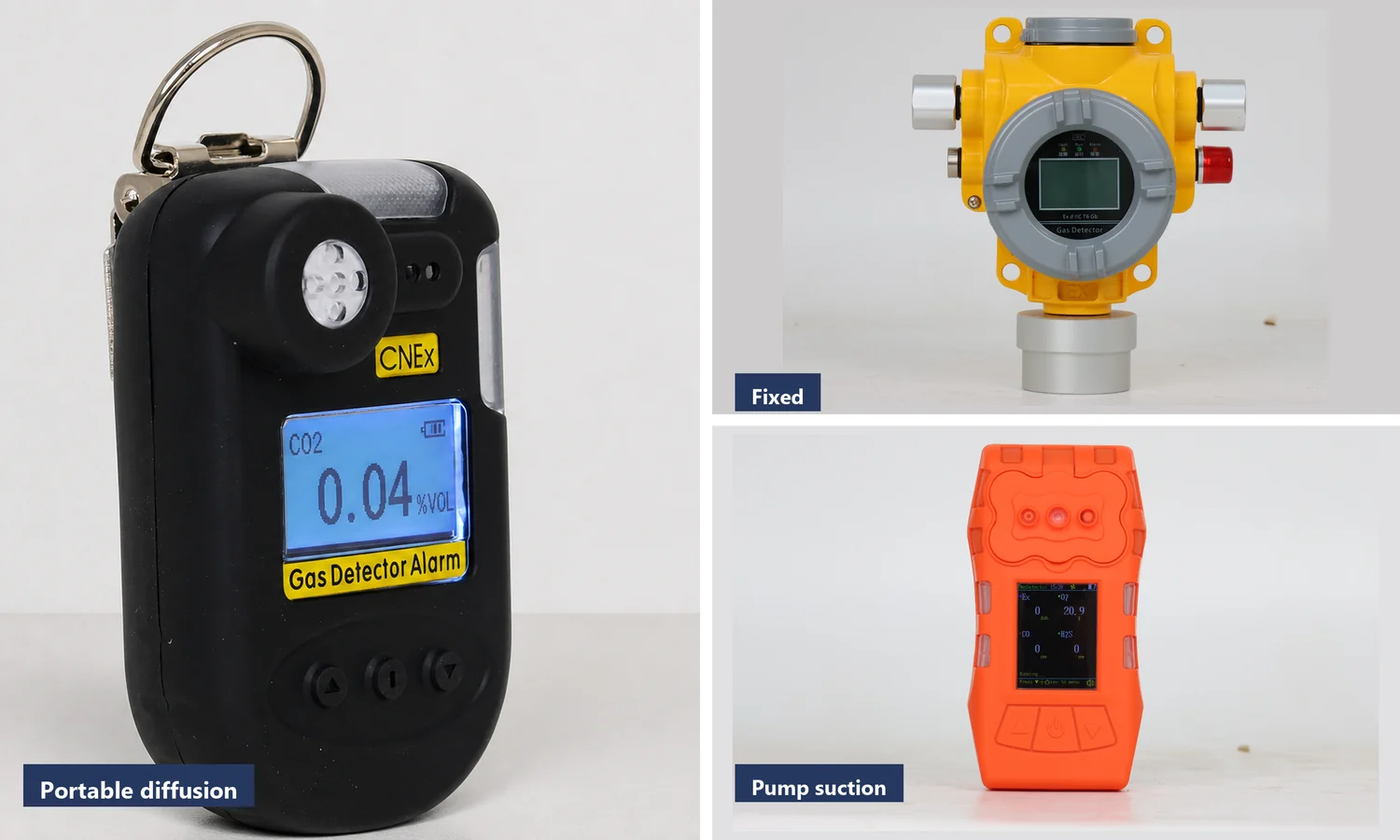
| Monitoring role | Good fit | Questions for the RFQ |
|---|---|---|
| Fixed | Continuous coverage of a defined room or process area | How is it powered? Which outputs, controller and remote alarm devices are required? |
| Portable diffusion | Personal or mobile monitoring where gas reaches the instrument directly | Which range, สัญญาณเตือน, logging and operating time are included in the ordered version? |
| Portable pump suction | Remote checks, probes and sample lines | What are the pump flow, maximum line length, delay, filter and blockage-alarm details? |
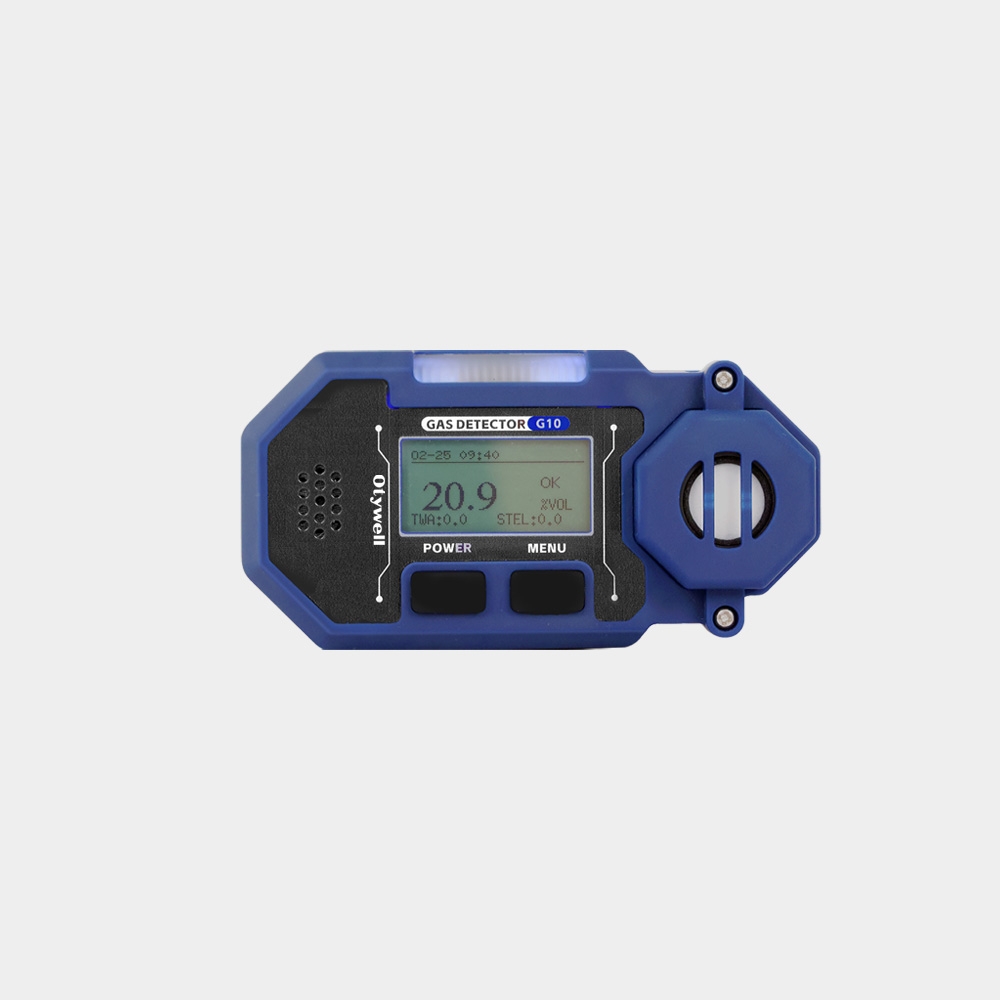
Otywell CO2 Monitoring Options
The following products cover different monitoring formats. Their CO2 ranges and final sensor configurations need to be stated in the quotation.
Plan Detector Placement Around Sources and Air Movement
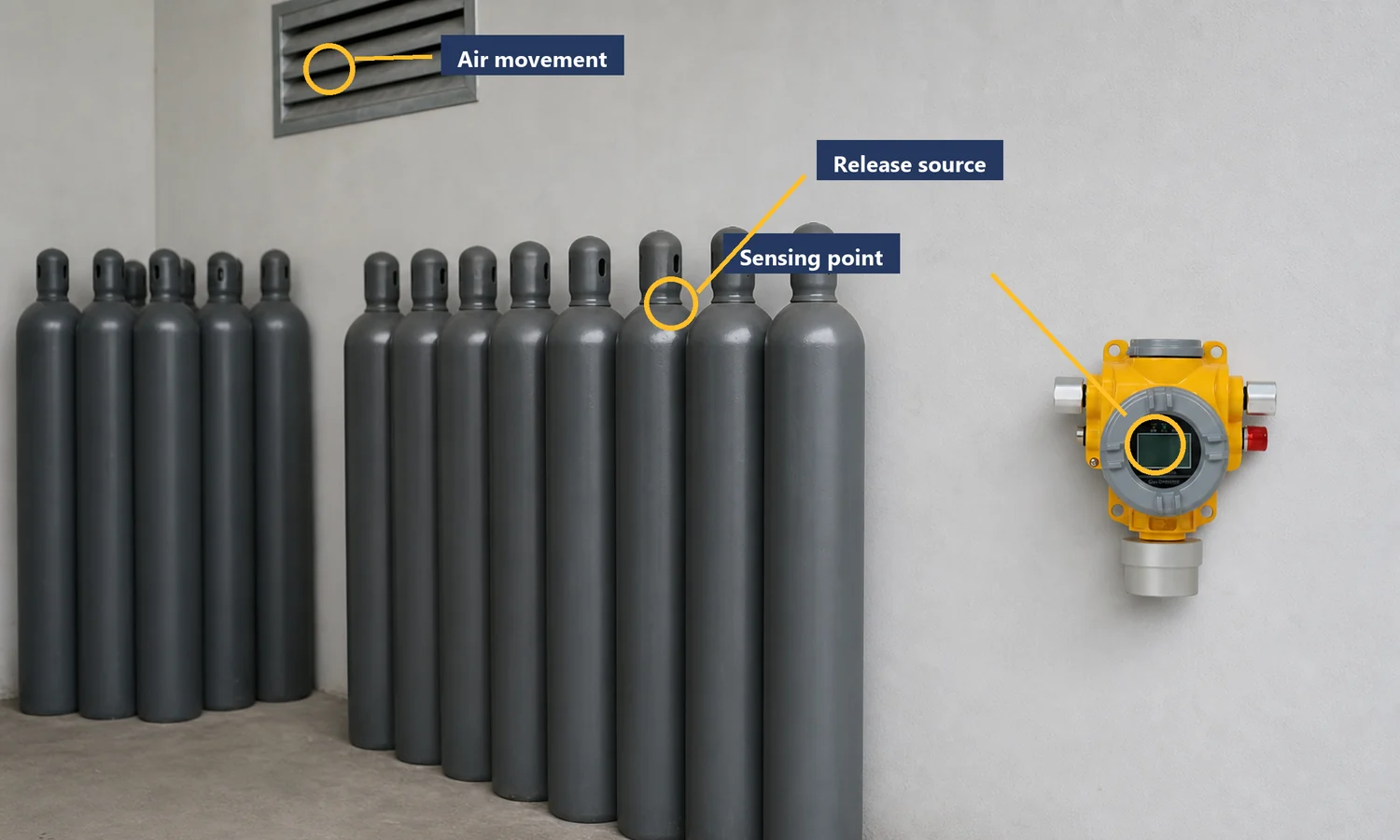
Carbon dioxide has a relative gas density of about 1.53 เมื่อเทียบกับอากาศ, according to NIOSH. That property helps explain why CO2 can collect in low or poorly ventilated spaces, but it is not a complete placement rule. A cold release, a warm process plume, a high-pressure jet and a slow leak from a fitting will not behave in the same way.
Build the detector layout from the release scenario:
- Mark cylinders, นานาชนิด, คอมเพรสเซอร์, เครื่องระเหย, tanks, vents and transfer points.
- Identify occupied positions, ทางเข้า, หลุม, สนามเพลาะ, coolers and enclosed spaces.
- Review supply air, ไอเสีย, fans, ประตู, partitions and equipment that can redirect gas.
- Choose sensing points that give useful warning before the gas reaches a critical occupied location.
- เก็บเครื่องตรวจจับไว้เพื่อการตรวจสอบ, functional testing and calibration.
A sensor directly beside a normal process vent may spend much of its time reading expected process CO2. A sensor far from every source may respond too late. The layout needs to separate normal background, credible leaks and the places where an alarm must protect a person or trigger equipment.
For remote sampling, document the sample point and line route. Long tubing adds response delay. Filters and water traps add maintenance. A line routed through a cold area can also collect condensation. These details belong on the drawing and in the commissioning test.
Set Alarms and Outputs for the Required Response
An alarm value is useful only when it has a defined meaning and action. Exposure limits, process control values and emergency thresholds serve different purposes. Avoid copying a catalogue default without checking the detector range, local requirements and the response expected from operators.
For each alarm level, record:
- The concentration and any time-weighting function
- Which audible, visual or vibrating indication activates
- Whether a controller, รีเลย์, 4-20 mA signal or RS485 message changes state
- What personnel do when the alarm occurs
- How ventilation, valves or shutdown commands are tested
- How fault, power-loss and over-range conditions are displayed
คำแนะนำของเราในการ gas detector alarm setting terminology explains low, สูง, TWA and STEL functions. In the CO2 specification, list only the alarm functions supported by the selected sensor and instrument configuration.
การว่าจ้าง, Testing and Maintenance
Commissioning starts with the purchase order. Check the delivered gas, พิสัย, หน่วย, firmware settings, ค่าสัญญาณเตือน, output scaling and accessories against the approved specification. A detector ordered in ppm should not arrive configured in percent volume without that difference being noticed.
For a fixed system, test the full signal path. Confirm the local indication, controller channel, remote beacon, relay logic, ventilation command and fault response. Record what concentration or simulated signal was applied and how every connected device responded.
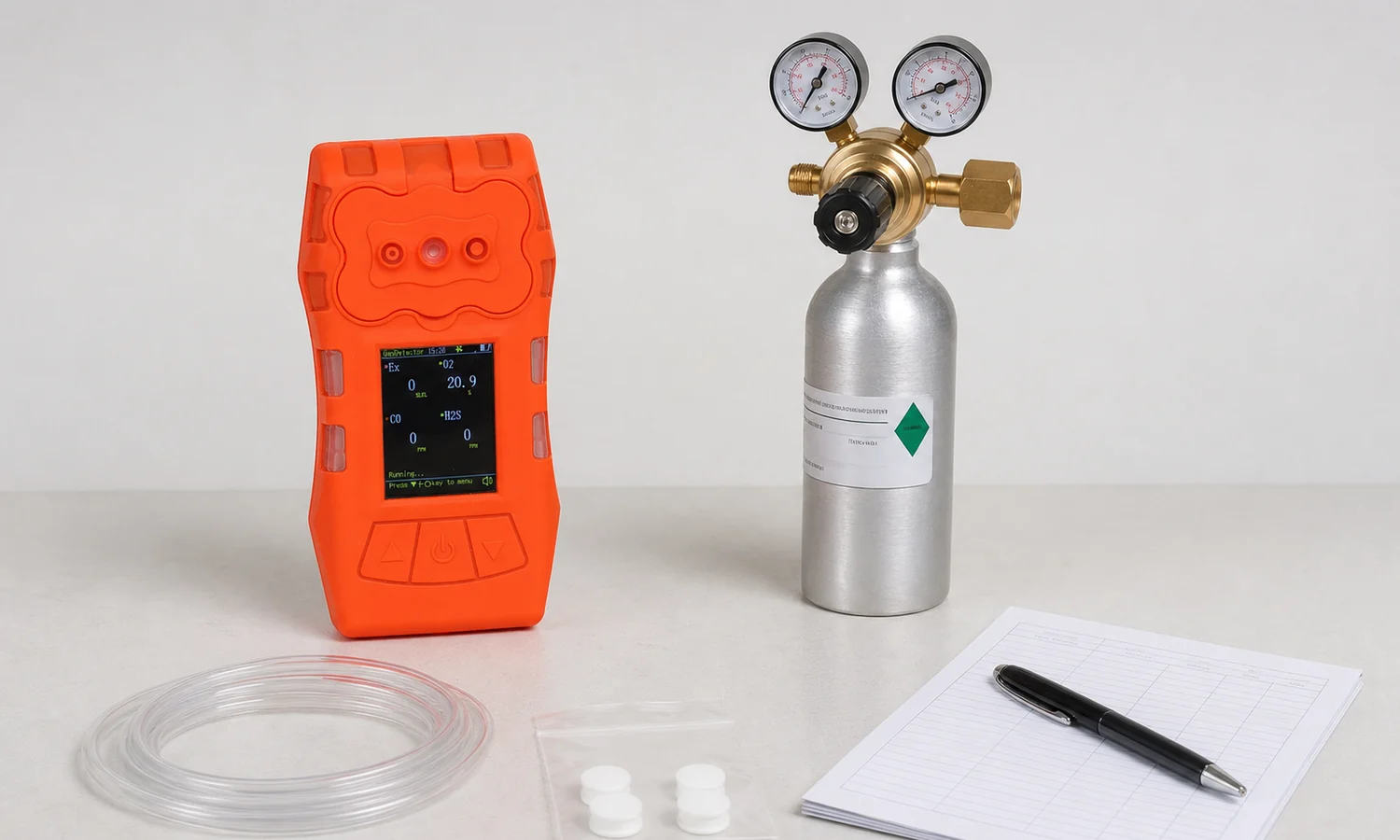
Portable instruments need the same discipline. Check the inlet, ปั๊ม, ท่อ, ตัวกรอง, charger or battery, สัญญาณเตือน, logging and date settings. A pumped monitor should indicate blocked flow. Measure the transport delay with the actual sample line instead of assuming the detector-only response time.
Use the zero medium, ก๊าซสอบเทียบ, หน่วยงานกำกับดูแล, flow and adapter specified for the instrument. Keep cylinders within date and store the service record with the detector identity. Trend zero drift, calibration adjustment and failed checks. The history can show whether the maintenance interval suits the environment.
Carbon Dioxide Gas Detector RFQ Checklist
A useful request for quotation gives the supplier enough detail to return an exact configuration. Include the following fields:
- CO2 source and work area
- Fixed, portable diffusion or pump-suction role
- Required full-scale range
- Resolution and accuracy requirement
- Expected normal and peak concentration
- Operating temperature and humidity
- ในร่ม, outdoor, cold-room or washdown conditions
- Sample line length and accessories
- ต่ำ, high and time-weighted alarms
- เสียง, light and vibration requirements
- 4-20 มิลลิแอมป์, อาร์เอส485, relay or wireless interface
- Power supply and backup arrangement
- Controller and remote alarm compatibility
- Data logging and record capacity
- Calibration kit and test-gas requirements
- Required documents and destination market
Ask the quotation to repeat the gas, พิสัย, sensor principle, sampling method and output for every line item. Product-family names are not enough because one family may support several sensors and ranges.
คำถามที่พบบ่อย
Is a CO2 detector the same as a carbon monoxide detector?
เลขที่. Carbon dioxide is CO2, while carbon monoxide is CO. They have different hazards, concentration ranges and sensing arrangements. An instrument must include the correct gas channel.
Can an oxygen monitor detect carbon dioxide?
An oxygen sensor measures oxygen concentration. It can show oxygen displacement in some release scenarios, but it does not identify or quantify CO2. Direct CO2 measurement is needed when the carbon dioxide concentration itself drives the alarm or process decision.
Should a brewery use fixed or portable CO2 detectors?
Fixed detectors suit continuous coverage of fermentation, พื้นที่จัดเก็บ, carbonation and cold-room areas. Portable instruments support personal monitoring, maintenance checks and remote sampling. Many facilities assign both roles rather than treating them as interchangeable.
What is the difference between ppm and %VOL?
Both describe concentration. หนึ่งเปอร์เซ็นต์โดยปริมาตรเท่ากับ 10,000 ppm. A detector range stated as 0 ถึง 5,000 ppm therefore covers up to 0.5%VOL.
Where should a carbon dioxide detector be installed?
Place it according to the release source, gas path, การระบายอากาศ, barriers and worker location. Include low areas where accumulation is credible, but do not rely on gas density as the only rule.
Does a CO2 detector normally use an NDIR sensor?
NDIR is widely used for carbon dioxide measurement. Confirm the full instrument range, ความแม่นยำ, การตอบสนอง, ข้อจำกัดด้านสิ่งแวดล้อม, zero method and maintenance requirements rather than selecting on the sensor acronym alone.
Build the Specification Before Comparing Models
A carbon dioxide gas detector becomes easier to select once the monitoring duty is clear. Define the source, ความเข้มข้นที่คาดหวัง, พิสัย, วิธีการสุ่มตัวอย่าง, detector location, alarm response and system interface. Then compare fixed and portable products against the same written requirements. This produces a cleaner quotation and makes commissioning checks much more direct.

Wechat
สแกนรหัส QR ด้วย weChat