 Хэнаньская компания Otywell Electronic Technology Co., ООО

Plan a gas detection system from the monitoring task outward. List the gas risks, work areas, required measurement points, alarm recipients and response actions before choosing detectors or a controller. This produces a specification that suppliers can answer and a system that the site can test at handover.
A detector count on its own is not enough. The buyer also needs to know what each point measures, where its signal goes, how alarm and fault states are shown, and what remains operational if power or communication is lost. These questions apply to new installations and to extensions of an existing industrial gas detection system.
Scope: This guide supports purchasing and project planning. Detector placement, alarm settings, cause and effect logic, wiring and protective actions require a site-specific risk assessment and qualified engineering review.
Start with a monitoring schedule, not a detector count
Prepare one row for every proposed monitoring location. Name the area, the possible release source, целевой газ, the measurement purpose and the people or equipment that must receive an alarm. Add the expected operating conditions and the project documents that govern the installation.
The target gas should come from the substances and processes present at the site. A room label is not a gas specification. A laboratory may use several cylinders, while a boiler room may have fuel and combustion concerns that differ from another boiler room. The same product name should not be copied across both locations without checking the actual hazard.
State the measurement unit and required range with the gas. Percent LEL, percent by volume and ppm describe different measurement tasks. If a display, controller or data platform will show the reading, use consistent gas names and units throughout the schedule.
The monitoring purpose also matters. Continuous area warning, process observation, leak investigation and personal exposure monitoring are different jobs. This article focuses on fixed systems. Portable instruments may support maintenance or entry checks, but they do not become permanent fixed points simply because they can be left in a room.
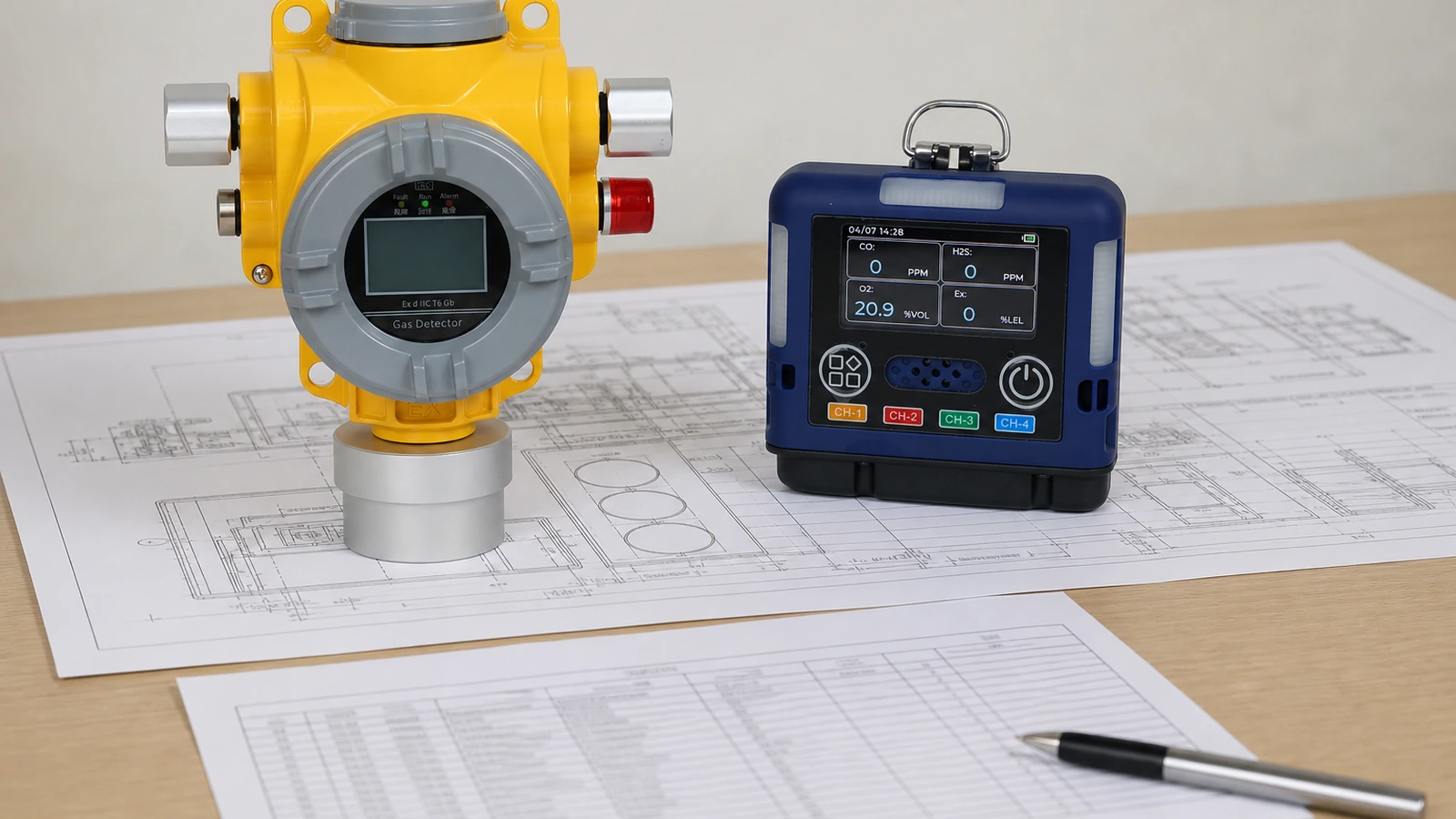
Define what each part of the system must deliver
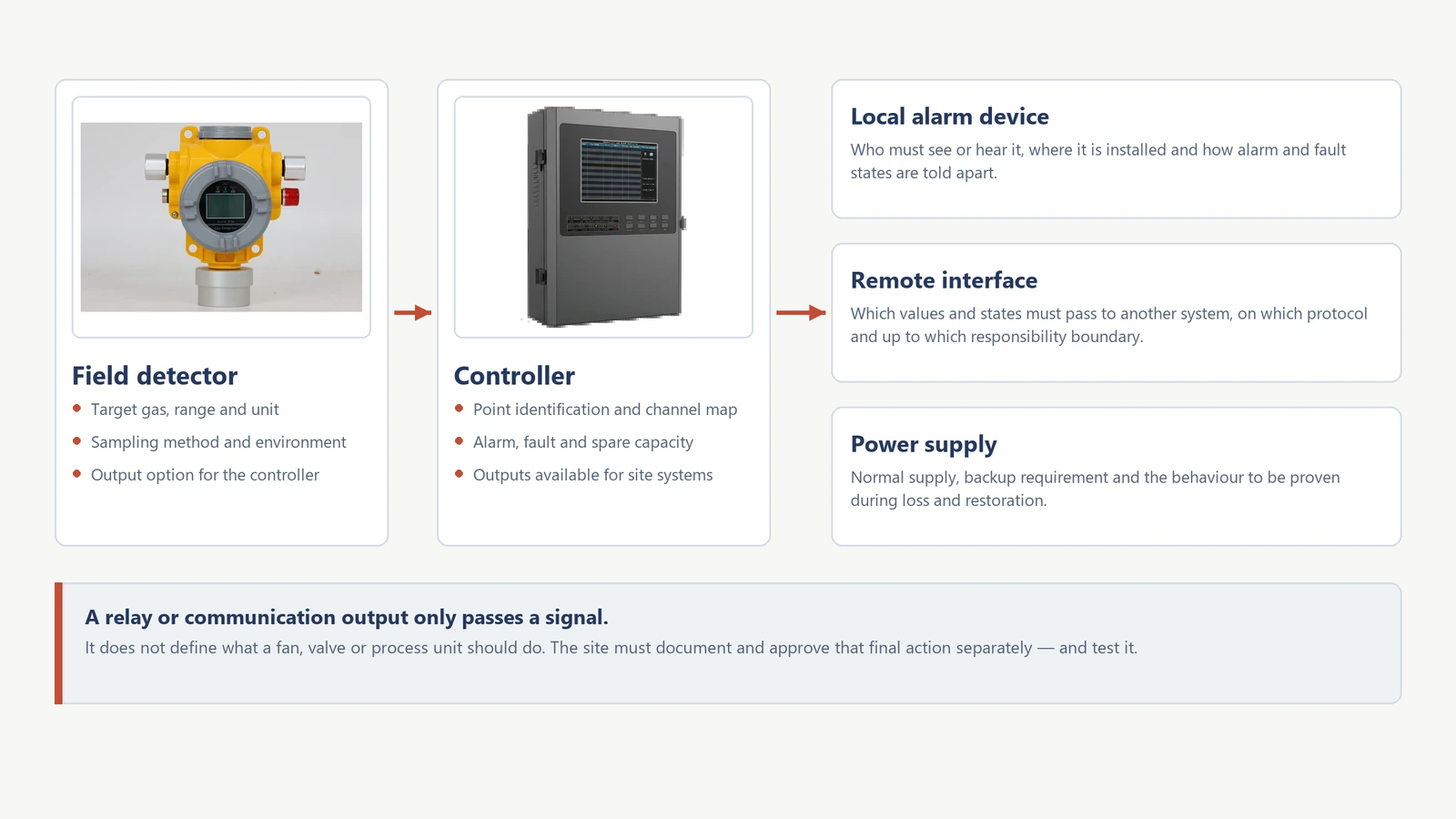
A fixed gas detection system usually includes more than field detectors. It may also include a controller, local audible and visual alarms, signal interfaces, power supplies and connections to other site systems. Each item needs a defined role.
| System element | What the buyer should define | Evidence to request |
|---|---|---|
| Field detector | Целевой газ, диапазон, единица, метод выборки, environment and output | Datasheet for the exact sensor and ordered configuration |
| Controller | Required inputs, displayed information, alarm levels, fault states and outputs | Channel schedule, terminal details and operating manual |
| Local alarm device | Who must see or hear it, where it will be installed and how states are distinguished | Device specification and alarm-state description |
| Remote interface | Which values and states must pass to another system | Signal list, protocol details and responsibility boundary |
| Источник питания | Normal supply, backup requirements and behavior during loss and restoration | Power schedule and test procedure |
The detector measures gas at its sensing location. The controller receives supported inputs and handles the functions provided by its configured hardware and software. A relay or communication output can pass a signal, but that does not define what a fan, valve or process unit should do. The site must document and approve that action separately.
For flammable-gas applications within its stated scope, the UK Health and Safety Executive’s руководство по выбору и использованию детекторов горючих газов distinguishes fixed, portable and transportable equipment and notes that a detector does not prevent leaks or replace safe working practices. The document does not cover toxic-gas monitoring, domestic detectors, mining or offshore work, so it should not be applied outside those boundaries.
Build the requirements around the work area
Use the same planning method across the facility, but do not force every area into the same gas list or detector configuration.
| Area | Questions for the monitoring schedule | Project information to provide |
|---|---|---|
| Boiler room | Which fuel, combustion products and release points does the assessment identify? | Fuel type, расположение оборудования, ventilation and alarm response requirements |
| Laboratory | Which gases are stored or used in each room, cabinet or process? | Cylinder and process inventory, room divisions, ventilation and occupancy |
| Wastewater treatment plant | Which gases may occur at wet wells, sludge handling, enclosed spaces or chemical areas? | Process map, moisture and corrosion conditions, access and maintenance plan |
| Chemical plant | Which materials, reactions and transfer operations create a credible release? | Chemical inventory, area classification, environmental conditions and interface standard |
| Underground utility corridor | Which services may introduce gas, and where could gas collect or travel? | Corridor sections, вентиляция, access points, communication route and rescue arrangements |
| Nitrogen generator room | Does the assessment require oxygen-deficiency monitoring? | Room volume, вентиляция, nitrogen equipment, occupied locations and alarm response |
Do not describe an oxygen monitor as a direct nitrogen leak detector. It measures oxygen concentration and may be selected where nitrogen displacement can create an oxygen-deficiency risk. The wording on the detector, controller and operating procedure should match that measurement.
Wastewater locations may involve hydrogen sulfide, горючие газы, oxygen deficiency or chemicals used in treatment. The process and location determine the channels. A standard four-gas combination is not proof that every relevant hazard has been covered.
In chemical and laboratory areas, review sensor suitability for the expected substance and conditions. Перекрестная чувствительность, температура, влажность, давление, poisoning or other limitations can affect selection. Request the relevant sensor information for the ordered configuration rather than relying on a general product-family table.
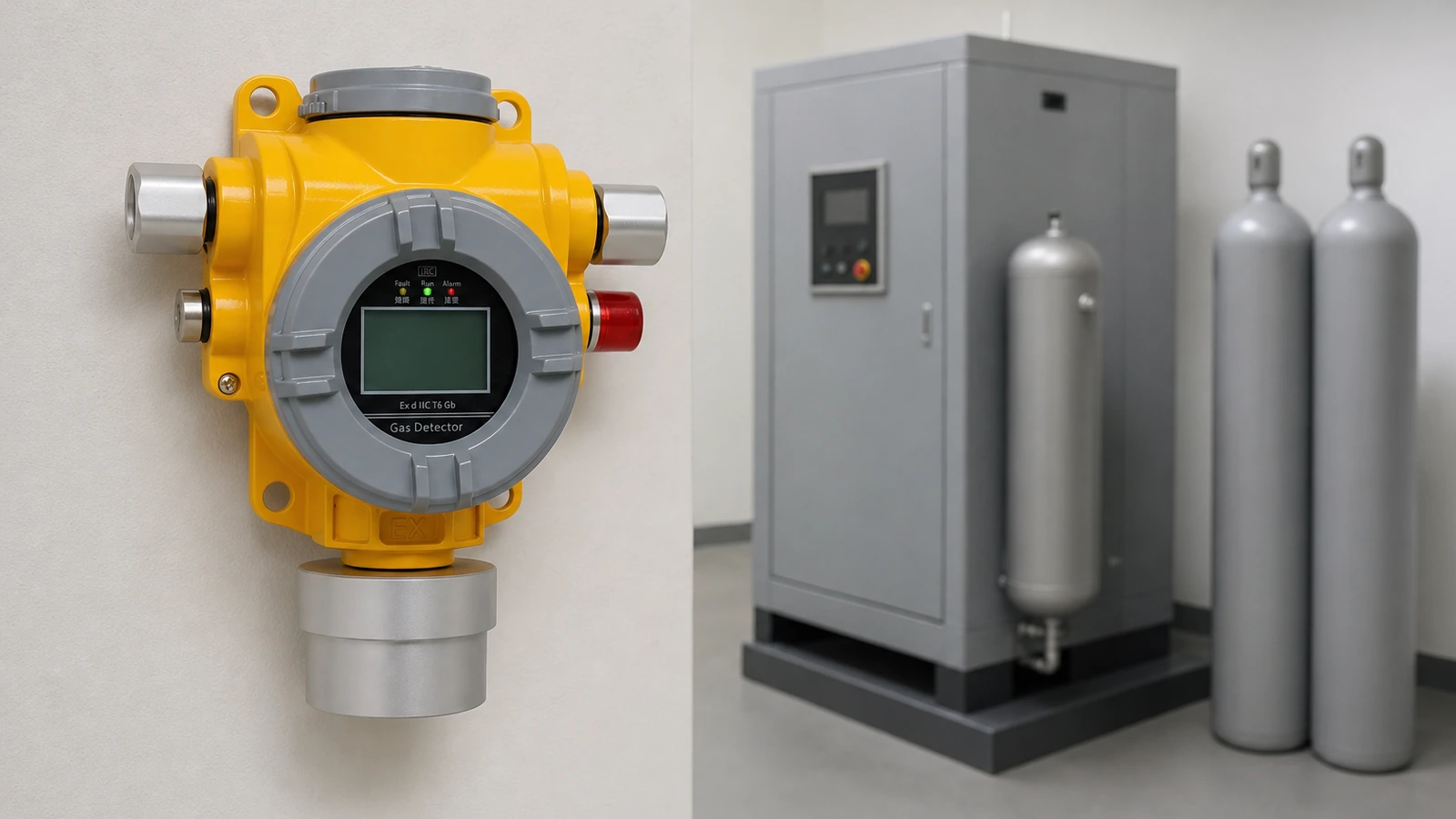
Separate measurement points, input channels and alarm zones
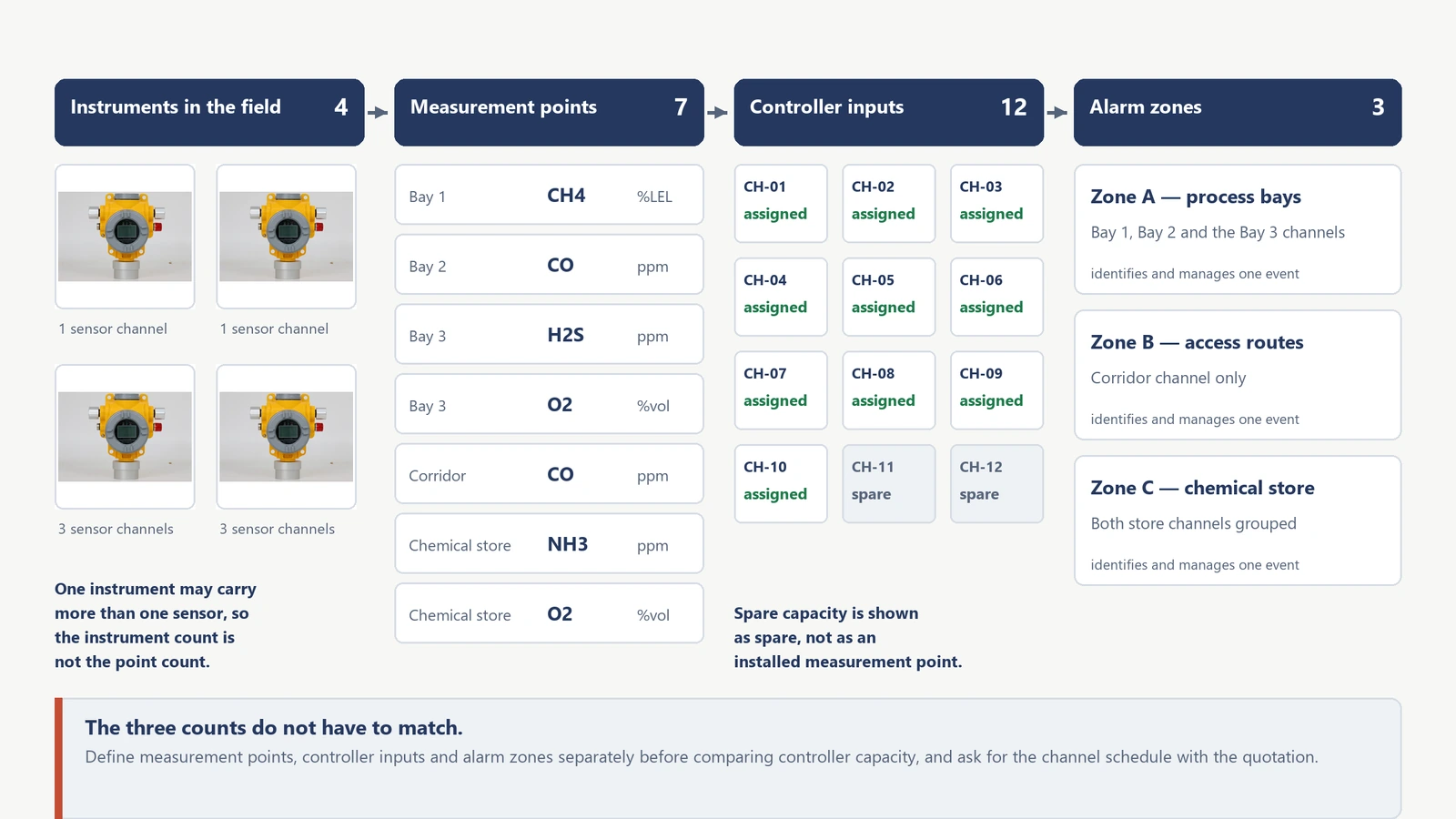
A measurement point is a place where the project needs a gas reading. A detector may carry one sensor or more than one, depending on the product configuration. A controller input is the means by which a signal enters the controller. An alarm zone is the area or grouping used to identify and manage an event.
These quantities do not always match. One physical detector may supply several measurements. A controller may reserve inputs for future expansion. Several points may be grouped for display, while maintenance records still need the identity of each instrument. Define all three quantities before comparing controller capacity.
Ask suppliers to return a channel schedule with the quotation. It should state the point name, detector model, газ, диапазон, единица, signal type, controller input and relevant alarm outputs. If the proposal includes spare capacity, show it as spare rather than as an installed measurement point.
Detector quantity should not be calculated from floor area alone. Release sources, расход воздуха, препятствия, поведение газа, occupied positions, access and response time can all affect the design. The final placement and coverage decision belongs in the site-specific engineering work.
If a project has difficult cable routes or needs remote communication, review the separate wireless gas detector selection guide. Wireless communication changes part of the connection architecture; it does not remove the need to define measurement points, alarm behavior, power and maintenance.
Otywell equipment to discuss for the project
The following product families can start a configuration discussion. They are not a pre-approved system for every site. Confirm sensor channels, диапазоны, signal compatibility, controller capacity, environmental conditions and the documents required in the destination market before ordering.
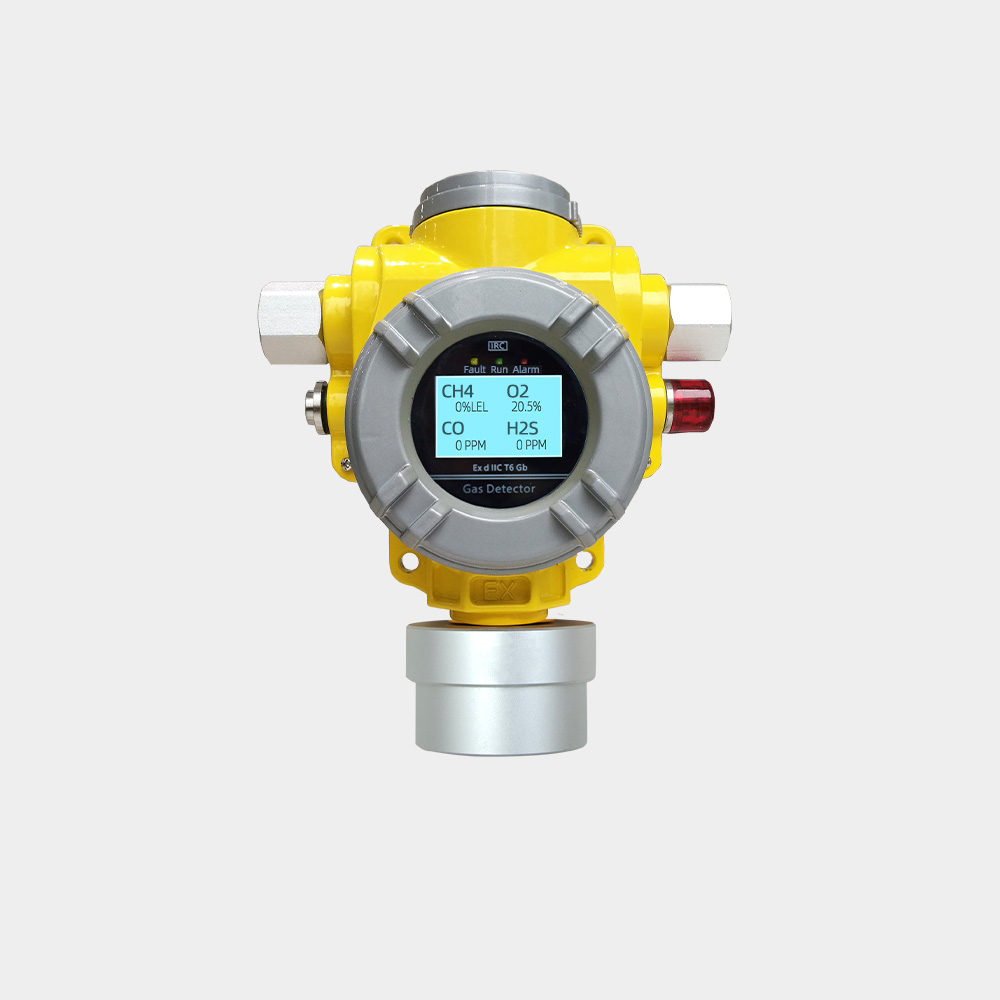
Fixed measurement point
TCB2-F point-type gas detector
Review a one-to-four-gas configuration for identified fixed points. Confirm the selected sensors, measurement ranges, output option and controller compatibility.
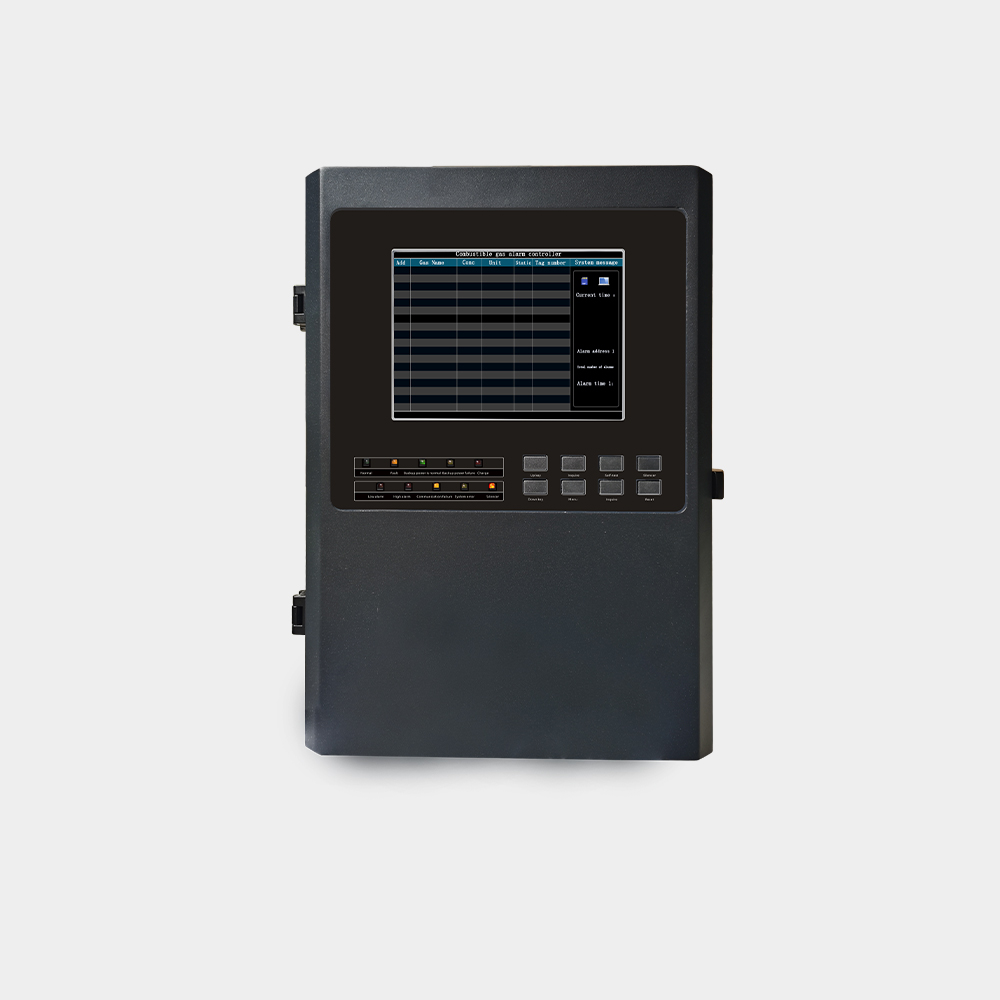
Central alarm management
GDB9 gas alarm controller
Discuss the number and type of detector inputs, point identification, alarm and fault records, output requirements and required spare capacity.
The product photographs show the model families. The ordered detector and controller configuration must be documented for the project. The cards do not establish compatibility by themselves.
Ask for alarm, fault and power-loss acceptance tests
Commissioning should prove more than the presence of a reading on the controller. Prepare the acceptance test before installation so that the supplier, installer and site team agree on the required evidence.
| Test condition | Questions to answer | Record to retain |
|---|---|---|
| Normal measurement | Does the correct point, газ, value and unit appear at each intended location? | Point-to-point check sheet |
| Газовая сигнализация | Are the intended local and remote indications produced, and can the affected point be identified? | Alarm test result and approved response reference |
| Detector fault | How is a sensor or instrument fault distinguished from a normal zero reading? | Fault simulation result |
| Communication loss | Does the receiving equipment identify missing or stale data within the documented behavior? | Communication-failure test |
| Power loss | Which components stop, which remain available and how is the condition shown? | Power-loss and restoration test |
| Maintenance isolation | How is an isolated point identified and returned to service? | Isolation permit and restoration record |
Test the approved cause and effect separately where the system sends signals to ventilation, valves or process equipment. Verify the complete path, including the receiving equipment and final action. A controller output shown on a datasheet is not proof that an external action has been designed, wired or accepted correctly.
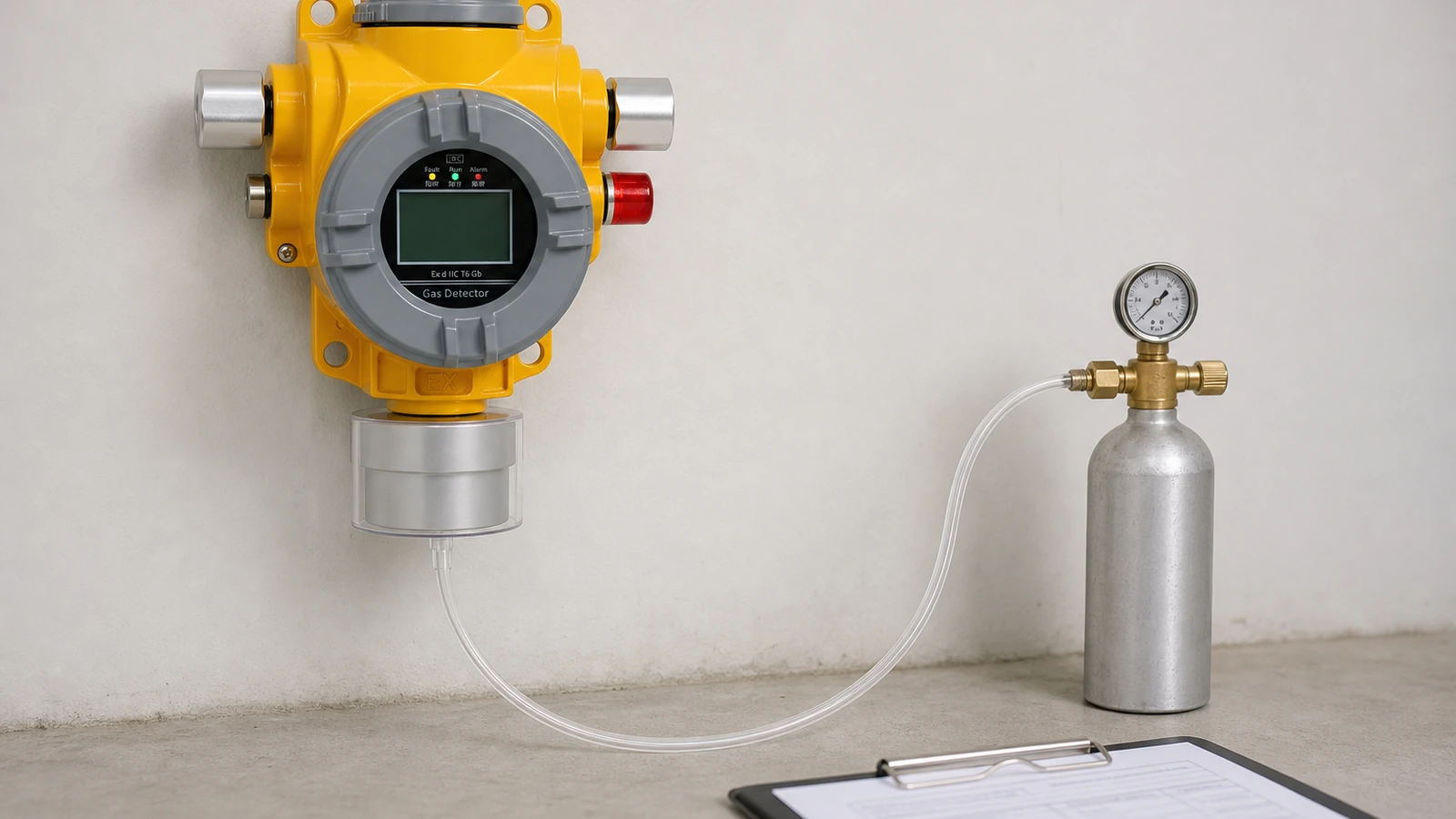
Record the test instrument, gas or simulator used, point identity, expected result, actual result, date and responsible person. Where calibration gas is required, use the type, concentration, regulator and adaptor specified for the instrument and follow the manufacturer’s procedure.
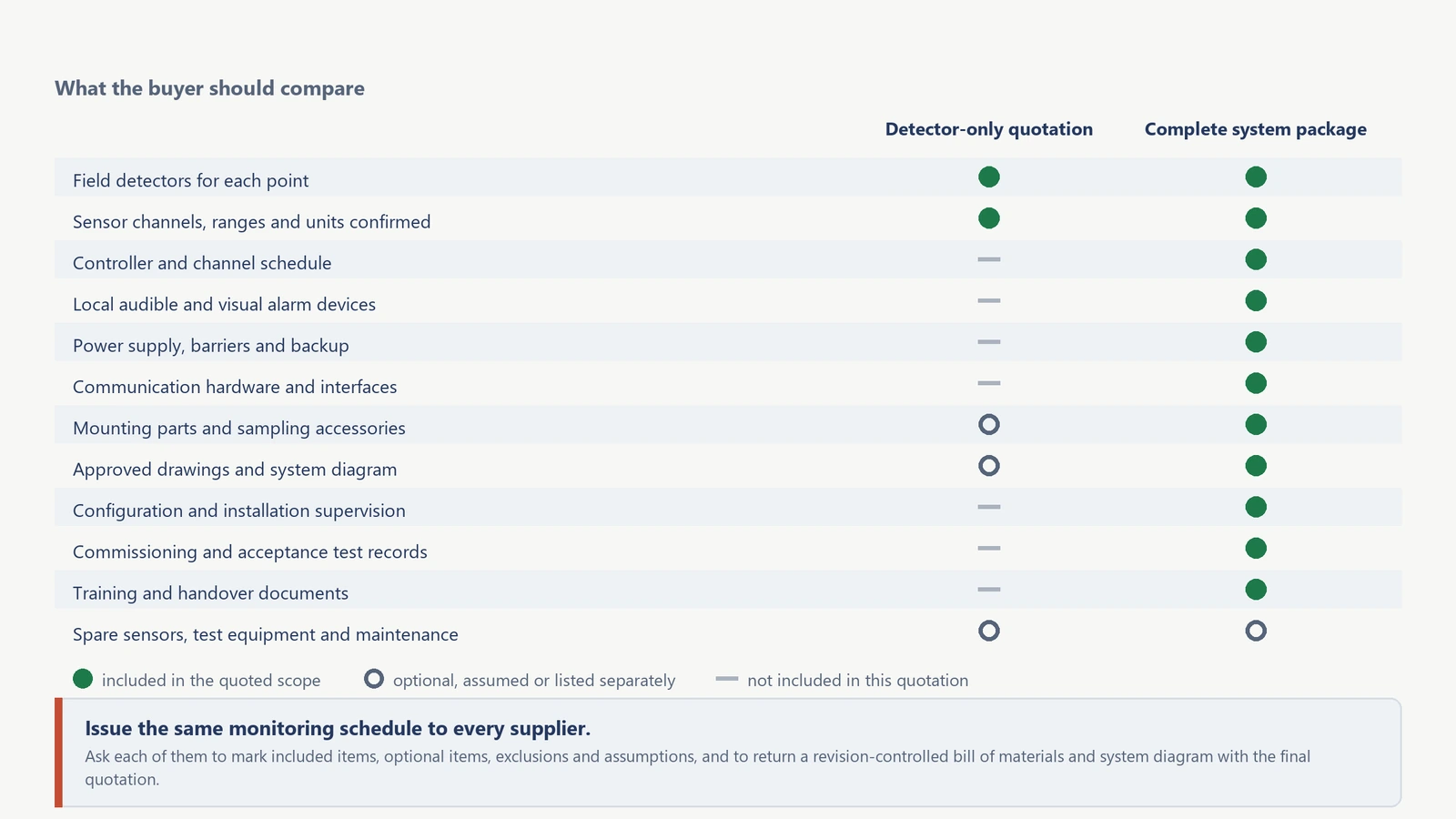
Compare quotations on the same delivery scope
Issue the same monitoring schedule to each supplier. Ask them to mark included items, optional items, exclusions and assumptions. This makes detector-only pricing easier to distinguish from a complete package.
The equipment scope may include field detectors, контролеры, local alarms, power equipment, барьеры, communication hardware, mounting parts and sampling accessories. The service scope may include drawings, configuration, installation supervision, ввод в эксплуатацию, training and handover documents. Maintenance support, spare sensors and test equipment should be listed separately.
Request a revision-controlled bill of materials and system diagram with the final quotation. The model number, датчик, диапазон, output and quantity should agree across the proposal, datasheets and channel schedule. Unresolved items can be marked for site survey or technical confirmation rather than hidden in general notes.
Useful quotation input: site layout, gas and process inventory, monitoring schedule, условия окружающей среды, area classification, available power, existing controller details, alarm recipients, interface requirements, required documentation and maintenance responsibility.
Часто задаваемые вопросы
Is a gas detector the same as a gas detection system?
Нет. A detector is one field device. A system may include multiple detectors, a controller, alarm devices, power supplies, communication interfaces and documented response arrangements.
How do measurement points differ from controller channels?
A measurement point is a required gas reading at an identified location. A channel is an input or data path handled by the controller. The relationship depends on the detector configuration and communication design, so the project schedule should list both.
Can a gas alarm automatically operate ventilation?
Only when the complete arrangement has been designed and approved for that action. Confirm the controller output, receiving circuit, operating logic, failure behavior, manual controls and acceptance test. Do not infer the final function from the presence of a relay alone.
What documents should be included at handover?
The project should identify its required documents. A typical handover package may include the final bill of materials, detector and channel schedules, approved drawings, exact product manuals, certificates applicable to the ordered equipment, configuration records, test results, записи калибровки, training records and a maintenance plan.
Can one standard gas list be used throughout a facility?
Not without confirming the hazards in each area. Select gases and ranges from the substances, processes and tasks present at the location. Use one consistent documentation format across the facility, but allow the monitored channels to differ.
This article is a planning guide. A qualified person must review the final gas selection, detector placement, alarm settings, interfaces and response actions for the actual site and applicable requirements.

Вичат
Сканируйте QR-код с помощью WeChat