 Henan Otywell Electronic Technology Co., Ltd

最初にガス測定値を確認してワイヤレスガス検知器を選択してください, それから電源, 無線リンクとアラーム接続. A detector that measures the right gas but cannot reliably report its status at the intended location is not a complete monitoring solution.
For an existing plant, the buying question is often practical: can another monitoring point be added without a difficult cable run? Wireless equipment may help, but the quotation needs to cover more than the transmitter. Gateways, 力, 試運転, maintenance access and fault handling all belong in the decision.
This guide covers industrial fixed monitoring and site upgrades, not household Wi-Fi alarms. It is a purchasing checklist, not a detector-placement design or a substitute for the site’s risk assessment.
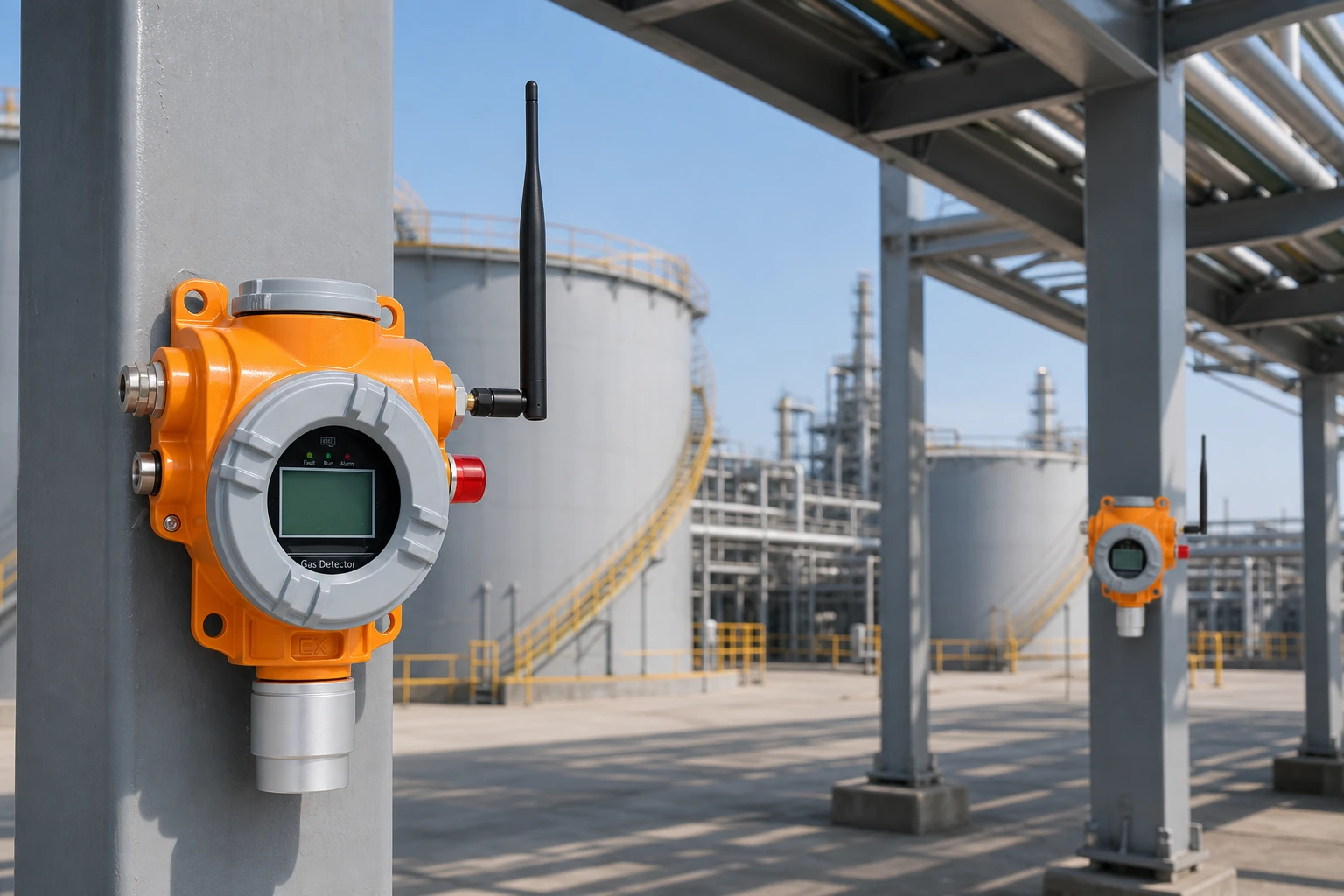
What Does Wireless Mean in a Gas Detection System?
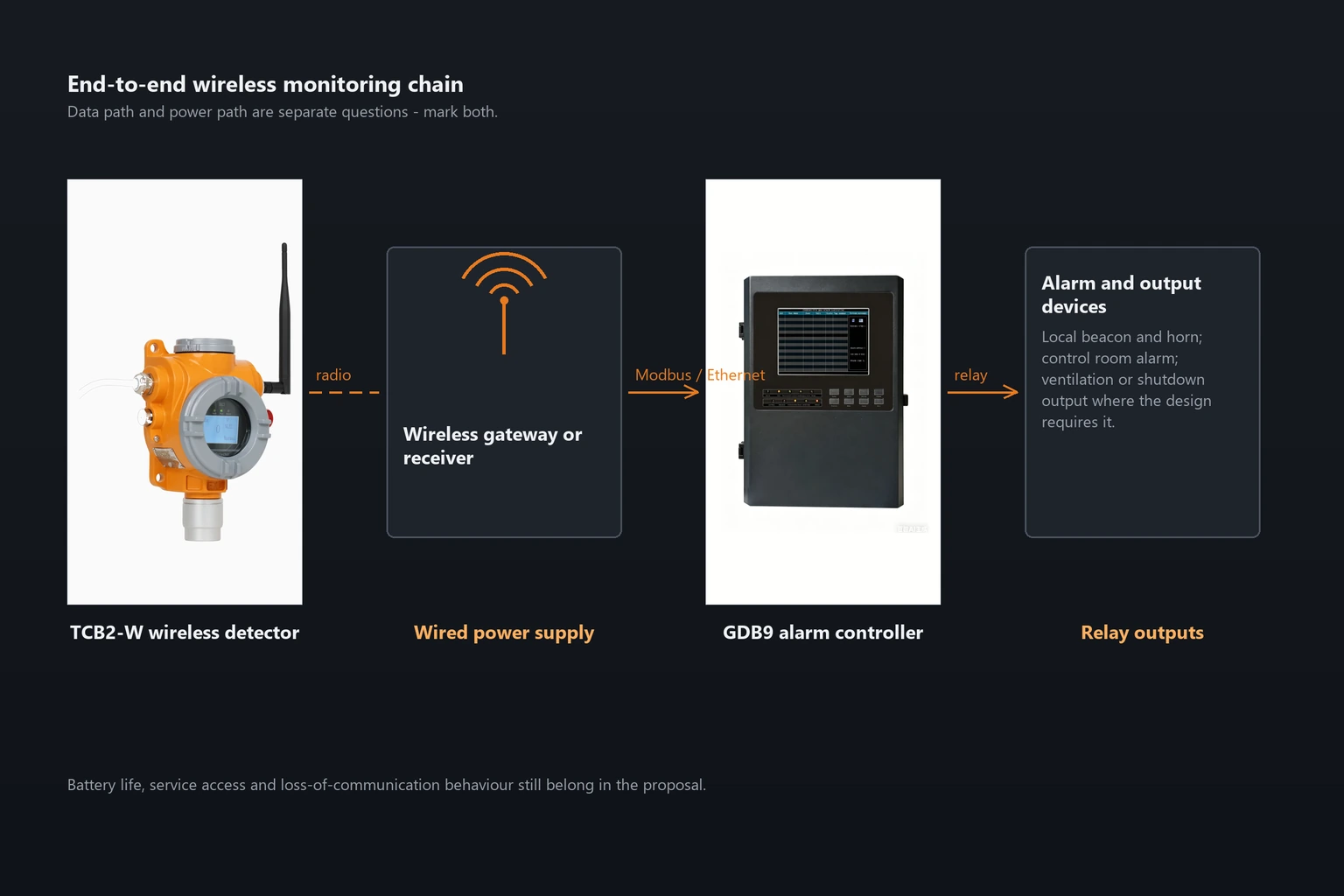
Ask the supplier to draw both the data connections and the power connections. They are not necessarily the same route. A transmitter may send readings by radio while receiving power through a cable. A battery-powered detector may report to a gateway that still requires a wired supply.
Separate three questions in the proposal: how readings reach the receiver, how alarms reach the people or equipment that must respond, and how technicians access the device for maintenance. A service connection does not, それ自体で, establish the operating alarm path.
Request an end-to-end diagram. It should identify the detector, receiver or gateway, controller, alarm devices and every required power source. Mark optional components separately from those needed for the proposed system to work.
Match the System to Your Industrial Site
Start with the gas sources and work activities, not the building name. Two laboratories can require different sensors. Two wastewater areas can have different exposure and installation conditions. The following table identifies questions to resolve before requesting a model recommendation.
| Work area | Monitoring question | Wireless planning question |
|---|---|---|
| ボイラー室 | Which fuel and combustion-related hazards does the assessment identify? | Can the proposed radio route work around the installed equipment, and where will the alarm be received? |
| 研究室 | Which cylinders, gases and processes need monitoring in each room? | How will partitioned rooms connect, and who receives alarms outside working hours? |
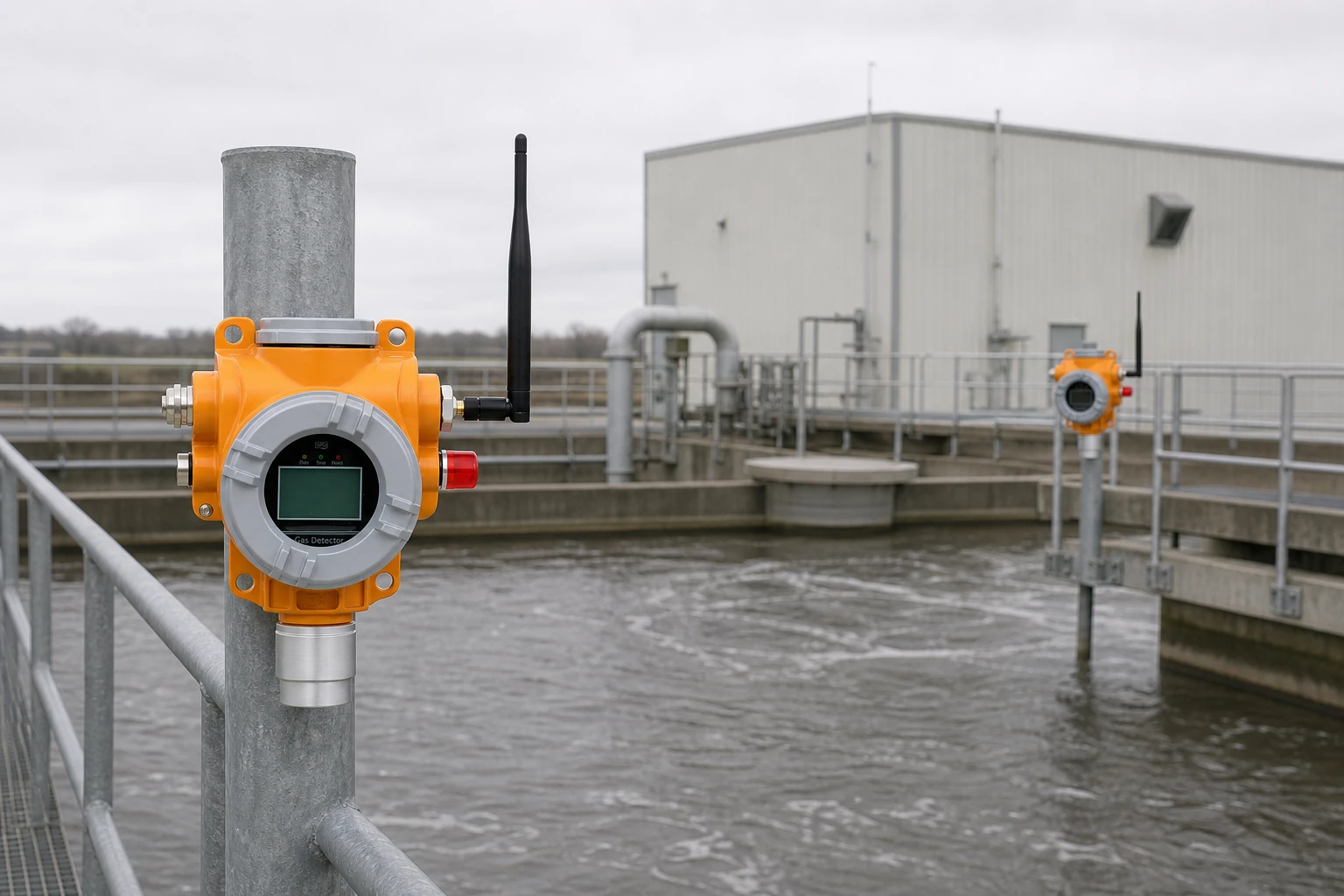
| 廃水処理場 | Which locations require assessment for H2S, combustible gas or oxygen deficiency? | What are the moisture, 腐食, enclosure and communication requirements at each point? |
| 化学工場 | Which substances, sensor limitations and hazardous-area requirements apply? | Can the proposed equipment and network integrate with the approved site architecture? |
| 地下共同通路 | Which services or potential gas-entry sources create the monitoring need? | How will bends, compartments and the route to the control room be surveyed? |
| 窒素発生室 | Does the assessment call for oxygen-deficiency monitoring? | How will the detector, local indication and receiving system be powered and maintained? |
For wastewater tasks, do not use odor as evidence that an area is safe. の NIOSH hydrogen sulfide entry warns that smell rapidly becomes unreliable during continuing exposure. A monitoring proposal needs a measurement task, not a promise to detect a noticeable smell.
In a nitrogen generator room, specify what the instrument actually measures. An oxygen monitor measures oxygen; it should not be described as a direct nitrogen leak locator. Keep that distinction in the equipment list and operator instructions.
For an underground corridor, do not transfer a quoted open-area transmission distance into the design. Ask for evidence from the intended route. Gas detection coverage and radio coverage are separate questions, and both need to be addressed.
Seven Checks Before You Specify a Wireless Gas Detector
1. Confirm the Gas, Range and Sensor Configuration
Put the target gas and required measurement range on the enquiry. Ask the supplier to identify the sensor configuration, relevant interference limitations and operating conditions. A list of gases available across a product family does not mean one ordered unit measures all of them.
Specify the unit alongside the range. Toxic-gas concentration in ppm, oxygen concentration in percent by volume and combustible-gas readings in percent LEL are not interchangeable specifications. The display, transmitted value and controller label should agree.
2. Identify Every Power Requirement
For a battery-powered wireless gas detector, ask what conditions support the quoted battery life. The selected sensor, reporting settings, operating environment and alarm use should be addressed in the manufacturer’s estimate, rather than hidden behind a single headline number.
Also ask how low-battery status is reported, who replaces the battery and what procedure applies at the installed location. For externally powered equipment, include the supply and its failure behavior in the system design.
3. Survey the Actual Communication Route
Provide a layout showing the proposed points, major structures and receiving equipment. Ask the supplier to define the survey method and acceptance criteria before installation. Record any required repeaters or antenna arrangements in the quotation.
4. Check Protocol and Gateway Compatibility
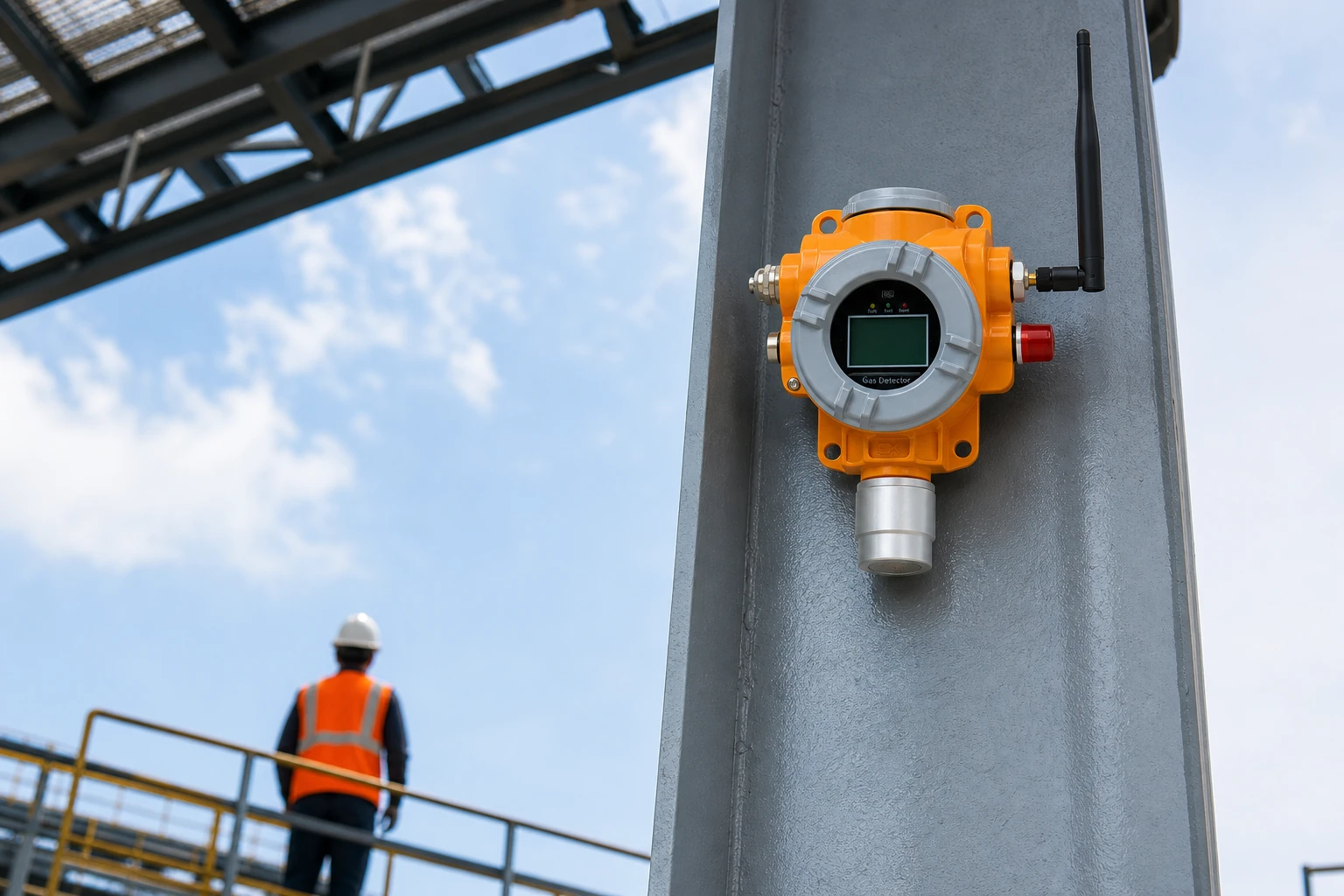
“Wireless” is not a compatibility specification. Request the exact communication option and matching receiver or gateway. Where an existing controller is involved, obtain written confirmation of the supported connection and data mapping.
Check more than the gas value. Identify how the receiving system handles measurement units, device identity, アラーム, sensor faults, communication faults and maintenance status. If these are separate signals or registers, they should appear in the integration documents.
5. Review Alarms and Loss-of-Communication Behavior
Ask what happens if a reading is no longer being updated. Does the receiving system identify stale data? How is a lost connection indicated, and what does the local detector continue to do? These are acceptance-test questions, not assumptions to leave until commissioning.
Keep notification and protective action separate. An email or phone message is not evidence of an approved shutdown function. Any required interlock needs review of the complete equipment chain, its documented capabilities and the site’s response requirements.
6. Verify Environmental and Certification Documents
Match the exact ordered version to the installation conditions. Request the applicable environmental ratings and, where required, hazardous-area certificates with their scope and conditions. Do not treat an enclosure’s water-resistance rating as explosion-protection approval.
A certification logo on a family brochure is not enough to settle the choice. Check the model, センサー, accessories and regional applicability against the project specification.
7. Plan Maintenance Access Before Installation
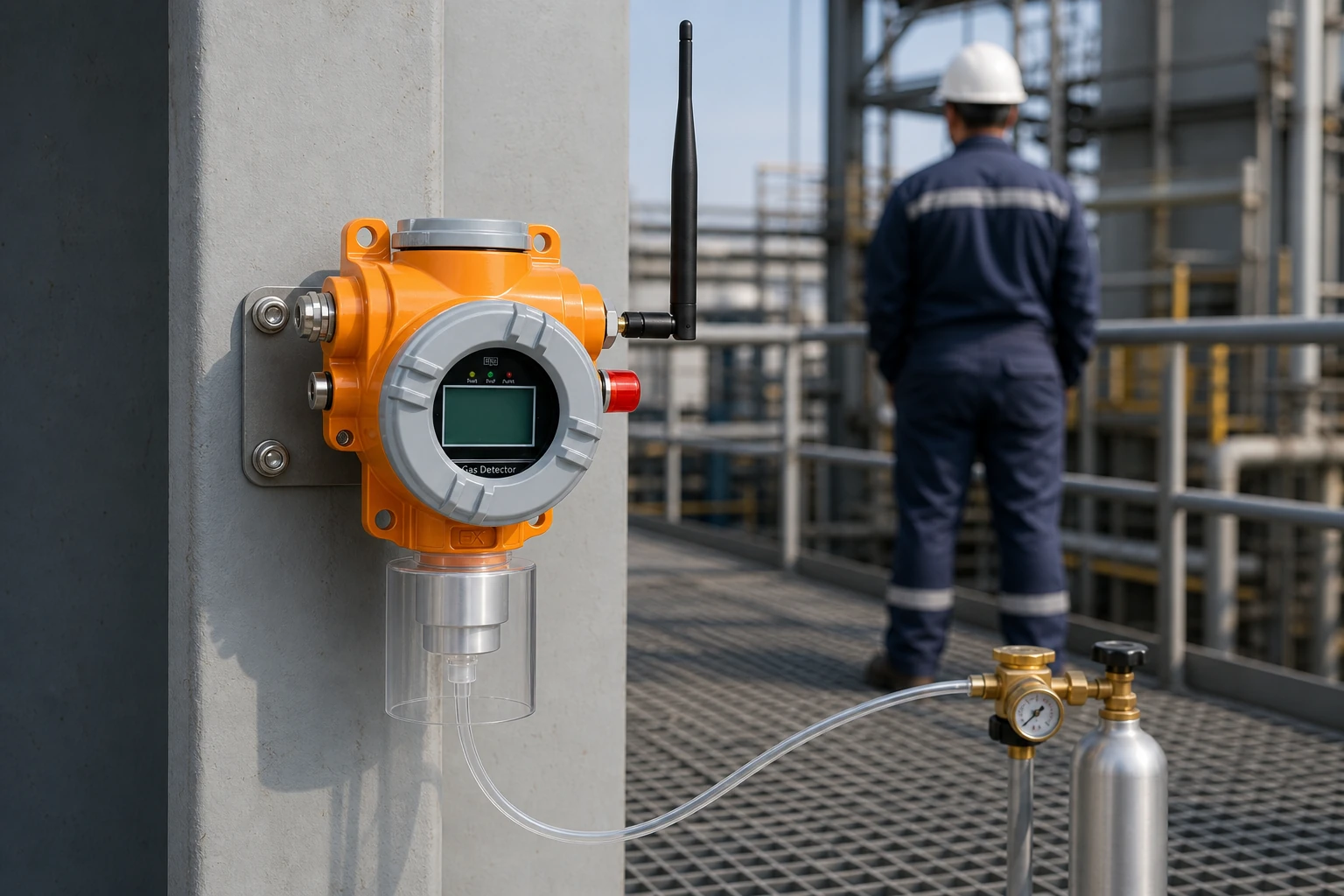
Confirm how technicians will test the sensor, apply calibration gas where required, replace consumables and record work. Radio communication does not remove sensor-maintenance requirements. A location that is difficult to reach can remain expensive to maintain even when signal cabling is avoided.
| Procurement item | 要求する証拠 | Do not accept as a substitute |
|---|---|---|
| Gas measurement | Ordered sensor, 範囲, units and relevant limitations | A product-family gas list |
| Wireless connection | Site survey and proposed network design | Maximum range without test conditions |
| Power and maintenance | Power schedule, service procedure and stated assumptions | “Cable-free” or “maintenance-free” alone |
| Alarm integration | Interface details and documented alarm/fault behavior | A screenshot showing one live reading |
| Installation suitability | Applicable documents for the exact configuration | Unqualified certification or enclosure claims |
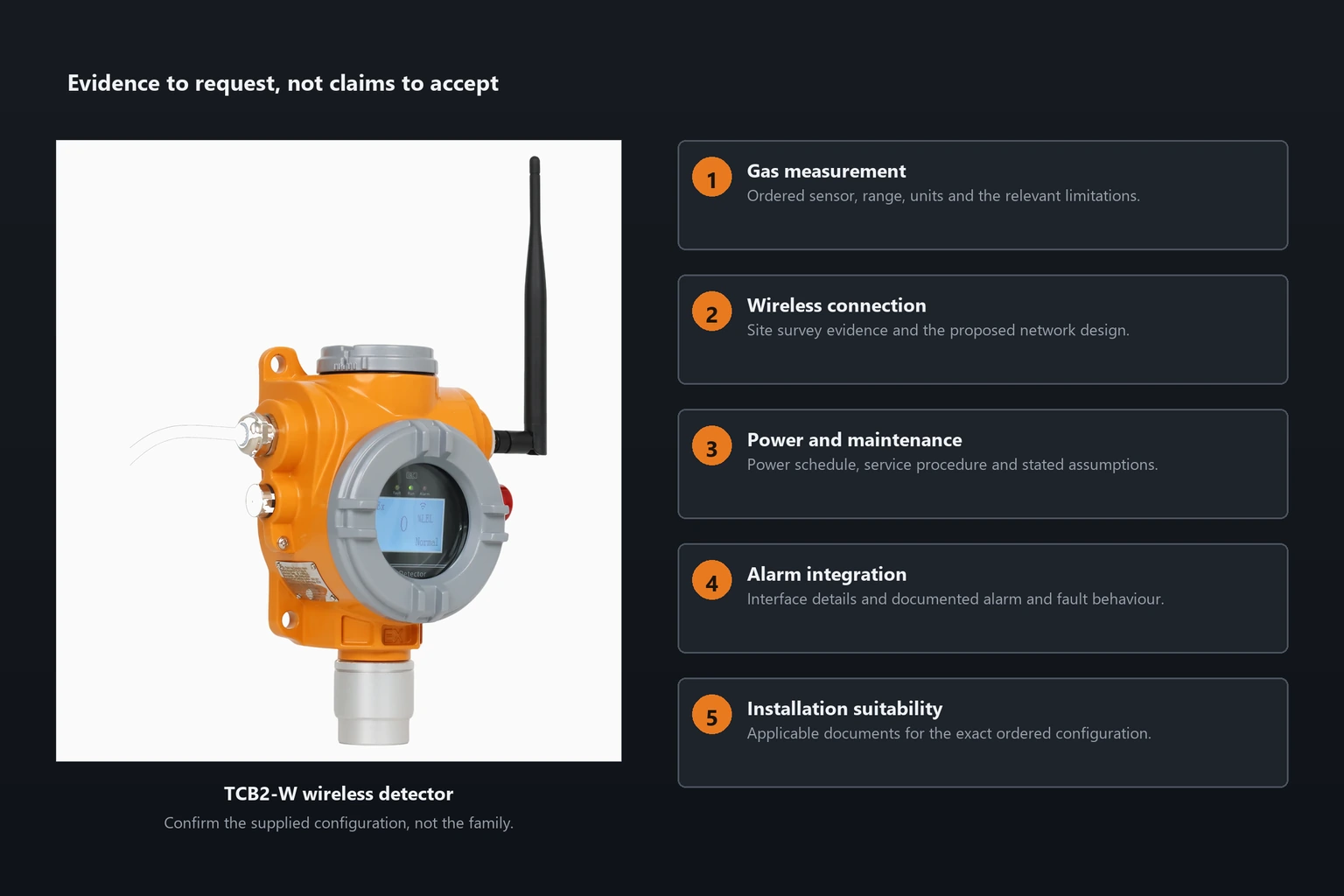
Discuss an Otywell Wireless Monitoring Configuration
Use the TCB2-W product enquiry as a starting point for a configuration discussion. Send the target gas, サイトレイアウト, available power and receiving-system requirements. Confirm the current specification and included components before selecting a unit.
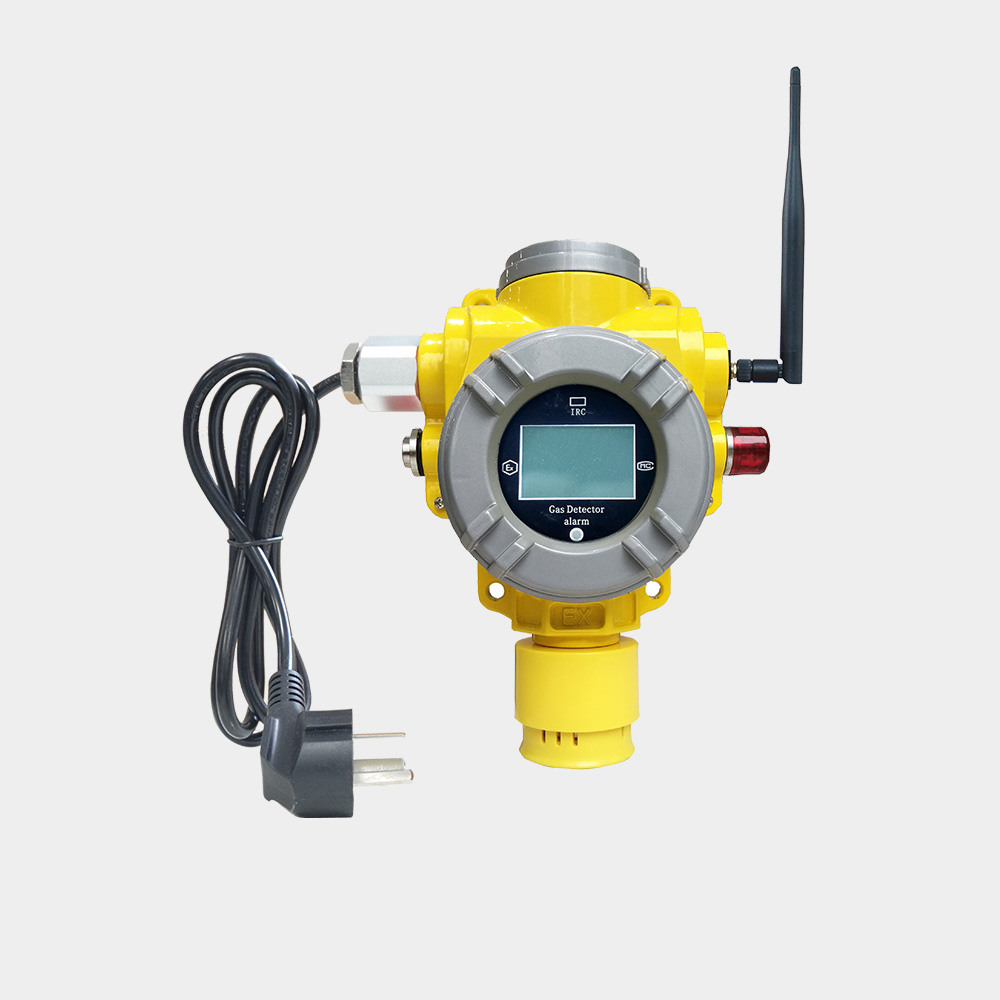
Wireless monitoring enquiry
TCB2-Wワイヤレスガス検出アラーム
Discuss the gas configuration, power arrangement, 互換性のある受信機器とプロジェクトに必要なアラーム出力.
有線またはハイブリッド監視の方が適している場合
使用可能なインフラストラクチャがすでに存在する場合は、有線の代替手段を含める. 拡張に必要な作業と、無線増設に必要な機器およびメンテナンスを比較してください。. 信号ケーブルの取り外しは計算の一部にすぎません.
混合配置も検討する価値があるかもしれません: 既存の有線ポイントはサービスを継続しながら、適切な無線セクションが特定の設置上の制約に対処します. その組み合わせが実現可能かどうかは、インターフェースと承認されたシステム設計によって決まります。, not merely on both products having a gas-detection function.
If the radio survey does not support the intended arrangement, revise the design. Do not move a detector away from its required monitoring location solely to improve reception. Resolve the measurement and communication requirements together with the project engineer.
Compare Lifecycle Costs, Not Just Detector Prices
Ask suppliers to quote the same scope. A detector-only price cannot be compared fairly with a package that includes receiving equipment, commissioning and training. Separate one-time costs from recurring work.
The initial schedule should cover transmitters, gateways, 電力設備, mounting, any required network components and integration. The service schedule should identify batteries where applicable, センサーの交換, testing materials, calibration support and access costs. Include communication or software charges only where the proposed solution actually requires them.
Consider responsibility as well as price. Decide who owns the system records, who responds to a device fault and who supports an interface problem after handover. A clear service scope is more useful than an unsupported percentage saving.
Prepare a Useful Quotation Request
A request for “ten wireless gas detectors” leaves important choices unanswered. Send a short project brief containing:
- The target gases, required ranges and purpose of each monitoring point.
- A site drawing showing proposed locations, structures and the control room.
- Available power and the intended communication route.
- Existing controller or gateway details, including interface requirements.
- Required local indications, remote alarms and fault reporting.
- Environmental conditions and applicable hazardous-area documentation.
- Maintenance arrangements, spare-parts needs and handover requirements.
Ask for a documented configuration, not just a model number. Request a component list, system diagram, compatibility statement and commissioning scope alongside the price. Note anything that still depends on a site survey or technical review.
よくある質問
Does a wireless gas detector still need power wiring?
It can. Wireless data transmission and power supply are separate specifications. Confirm whether the proposed detector uses a battery or external power, then check the gateway and alarm equipment as well.
Does it need an internet connection?
That depends on the architecture. Ask which functions run locally and which depend on an external network or cloud service. リモート アクセスとローカル監視が同一であると仮定するのではなく、接続が失われたときに利用可能なものを文書化します。.
地下での通信範囲の確認方法?
実際のルートに沿った提案された機器の調査と合意されたテストを通じて. 一般的な距離の主張では、敷地の曲がり角付近でのパフォーマンスを確立することはできません, パーティションやその他の障害物.
既存のガス警報器に接続できますか?
互換性が確認されてからのみ. 正確な機器を特定する, 通信オプションとインターフェース. 統合の一環としてアラームと障害の処理を検証する, 濃度値が画面に表示されるかどうかだけではありません.
無線通信によりキャリブレーション要件が不要になるか?
いいえ. 通信はデータがどのように移動するかを説明します. 機器メーカーのテストおよび校正の指示と、選択したセンサー構成に対するサイトのメンテナンス プログラムに従ってください。.

微信
QRコードをWeChatでスキャンします