 Henan Otywell Electronic Technology Co., Ltd

I once took a call from a procurement manager who had just received his third shipment of portable gas detectors in six months — from three different suppliers. The first batch failed an ATEX audit because the marking plate did not match the site zone classification. The second batch had battery life that fell short of the specification sheet by nearly four hours. The third was still on the shelf, unopened, because he was not sure what to check before signing the delivery note.
He had chosen each supplier on price and delivery time. Each time, the unit cost was competitive. Each time, the total cost — downtime, re-order, audit failure, management reporting — was far higher than the saving. After the third round, he asked me: “What should I have checked, before I even looked at the price?”
That question is what this article answers. Not a checklist of obvious items — everyone knows to ask for a certificate. But the things that actually separate a supplier you can build a business on from one that costs you more in the second year than you saved in the first.

What a reliable portable gas detector supplier’s certificate should actually prove
Almost every portable gas detector alarm on the market lists CE and ATEX. The question is not whether the supplier claims certification. It is what the marking plate actually says, and whether it matches your site requirements.
Ask the supplier for a photograph of the marking plate on the unit — not a stock image, a photo of the plate on a production unit. Then check three things:
| What to check on the marking plate | Why it matters |
|---|---|
| Equipment Protection Level — Ga, Gb or Gc | Ga covers Zone 0/1/2. Gb covers Zone 1/2 only. If your site has Zone 0 areas, Gb detectors are not compliant for those entries |
| Gas group — IIA, IIB or IIC | IIC covers hydrogen and acetylene. If hydrogen is on your site gas list, a IIB detector is not certified for those environments |
| Temperature class — T4 or lower | T4 covers almost all industrial gases. If the marking says T3 or higher, check your gas list carefully |
The G60 carries Ex ia IIC T4 Ga. Ga means it is rated for the highest-risk zone. IIC means hydrogen and acetylene are covered. T4 means the surface temperature stays safe for all common industrial gases. A detector with this marking covers every zone on a typical industrial site, which means your supplier can deliver one model for the whole facility rather than a mixed fleet.
Weight — the portable gas detector alarm safety metric nobody talks about
Ask any site safety manager how many portable gas detectors are left on the charging rack at lunchtime, and you will get a number. It is never zero. The detectors that stay behind are consistently the heavy ones. Nobody complains about the weight out loud — they simply do not pick them up after the break.
A portable gas detector alarm that is not on a person is not detecting gas. It does not matter what the certification says if it is sitting in the office. When you evaluate a supplier, look at the weight of the unit they are proposing, and ask yourself whether a worker on a 12-hour shift in coveralls, with a tool belt and a radio, will notice 250 grams clipped to their waist. If the answer is yes, half your fleet will be on the charging rack by the second month.
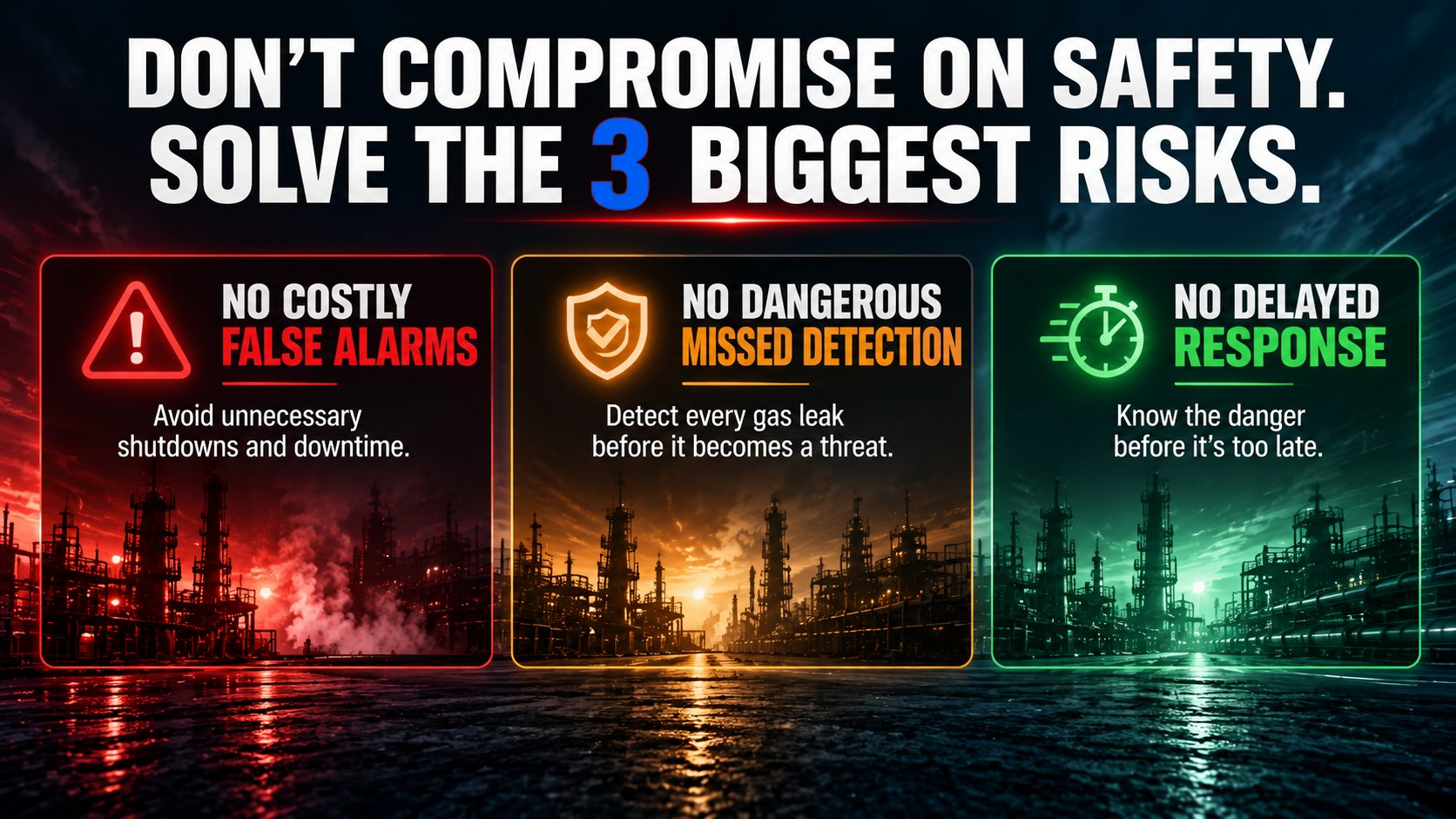
The G60 weighs 130 grams. It clips onto a belt or harness and stays there. At that weight there is nothing to notice, which means the detection coverage on your site register is the same as the detection coverage on the plant floor.
Battery life — when a portable gas detector alarm dies before the shift ends
A specification sheet that says “20 hours battery life” tells you very little. The question is: 20 hours under what conditions? Standby with no alarms, or continuous operation with the pump, screen backlight and wireless module active? And how much of that 20 hours is the last 20%, when the low-battery indicator is flashing and the worker is trying to finish the job before it dies?
Ask the supplier for three numbers:
| Ask for | Why |
|---|---|
| Continuous runtime in alarm state | A detector that runs 20 hours in standby may run 8 hours with the alarm sounding periodically. Know both numbers |
| Charge time — 0% to 100% | A detector that takes 6 hours to charge needs overnight turnaround. A shorter charge time means the same unit can serve two shifts with a mid-day top-up |
| Battery type and replacement procedure | Lithium-ion rechargeable with a magnetic USB interface means no enclosure to open, no seal to damage |
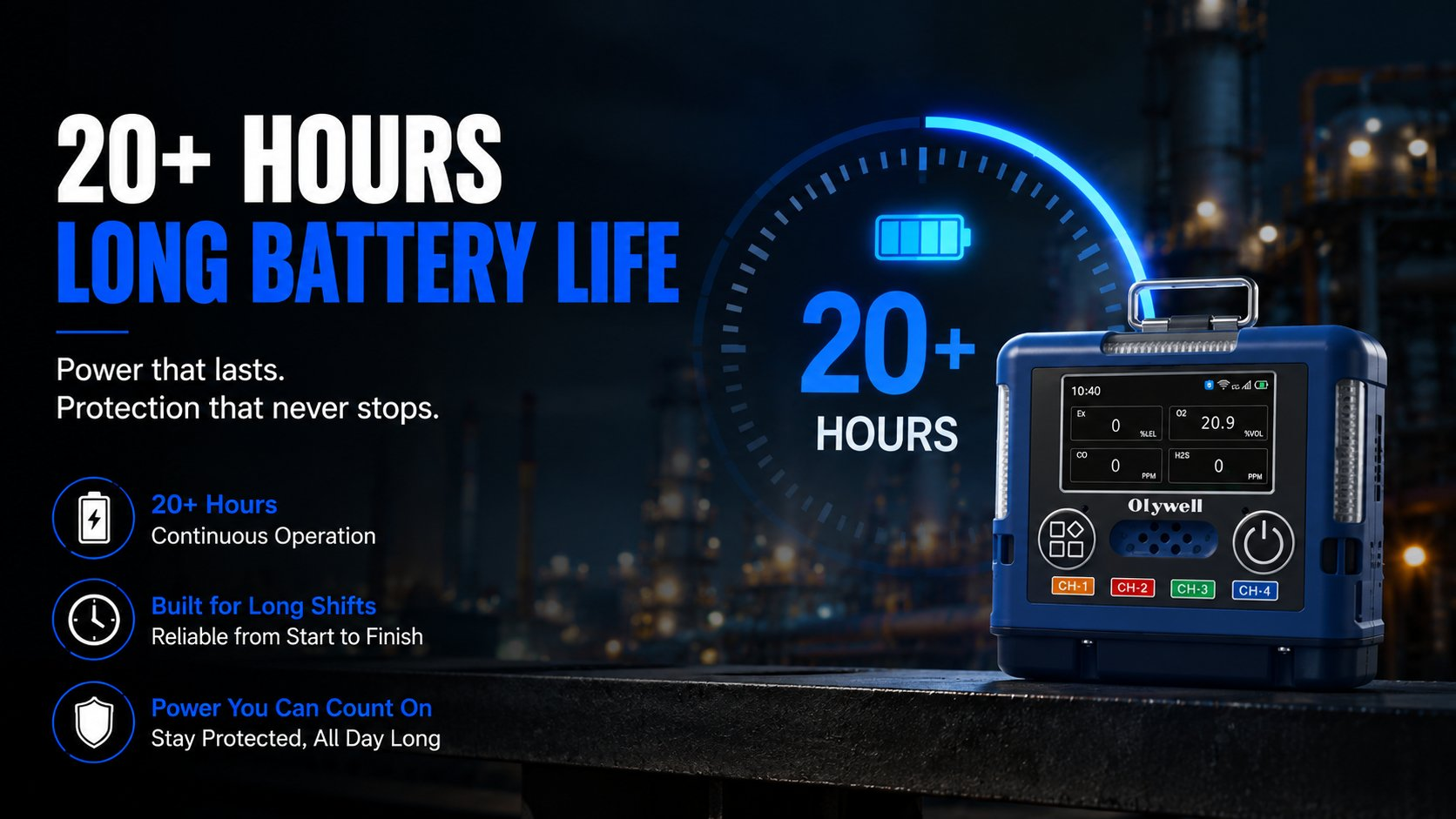
The G60 runs 20 hours continuously in non-alarm standby, charges in under six hours via a magnetic USB port, and does not require the enclosure to be opened for routine charging. The enclosure stays sealed, which keeps the ATEX certification status intact without a service event every time the battery runs down.
Factory audit — how to verify a portable gas detector supplier before you order
A supplier’s website can say “ISO 9001 certified factory” and “in-house R&D team.” It can show photographs of a production line. It can list impressive client logos. None of that proves the factory can produce your order to specification on schedule.
The most reliable verification is a factory audit — either by your own team, by a third-party inspection service, or by reviewing a recent audit report from a recognised body. If you cannot visit in person, ask for a video walkthrough of the production line showing the calibration station, the ageing test rack, and the outgoing inspection area. A supplier who refuses this request is not hiding anything — but a supplier who provides it, without hesitation, is demonstrating something about their production control that a brochure cannot.
Otywell operates a 41,000-square-metre factory in Zhengzhou with SGS-audited ISO 9001 certification. The production line includes a sensor ageing and screening process before assembly and a full functional test — bump test on certified gas — on every unit before packaging. The annual production capacity is 14.9 million gas detectors.
Warranty and after-sales — what happens to your portable gas detector alarm in month 13
A two-year warranty is standard. What matters is what happens when a detector fails in month 13 — one month after the warranty expires. Some suppliers treat the warranty expiry date as the end of the relationship. Others treat it as the start of the maintenance cycle.
Ask the supplier three questions about after-sales:
| Question | What a good answer sounds like |
|---|---|
| What is the sensor replacement cost and lead time? | A fixed price list, not “depends on quantity.” Sensor modules in stock, not built to order. Typical lead time under two weeks |
| Can a field technician perform a sensor swap, or must the unit be returned? | Replaceable sensor module — the technician swaps the module, runs a bump test and a calibration, and the unit is back in service. No return-to-factory required |
| How do I reach technical support when my site is in a different time zone? | Multiple channels — email, WhatsApp, phone — with response times quoted in hours, not days. Someone who understands the product, not a call centre script |
The G60 uses a field-replaceable sensor module. A trained technician can swap a sensor, run a bump test and a calibration, and return the unit to service without shipping it anywhere. On a site where every detector is a compliance item, the ability to service in place rather than return-to-factory is the difference between one shift of downtime and two weeks of downtime.
Lead time — the portable gas detector supplier metric that costs more than unit price
I have seen projects delayed by three weeks because a supplier quoted a 10-day lead time on the first order and a 30-day lead time on the re-order. The re-order is the one that matters. The first order gets a dedicated production slot because the supplier wants to win the account. The re-order goes into the queue, and the queue is the real measure of production capacity.
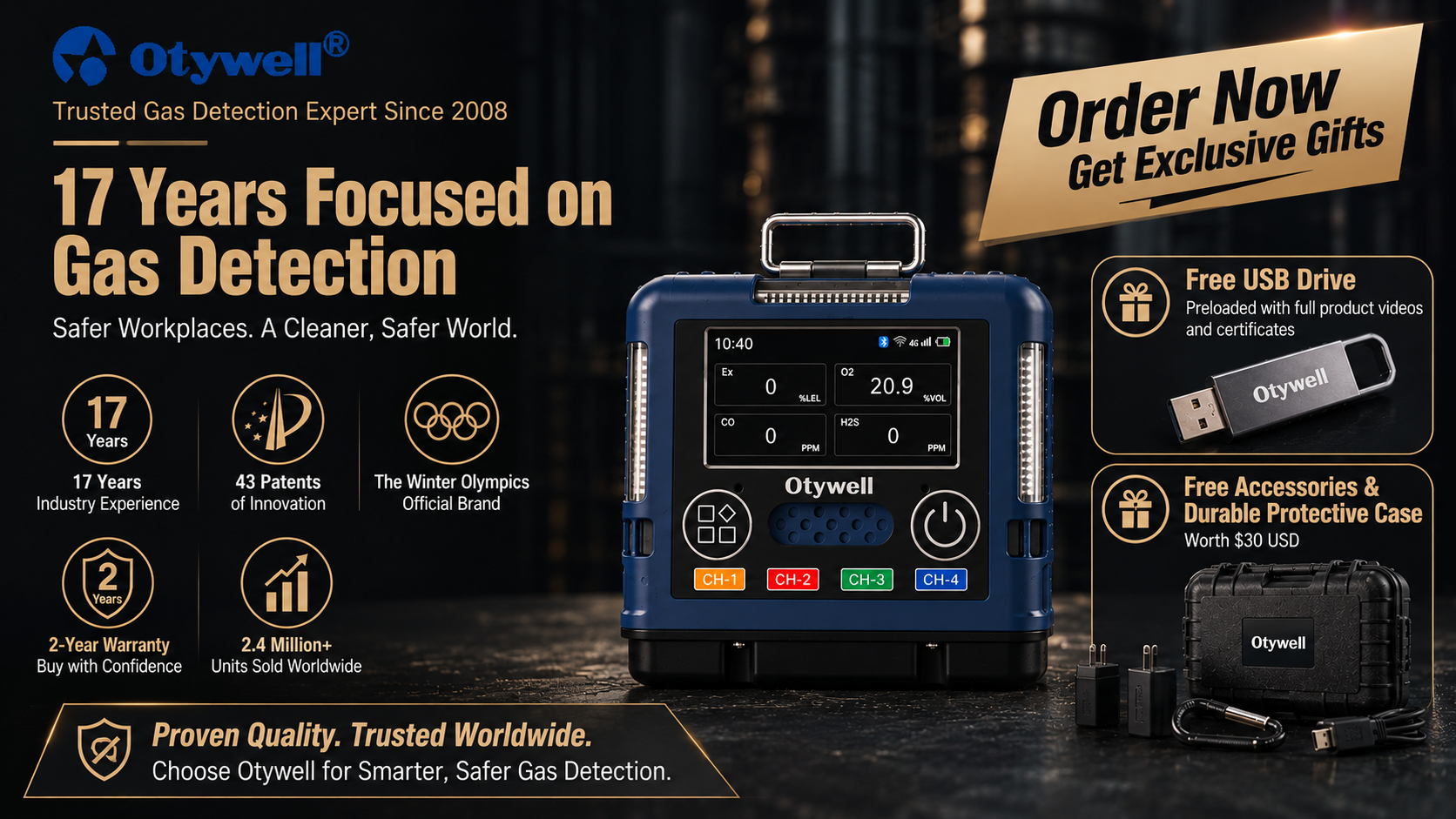
Ask for the re-order lead time. If the supplier cannot quote it — if the answer is “it depends on current production load” — then plan your inventory around the worst case, not the first-order promise. Otywell ships from stock on standard G60 configurations and maintains production capacity that supports a typical re-order lead time of 7–15 days depending on volume.
OEM customisation — what a portable gas detector supplier actually means by “we can do your logo”
Many suppliers offer logo customisation. Fewer offer sensor configuration customisation — changing the default gas combination, adjusting alarm setpoints to match your site risk assessment, pre-configuring the data logging settings before shipment. A supplier who can deliver detectors that are ready to issue on arrival, with no setup required, saves your technical team hours of work per batch.
Otywell supports full OEM customisation on the G60 — logo, packaging, sensor configuration, alarm setpoints, and data logging parameters — applied during production, not as a post-delivery service. The units arrive configured to your specification.
G60 portable gas detector alarm — how it benchmarks against the selection criteria
| Criterion | What to look for | G60 |
|---|---|---|
| ATEX certification depth | Ga EPL, IIC gas group, T4 temperature class | Ex ia IIC T4 Ga — Zone 0/1/2, hydrogen rated |
| Weight | Under 200g — light enough for a full shift | 130g |
| Battery life | 20 hours minimum in standby | 20 hours continuous, magnetic USB charging |
| Ingress protection | IP66 minimum for industrial washdown | IP66 |
| Alarm channels | Sound, light and vibration — all three | Three-channel: 85dB+ sound, high-brightness LED, vibration motor |
| Sensor replaceability | Field-replaceable module, no return-to-factory | Field-replaceable sensor module |
| Data storage | Sufficient for audit trail | 300,000 records, magnetic USB data upload |
One decision that pays back across the fleet
Choosing a portable gas detector supplier is not about finding the lowest unit price. The unit price is visible on the quotation. What is invisible — and what you pay for over the next two years — is the cost of the detectors left on the charging rack, the cost of the batch that failed the audit, the cost of the sensor replacement that required a return-to-factory, and the cost of the re-order that arrived three weeks late.
If you are evaluating suppliers and want to benchmark the G60 against your current fleet — weight, battery runtime, certification coverage, total cost of ownership over two years — send us your detector specification sheet and your site zone classification. We will run the comparison and send it back. It takes a few minutes, and it costs nothing.

WeChat
Scan the QR Code with wechat