 Henan Otywell Electronic Technology Co., Limitado

La selección del detector de llama se reduce a cuatro variables: el tipo de fuego, la interferencia ambiental en la zona, la cobertura requerida, y el índice de explosión que exige la ubicación. Trabaje con esos cuatro y la tecnología de sensores se seleccionará sola.. Esta guía hace exactamente eso., en el orden que necesita un proyecto real.
ultravioleta. Y. UV/IR. IR3. Cuatro familias de sensores, un trabajo, y las diferencias entre ellos importan más de lo que admiten la mayoría de las hojas de especificaciones.
La guía cubre cómo funcionan los detectores de llamas., compara las cuatro tecnologías de sensores, aborda el problema de las falsas alarmas de frente, y camina a través del montaje, cobertura, y certificación. Cada sección termina donde comienza la siguiente decisión de compra..
Qué hace un detector de llamas
Cómo detectan los detectores de llamas el fuego
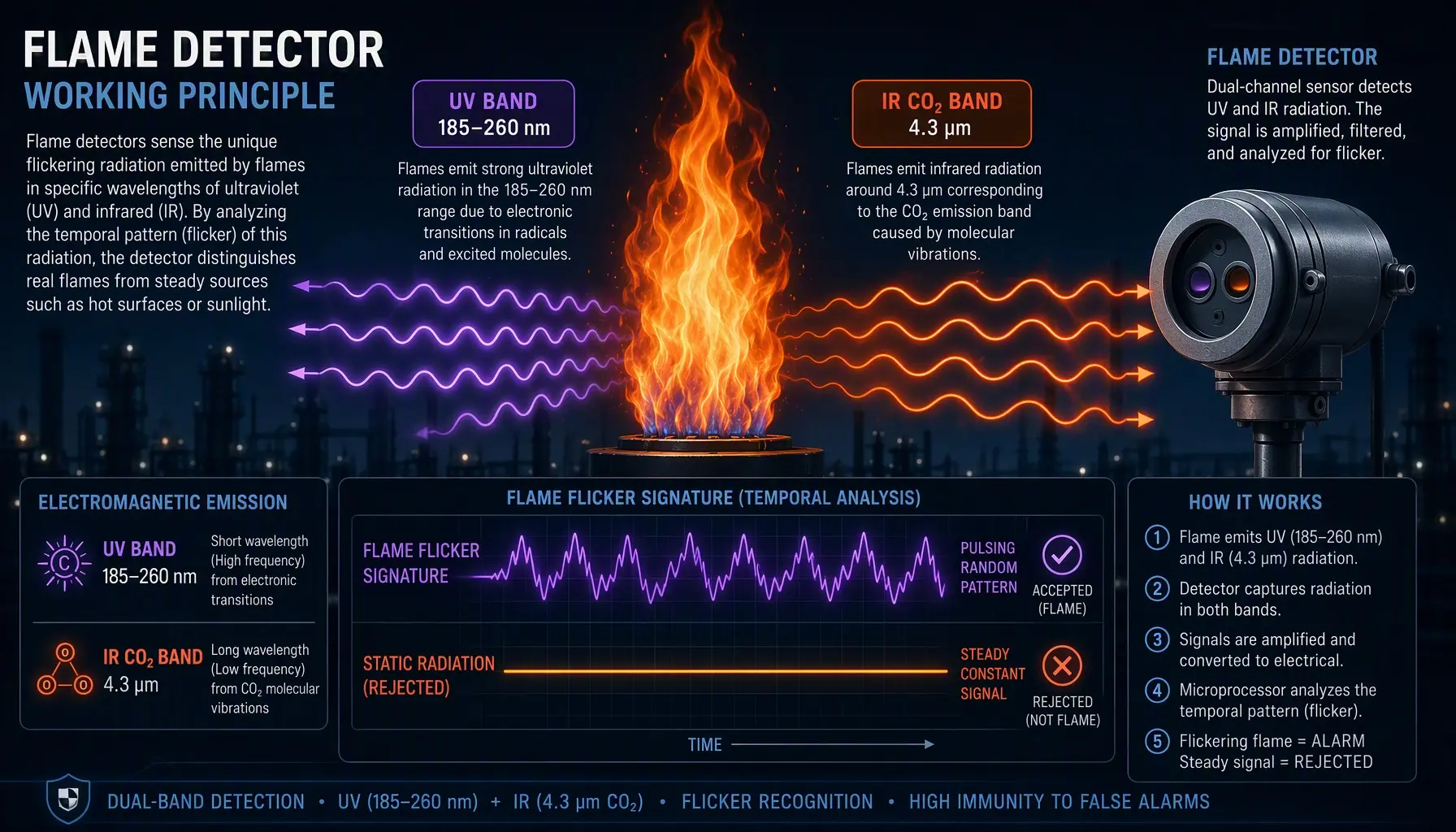
Un detector de llamas observa la firma electromagnética de un incendio. Las llamas se emiten en bandas características., ultravioleta alrededor 185 a 260 nm e infrarrojos en el 4.3 µm banda de emisión de dióxido de carbono, y un detector sintonizado con esas bandas señala un incendio creciente en segundos, mucho antes de que respondiera un dispositivo térmico o un detector de humo.
El núcleo de la física es el parpadeo.. Una llama real pulsa a una frecuencia característica., y los detectores modernos utilizan esa señal de parpadeo para separar el fuego de fuentes infrarrojas constantes, como calentadores y tuberías calientes.. Radiación estática, no importa lo brillante, no pasa la prueba de parpadeo.
Detectores de llama versus detectores de humo
Los detectores de humo protegen a las personas. Los detectores de llama protegen activos y procesos. Un detector de humo necesita productos de combustión para llegar hasta él., lo cual lleva tiempo y requiere que el humo viaje. Un detector de llamas detecta el incendio en su origen, a través de un área abierta, y sigue trabajando al aire libre y en espacios con alto flujo de aire donde el humo nunca se acumula.
Los dos se complementan. La detección de llamas cubre el área de proceso; La detección de humo cubre la envolvente del edificio.. Una instalación que ejecuta procesos peligrosos normalmente necesita ambos, y los documentos de diseño deben decir qué zona posee cada dispositivo.
Comparación de cuatro tecnologías de sensores
ultravioleta (Ultravioleta)
Los sensores UV vigilan la 185 a 260 banda nm, que la luz del sol apenas llega, por lo que las unidades UV son inherentemente resistentes a las falsas alarmas solares. La respuesta es rápida. La debilidad es que los rayos UV son absorbidos por el humo., niebla, y niebla de aceite, y la soldadura por arco es una fuente clásica de molestias. Un detector UV montado en una zona de soldadura es un detector que no se queda quieto.
Y (Infrarrojo)
Los sensores IR funcionan en infrarrojos., típicamente alrededor del 4.3 Banda de µm donde el dióxido de carbono procedente de la combustión se emite con fuerza. Ven a través del humo y una neblina que ciega los rayos UV., y toleran mejor la óptica sucia. El fracaso clásico es el propio sol., que irradia fuertemente en el infrarrojo; Las unidades solo IR dependen de la lógica de discriminación para evitar disparos molestos por el sol.
Combinación UV/IR
Un detector de llama UV IR requiere ambas señales antes de generar alarma, que suprime la mayoría de las falsas alarmas de fuente única. Un arco de soldadura o una superficie caliente por sí solo produce una sola señal y se ignora. La compensación es un requisito de línea de visión hacia ambas firmas y una respuesta ligeramente reducida ante algunos escenarios de incendio.. El GSS800B es la unidad de doble espectro UV/IR de Otywell: 6-segunda respuesta, ángulo de visión hasta 120 grados, ignífugo Ex d IIC T6 Gb con protección IP66, Salida RS485, Suministro de 24 VCC, montaje en pared o techo, alrededor de un kilogramo. Es la recomendación estándar para áreas de proceso cubiertas donde la soldadura está controlada y la interferencia solar es real..
IR3 multiespectro
Las unidades IR3 utilizan tres canales infrarrojos y comparan proporciones y patrones de parpadeo en los tres., lo que proporciona el rechazo más fuerte de la interferencia solar y de fuentes de calor manteniendo la sensibilidad a las llamas reales.. Son la opción predeterminada para áreas exteriores de alto riesgo, como parques de tanques., bastidores de carga, y almacenamiento de GLP. El S600-ExIR3 es la unidad antideflagrante de triple IR de la gama, con canales de detección en 4.4, 5.0, y 3.8 µm, una respuesta de 6 segundos, un ángulo de visión de hasta 110 grados, Ex y IIC T6 Gb e IP66, RS485 más salida de relé, e instalación en pared o techo.
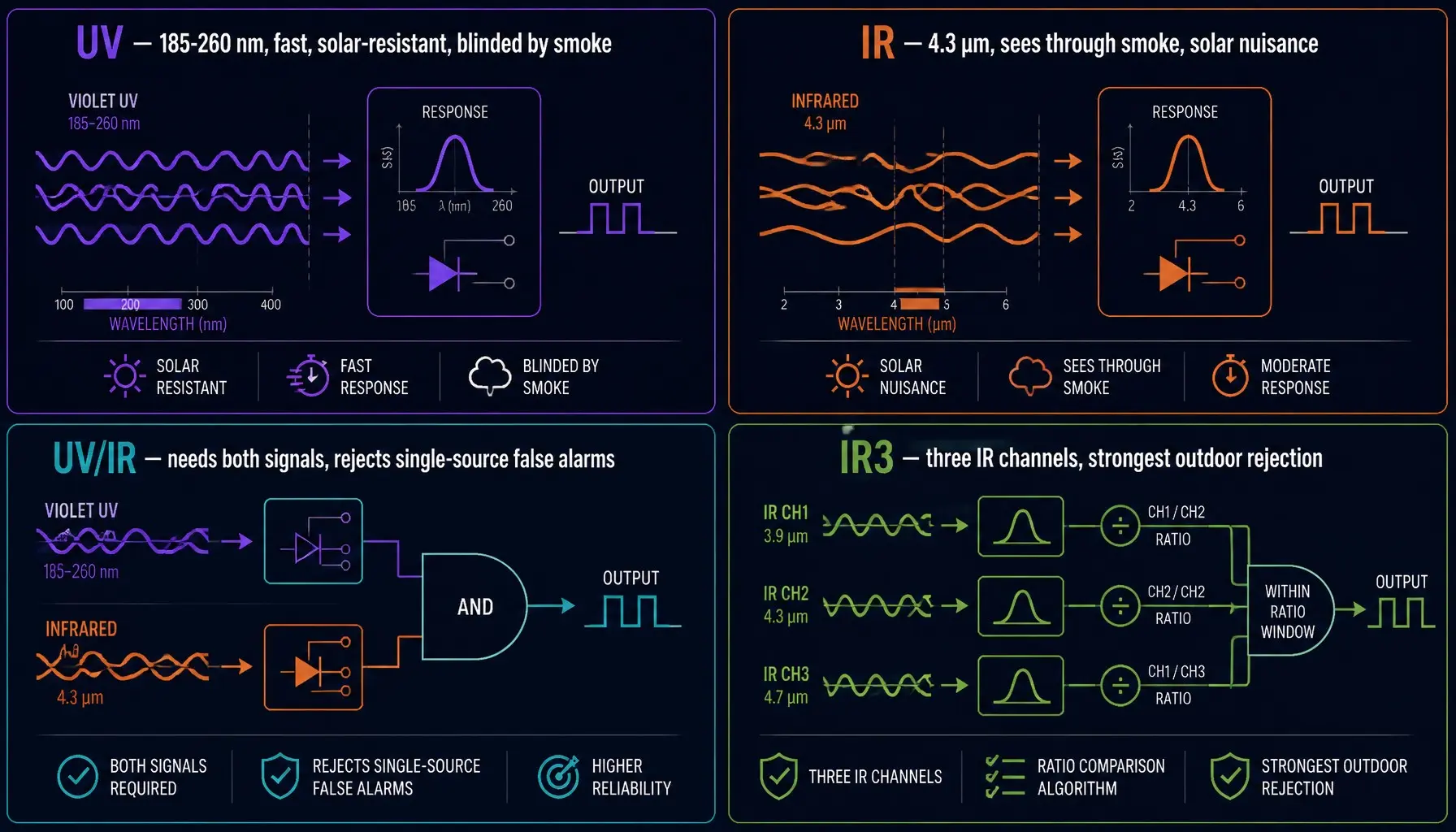
| Tecnología | Banda de detección | Fuerza típica | Debilidad típica | Uso típico |
|---|---|---|---|---|
| ultravioleta | 185–260 nm | Rápido; resistente al sol | Cegado por el humo/la niebla; los arcos de soldadura lo disparan | Interior, limpio, áreas de respuesta rápida |
| Y | ~4,3 µm | Ve a través del humo; óptica tolerante | Molestia por radiación solar | Interior/exterior con humo o neblina |
| UV/IR | UV e IR, Y lógica | Necesita ambas señales antes de dispararse. | Ruta clara necesaria para ambas firmas. | Salas de proceso cubiertas, salas de compresores |
| IR3 | Tres canales de infrarrojos, proporción y parpadeo | Más resistente contra las molestias del exterior | Más caro por punto | Parques de tanques, bastidores de carga, riesgo expuesto al aire libre |
Falsas alarmas: El costo real de hacer esto mal
¿Qué causa las falsas alarmas?
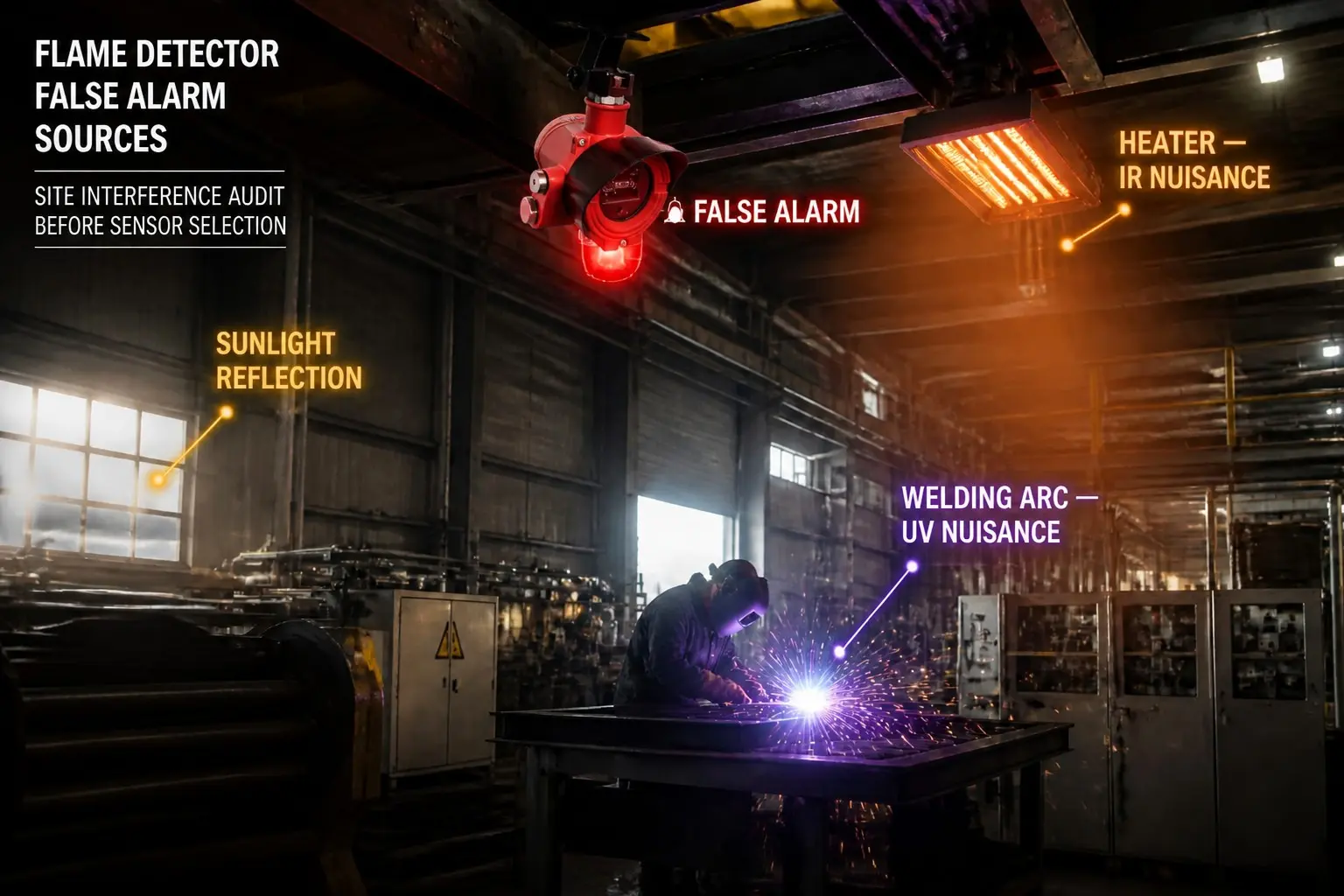
Los arcos de soldadura son la principal fuente de molestias en interiores. En el exterior, la luz del sol se refleja en los equipos en movimiento., y en algunas plantas, una línea de proceso que pasa caliente directamente a través del campo de visión del detector.. Un rayo ha disparado más de un cabezal ultravioleta. Cada tecnología rechaza parte de esta lista y se deja engañar por el resto, por lo que una auditoría de lo que realmente se encuentra en la habitación generalmente decide el sensor antes que cualquier hoja de datos..
Sol. Soldadura. Calentadores. Lo que sea que la habitación arroje a la óptica, selecciona el sensor., y un estudio del sitio resuelve más argumentos que una hoja de especificaciones.
El costo de una falsa alarma
Una falsa alarma en una planta química nunca es sólo un pitido. El sistema de supresión vuelca, o peor, la planta entra en parada de emergencia total, y la producción se detiene mientras un equipo de ingenieros determina si algo realmente se está quemando. Una instalación instaló cabezales solo de infrarrojos en una sala de proceso con dos calentadores superiores dentro del campo de visión.. La primera alarma llegó al cabo de una semana.. El segundo llegó una hora después de la reanudación. Cada evento le costó a la instalación la mayor parte de un día de producción., que es una manera rápida para que un proyecto de detección cuestione su presupuesto por escrito.
La solución tardó dos días.: volver a apuntar las cabezas, cambiar a UV/IR, hecho. El calentador dejó de ser un problema porque UV/IR necesita dos señales y un calentador solo emite una. Nada de esto hace que la IR sea una mala tecnología. Era la habitación equivocada para ello., y una auditoría del sitio cuesta menos que un viaje de supresión.
Montaje y cobertura
Línea de visión y ángulo de visión
La línea de visión es todo el juego.. Un detector de llamas ve lo que ve, y tuberías, faldas de embarcaciones, y el acero estructural come silenciosamente la cobertura que, según la hoja de datos, está ahí. El ángulo de visión corta hacia el otro lado: 90 grados cubre una habitación pequeña, 120 grados cubre uno más grande, y ninguna cifra significa mucho hasta que las matemáticas de cobertura se hagan en tres dimensiones., porque la geometría de la planta se encuentra.
Altura y distancia de montaje
La mayoría de los integradores diseñan en contra NFPA 72, y sus normas sobre colocación, espaciado, y el tiempo de respuesta se traslada a la detección de llamas a pesar de que el código se escribió teniendo en cuenta los dispositivos de humo. La creciente compensación es bastante simple: montaje más alto, cono más ancho, camino más largo hasta el suelo. Y el rango nominal en la hoja de datos supone una ventana limpia, lo cual es una suposición que vale la pena comprobar dos veces.
El tiempo de respuesta se considera una ocurrencia tardía hasta la puesta en servicio, cuando los números se niegan a alinearse. Un detector apuntado a una pared de tuberías no cumplirá el tiempo de detección indicado en la hoja de diseño., y nada de eso mejora al señalarlo con más fuerza.

Planificación del campo de visión
La planificación práctica del campo de visión es un ejercicio de dibujo.: envolvente de peligro en el plan, sombras de obstrucción marcadas, Detectores colocados de manera que cada superficie de alto riesgo sea vista por al menos una cabeza., idealmente dos. La redundancia en la etapa de diseño es casi gratuita. La redundancia después de la puesta en servicio es una llamada de grúa y una ventana de apagado. Y la limpieza de la óptica debe estar en el programa de mantenimiento desde el principio., porque una ventana revestida es un detector que no ve nada.
Clasificaciones y certificaciones a prueba de explosiones
Ex d frente a Ex ia
El hardware del detector de llamas viene en dos tipos de protección. Ex d es ignífugo: El recinto está construido para contener una explosión interna, de modo que nada se propague a la atmósfera exterior.. Ex ia toma el camino opuesto, Limitar la energía en el circuito para que la ignición nunca sea posible en primer lugar.. Ambos estan certificados, ambos trabajan, y el correcto depende de la zona y de cómo esté cableado el sitio.
En la práctica, detectores de llama en Zona 1 Las áreas de proceso terminan siendo a prueba de llamas la mayoría de las veces.. la optica, el sensor, y el calentador en la cabeza consume más energía de la que un circuito intrínsecamente seguro está feliz de suministrar, y la carcasa es lo suficientemente grande para soportar el peso de todos modos.
Leyendo el certificado
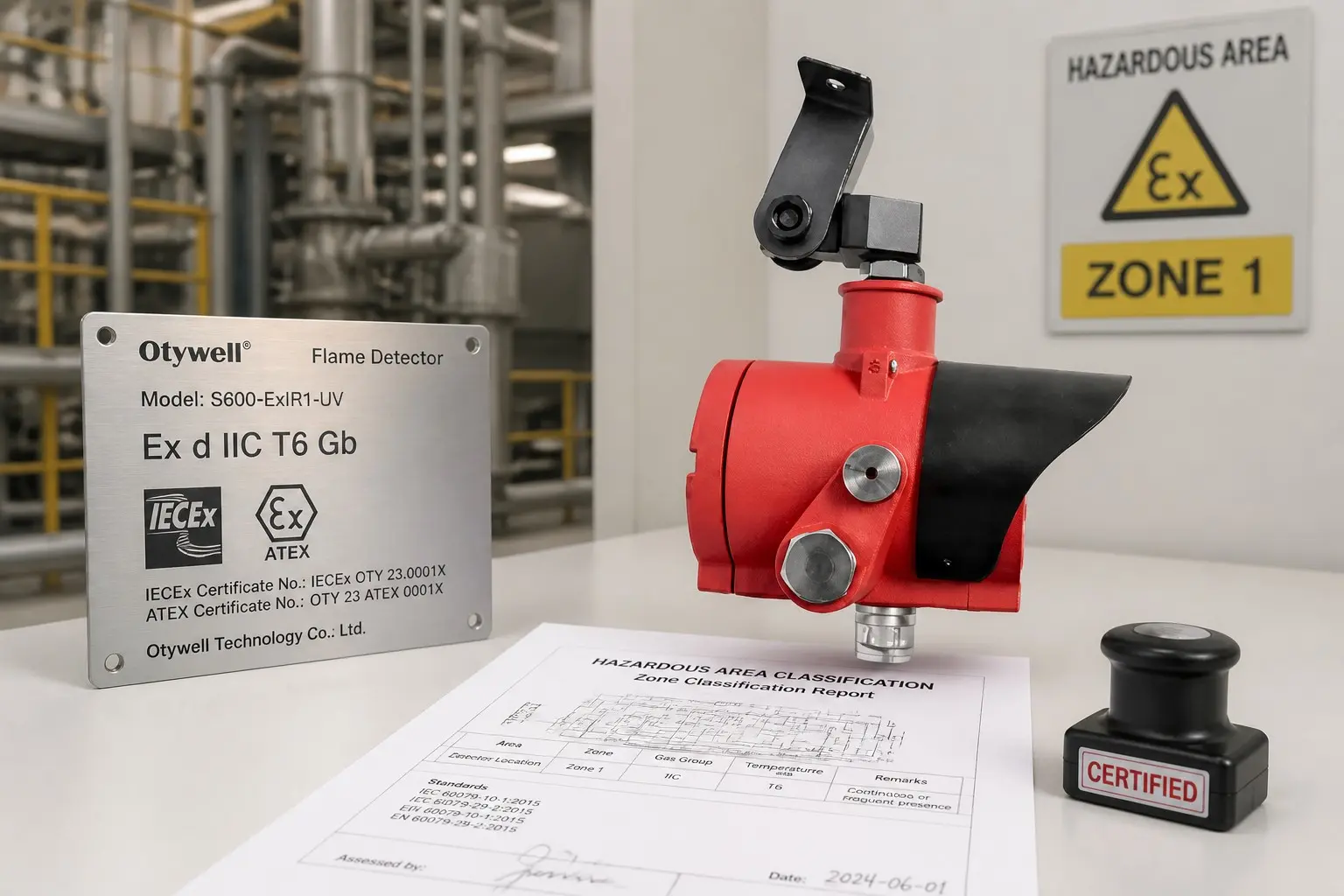
Los certificados son donde reside la verdadera especificación. El documento enumera el grupo de equipos., el grupo de gas o polvo, la clase de temperatura, y las zonas para las que la unidad está realmente aprobada, y cada línea de pedido debe alinearse con la clasificación del sitio. en los estados unidos, OSHA 1910.307 es la referencia para peligros (clasificado) ubicaciones y que “aprobado para la ubicación” medio. Haga coincidir esas líneas de pedido con la zona antes de que se envíe la orden de compra., porque después del parto es demasiado tarde para discutir.
IECEx y aprobaciones internacionales
Internacionalmente, el IECEx El esquema es el que hay que buscar.: Certificación para atmósferas explosivas reconocida a través de fronteras., y cada certificado se encuentra en una base de datos pública en línea donde se puede verificar en aproximadamente un minuto. Para equipos que tienen que moverse entre regiones, La aprobación IECEx o ATEX pasa por los mostradores de aduanas y el cliente HSE revisa que un certificado solo local se estanca en.
Casos especiales: Llamas de hidrógeno y detección basada en imágenes
Detección de llamas invisibles de hidrógeno
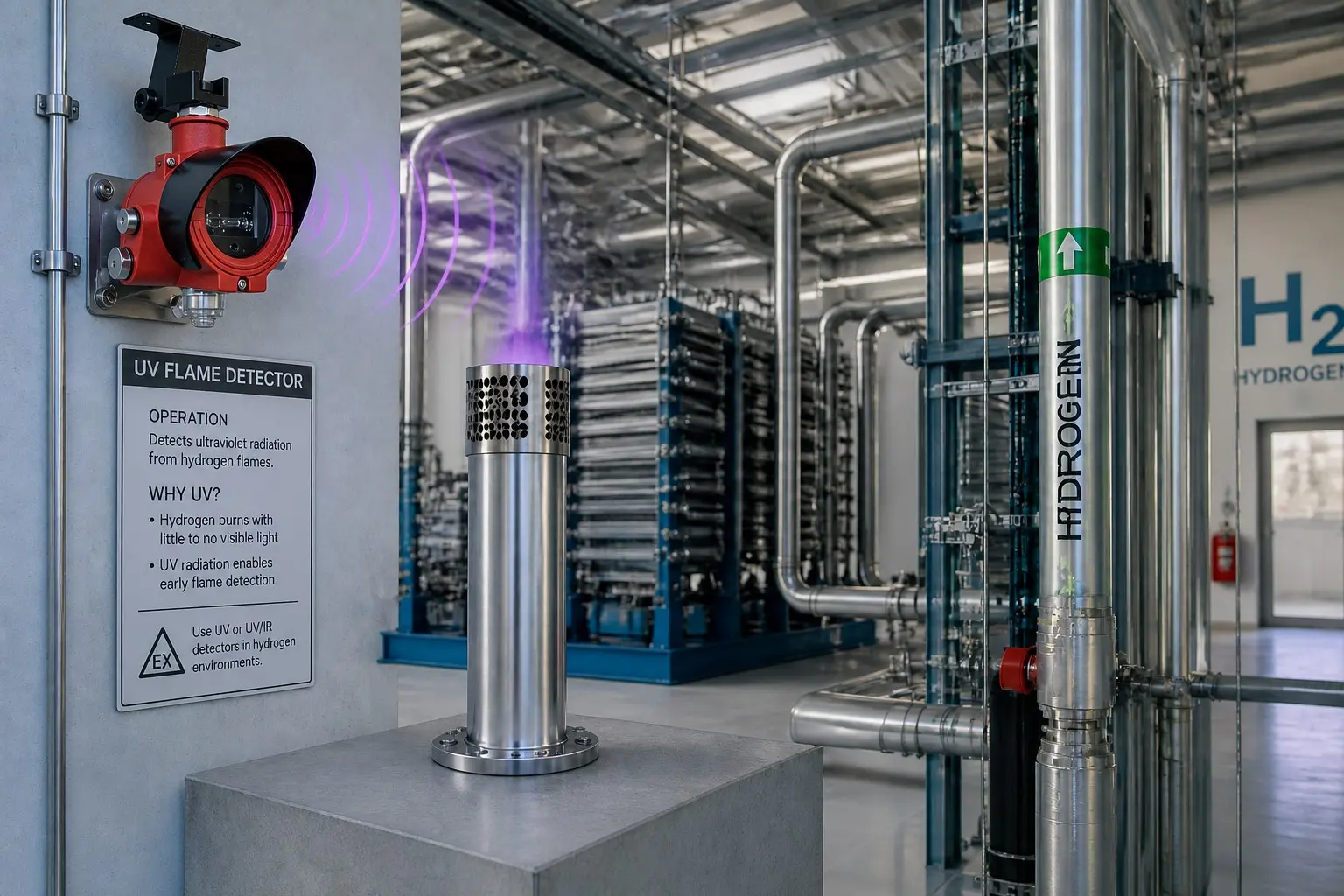
El hidrógeno es el caso especial que mantiene honestos a los ingenieros de detección.. La llama es casi invisible a la luz del día., porque la combustión del hidrógeno emite principalmente en las bandas ultravioleta y en las bandas infrarrojas de vapor de agua.. Los cabezales UV y UV/IR los captan, Por eso son la respuesta estándar para las salas de electrolizadores., estaciones de servicio de hidrógeno, y salas de baterías donde se puede acumular el gas.. Una unidad IR3 convencional vigila la 4.3 banda de dióxido de carbono µm, que el hidrógeno apenas toca, entonces una instalación de hidrógeno que se apoya en IR3 está apostando por una física que no existe.
Detectores de llama basados en imágenes
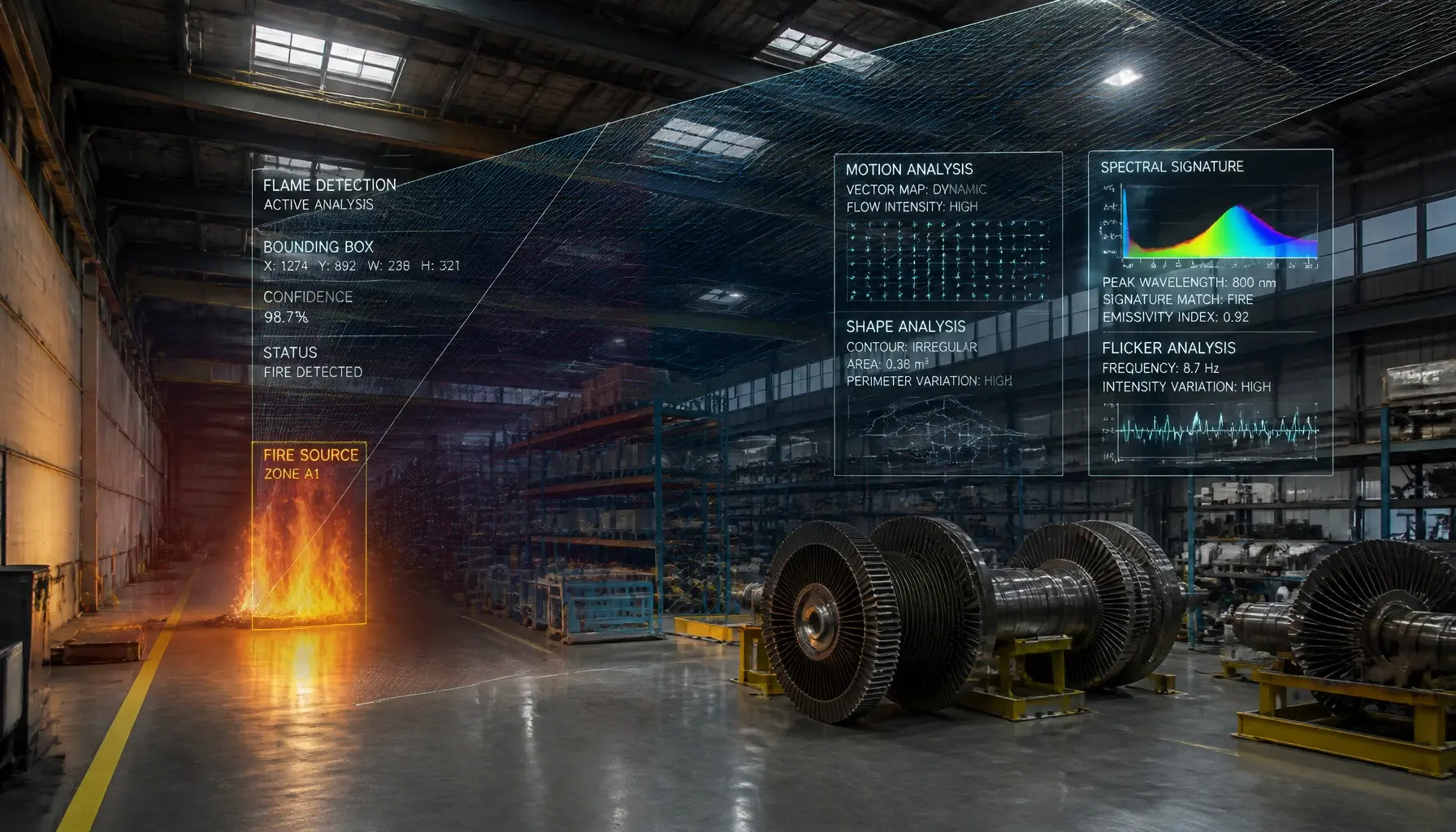
La detección basada en imágenes es el recién llegado que se gana la vida en grandes espacios. Una cámara de luz visible o de infrarrojos ejecuta algoritmos de análisis de llamas en movimiento, forma, parpadeo, y la firma espectral de lo que ve, y en algunos modelos la unidad informa en qué parte del marco se encuentra el fuego.. Una cámara puede sustituir varios detectores puntuales en una gran sala abierta, y las plantas que ya ejecutan videovigilancia obtienen esta capacidad casi gratis. Otywell Detector de llama tipo imagen es la opción de cámara en el rango, dirigido a almacenes, salas de turbinas, y almacenamiento exterior cubierto.
Preguntas frecuentes sobre detectores de llama
¿Cuál es la diferencia entre los rayos UV?, Y, Detectores de llama UV/IR e IR3?
Los detectores UV observan la banda ultravioleta y responden rápidamente, pero pueden quedar cegados por el humo y dispararse al soldar.. Los detectores de infrarrojos observan la banda infrarroja de CO2 y ven a través del humo, pero tienen problemas con la radiación solar.. Las unidades UV/IR requieren ambas señales, Rechazar la mayoría de las falsas alarmas de fuente única.. Las unidades IR3 comparan tres canales infrarrojos y ofrecen el mayor rechazo de falsas alarmas en exteriores.. La compensación entre los cuatro es la sensibilidad frente a la inmunidad a la interferencia..
¿Se puede utilizar un detector de llamas en exteriores??
Sí, con la tecnología y la clasificación climática adecuadas. Las unidades IR3 y UV/IR son las opciones para exteriores porque su lógica multiseñal rechaza la radiación solar.. La clasificación de la carcasa importa tanto como el sensor.: IP66 o superior mantiene la lluvia, polvo, y lavados fuera, y las unidades exteriores deben revisarse para detectar hielo o acumulación de revestimiento en la ventana durante el mantenimiento regular..
¿Cuál es el tiempo de respuesta de un detector de llama??
Los tiempos de respuesta nominales para los detectores de llamas suelen oscilar entre uno y diez segundos., dependiendo de la tecnología y el tipo de incendio. El GSS800B y el S600-ExIR3 de Otywell tienen una clasificación de seis segundos. El tiempo de respuesta indicado en la hoja de datos supone una ventana limpia y un incendio dentro del ángulo de visión nominal.; Ambas condiciones son responsabilidades de instalación y mantenimiento..
¿Cómo se pueden prevenir falsas alarmas en un sistema de detección de llamas??
Audite las fuentes de interferencia antes de seleccionar el sensor., luego otra vez antes de apuntar. Las áreas de soldadura apuntan hacia IR3 o UV/IR en lugar de UV o IR desnudos. Mantenga los calentadores, escapes, y reflejos de la luz del sol fuera del campo de visión, y programar la limpieza de ópticas en un horario real. Un detector multiespectro que se orienta correctamente superará a un detector de banda única que se orienta cómodamente.
¿Los detectores de llamas deben ser a prueba de explosiones??
Sólo si la ubicación está clasificada. En áreas peligrosas, el equipo debe estar homologado para la zona, y para detectores de llamas eso normalmente significa a prueba de llamas. (Ex d) o intrínsecamente seguro (A partir de ahora) construcción con el grupo de gas y la clase de temperatura correspondientes al lugar. Fuera de las zonas clasificadas, las carcasas de clasificación industrial son suficientes. La clasificación de zonas es la primera pregunta que debe hacerse un proveedor, y un comprador debe alejarse de cualquier cotización que la omita.
Donde esto te deja
La selección del detector de llama es una decisión de cuatro pasos: identificar el tipo de incendio, auditar la interferencia, calcular la cobertura, y hacer coincidir la certificación con la zona. Si salta un paso, el sistema omitirá incendios o alarmas sin razón alguna., y ambos modos de falla cuestan más que el tiempo de ingeniería para evitarlos.
Si un sitio está especificando un sistema de detección de llamas, enviar los detalles del peligro, tipos de combustible, diseño del área, clasificación de zonas, y fuentes de interferencia conocidas, a query@otywell-safety.com o a través del pagina de contacto, y obtenga una recomendación de sensor que se adapte al entorno en lugar de un folleto.
Anterior: Cómo elegir un detector de gas combustible: Lel, Y & Fijo versus portátil
Próximo: Cómo probar el aire en espacios confinados: Reglas OSHA, Orden de prueba de gas & Mejores prácticas
 Autor: Jack Niu
Veloz
Escanee el código QR con WeChat