 شركة Henan Otywell Electronic Technology Co., المحدودة

How to Choose an Industrial Hydrogen Gas Detector
Choose a hydrogen gas detector by starting with the job it must perform: continuous area monitoring, portable inspection, or process analysis. Then match the sensor and range to the expected release, environment, alarm actions, and required approvals.
A general combustible gas monitor is not automatically suitable for every hydrogen application. Its H2 response, range, cross-sensitivity, environmental limits, and maintenance requirements must fit the site. Placement, ventilation, control integration, and calibration access matter too.
Hydrogen, or H2, must not be confused with hydrogen sulfide, or H2S. They are different gases with different hazards and sensors. A detector labeled for H2S does not become a hydrogen detector simply because both gas names contain hydrogen.
Safety note: This guide supports product comparison, not site engineering. Detector quantity, location, alarm values, control actions, and test intervals must follow the site risk assessment, applicable codes, the authority having jurisdiction, and the detector manufacturer’s instructions.
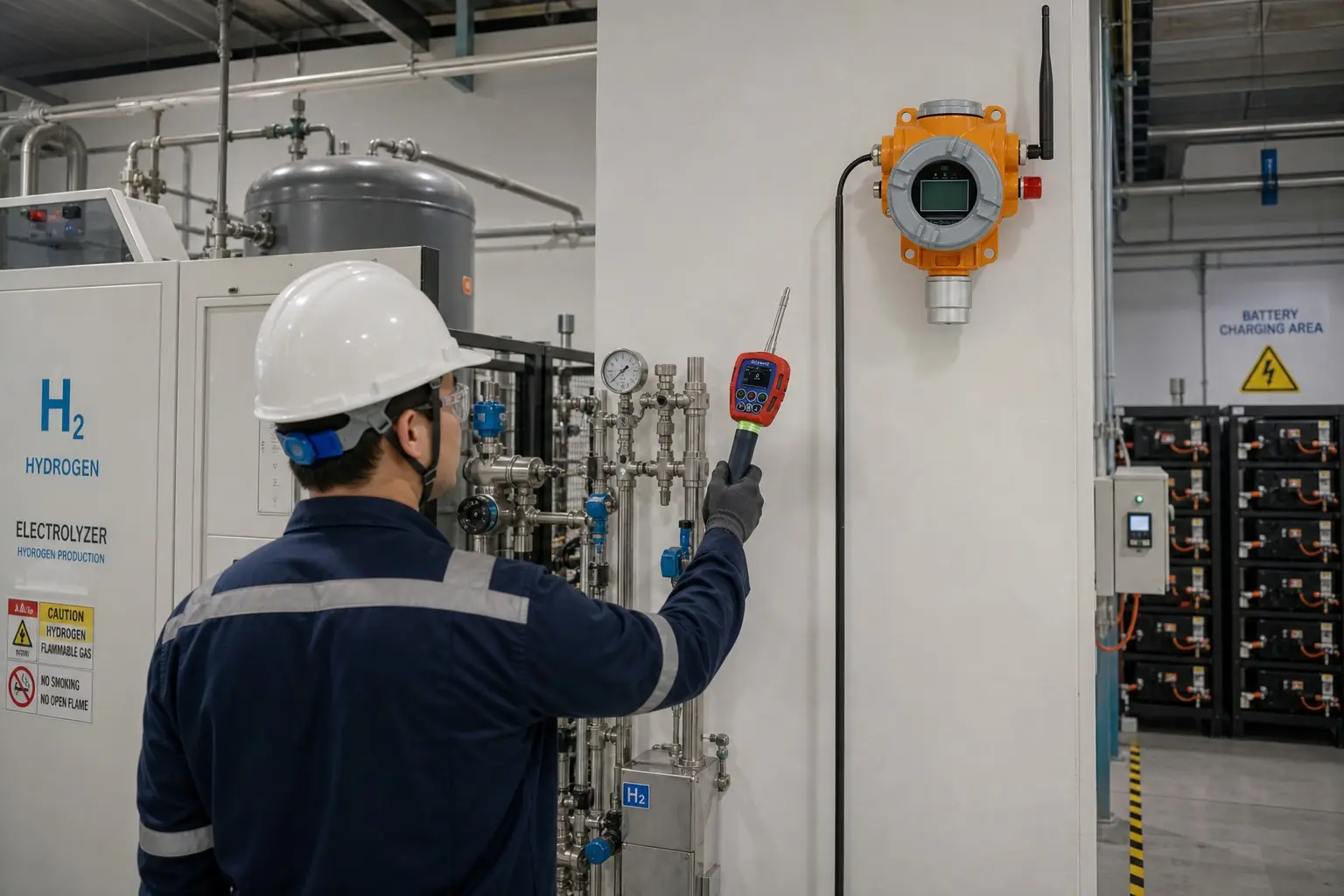
What does a hydrogen gas detector measure?
A hydrogen gas detector measures gaseous H2 in air or in a defined process sample. Safety instruments usually report the reading in parts per million, percent by volume, or percent of the lower flammable limit. The best unit and range depend on whether the goal is early leak recognition, flammable-gas protection, or process measurement.
Hydrogen is colorless and odorless, so people cannot rely on their senses to identify a release. It is also much lighter than air. In an open area it can disperse quickly, while an indoor leak may collect near a ceiling, roof pocket, or other high point if ventilation is poor. The U.S. Department of Energy’s hydrogen safety guidance notes its wide flammable range and low ignition energy, which is why ventilation, leak detection, and ignition control have to be considered together.
A safety detector is only one part of that arrangement. It can warn workers, operate a beacon or horn, signal a building management system, start ventilation, or initiate an engineered shutdown. It cannot correct a weak emergency plan or compensate for a sensor installed in the wrong place.
Start with the monitoring objective
Before comparing specifications, write a one-sentence objective. على سبيل المثال: “Detect an H2 release from battery charging equipment and start local exhaust before the concentration reaches the site’s action limit.” A clear objective narrows the detector type, range, location, outputs, and response time.
Continuous area safety monitoring
A fixed hydrogen gas detector is intended to watch a defined area around the clock. Typical locations include battery rooms, electrolyzer enclosures, hydrogen storage areas, test cells, compressor spaces, and indoor process equipment. The instrument normally sends a signal to a controller or PLC and may provide local alarm relays.
Area monitoring suits releases that may occur outside working hours and systems that must start ventilation or notify operators remotely. It does not replace portable checks during maintenance or beyond the fixed sensor’s effective coverage.
Portable inspection and leak survey
A portable hydrogen gas detector can support routine rounds, pre-entry checks, valve or fitting surveys, and investigation after an alarm. The instrument must still have an H2-capable sensor and a suitable measurement range. A diffusion instrument is convenient for personal use, while a pumped model can draw a sample through tubing from a hard-to-reach point.
Sampling changes response. Long tubing, restrictions, and low pump flow can delay a reading. Use the probe, filter, flow rate, and procedure specified by the manufacturer.
Process analysis and purity measurement
A process analyzer may measure H2 concentration, purity, or a controlled atmosphere. Its sample conditioning and operating assumptions may not suit room safety. Likewise, an area detector is not a purity analyzer.
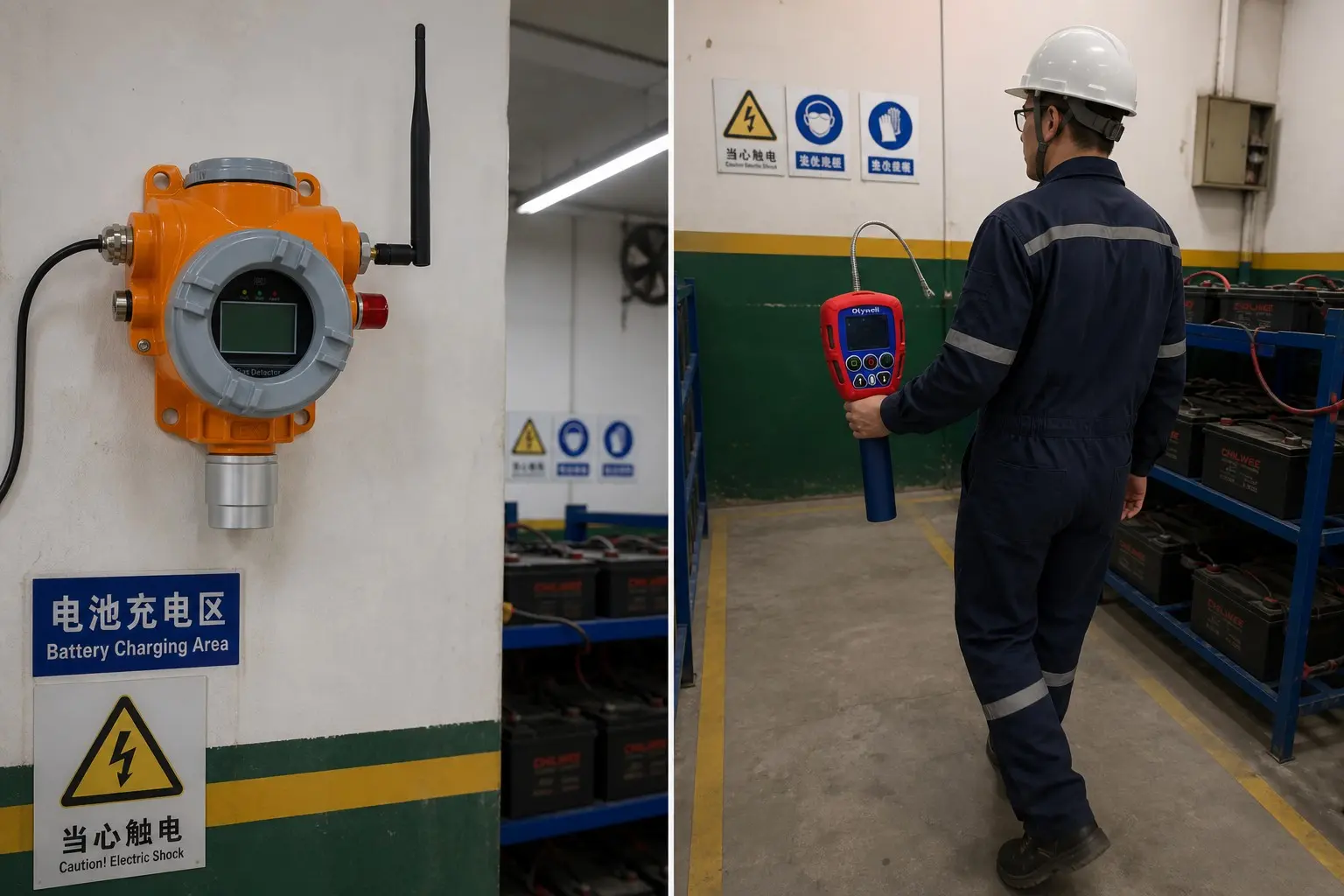
Fixed vs portable hydrogen gas detector
Fixed and portable instruments often work together. The decision is less about choosing a winner and more about identifying the gaps each format covers. Our separate fixed vs portable gas detector comparison explains the broader differences.
| Selection point | Fixed detector | Portable detector |
|---|---|---|
| Main role | Continuous monitoring of a defined room, enclosure, or release point | Personal monitoring, inspections, temporary work, and leak surveys |
| Power and signal | Permanent supply with wired or wireless connection to a controller | Rechargeable or replaceable battery with local display and alarms |
| Alarm action | Can activate remote alarms, ventilation, interlocks, or shutdown logic | Primarily warns the user and nearby workers |
| Coverage | Depends on sensor location, airflow, room geometry, and detector quantity | Moves with the worker or is carried to the inspection point |
| Maintenance issue | Access, isolation, calibration gas delivery, and control-loop testing | الشحن, bump testing, calibration, tubing, filters, and pump checks |
An unoccupied battery room may need fixed monitoring tied to ventilation, plus a portable unit for technicians entering after an alarm. An outdoor inspection route may rely mainly on portable equipment if the site assessment supports it. One instrument on a shelf does not provide continuous monitoring.
Compare hydrogen sensor technologies
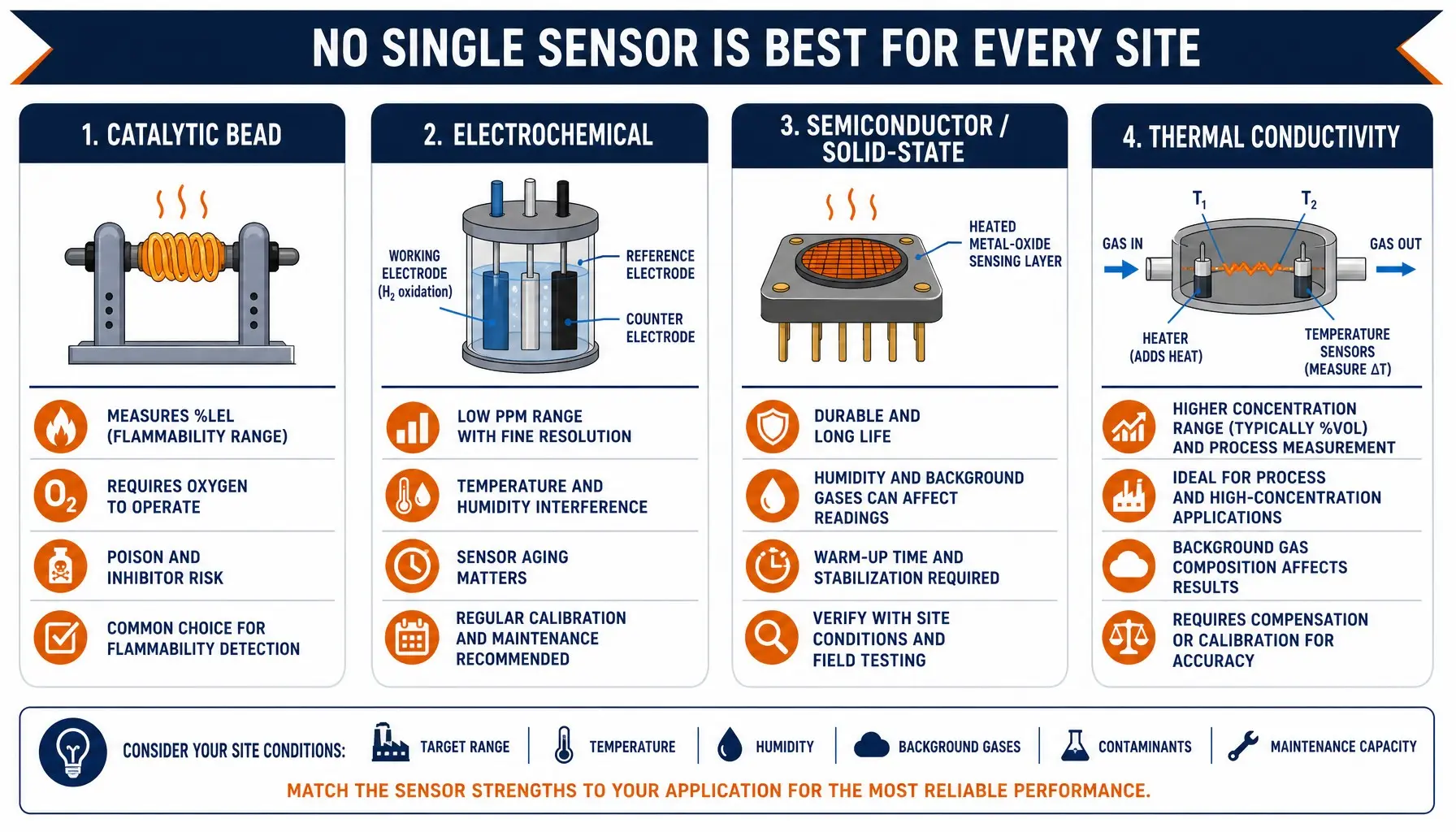
Sensor technology affects range, response, selectivity, service life, power demand, and behavior in changing oxygen or environmental conditions. No single sensor is best for every site. For a wider introduction, see our guide to how common gas detector sensors work.
Catalytic bead sensors
Catalytic bead sensors commonly measure combustible gas as a percentage of LEL. Gas oxidizes on a heated bead and changes its electrical resistance. This approach can suit flammability monitoring, but it normally needs oxygen and may be affected by catalyst poisons or inhibitors.
Ask whether calibration uses hydrogen or a correction factor. Review the oxygen requirement, poison resistance, response time, and expected performance around site contaminants.
أجهزة الاستشعار الكهروكيميائية
Electrochemical H2 sensors produce current through a chemical reaction. They often cover lower ppm ranges where a broad LEL scale lacks detail. Performance still depends on temperature, رطوبة, interfering gases, pressure, and sensor age.
A specification sheet should identify the H2 range, resolution, response time, cross-sensitivities, expected service life, and storage limits. Selectivity should not be assumed from the technology name alone.
Semiconductor and solid-state sensors
Metal oxide semiconductor sensors detect electrical changes in a heated material. They can be durable, but humidity, درجة حرارة, background gases, and power-up stabilization may affect readings. Review the application notes, not only range and price.
Thermal conductivity and process sensors
Thermal conductivity sensors compare a sample’s heat transfer with a reference. They can measure relatively high H2 concentrations in suitable mixtures and are more common in process work than early room-leak detection. Background gas composition affects the result.
Choose the right measurement range and units
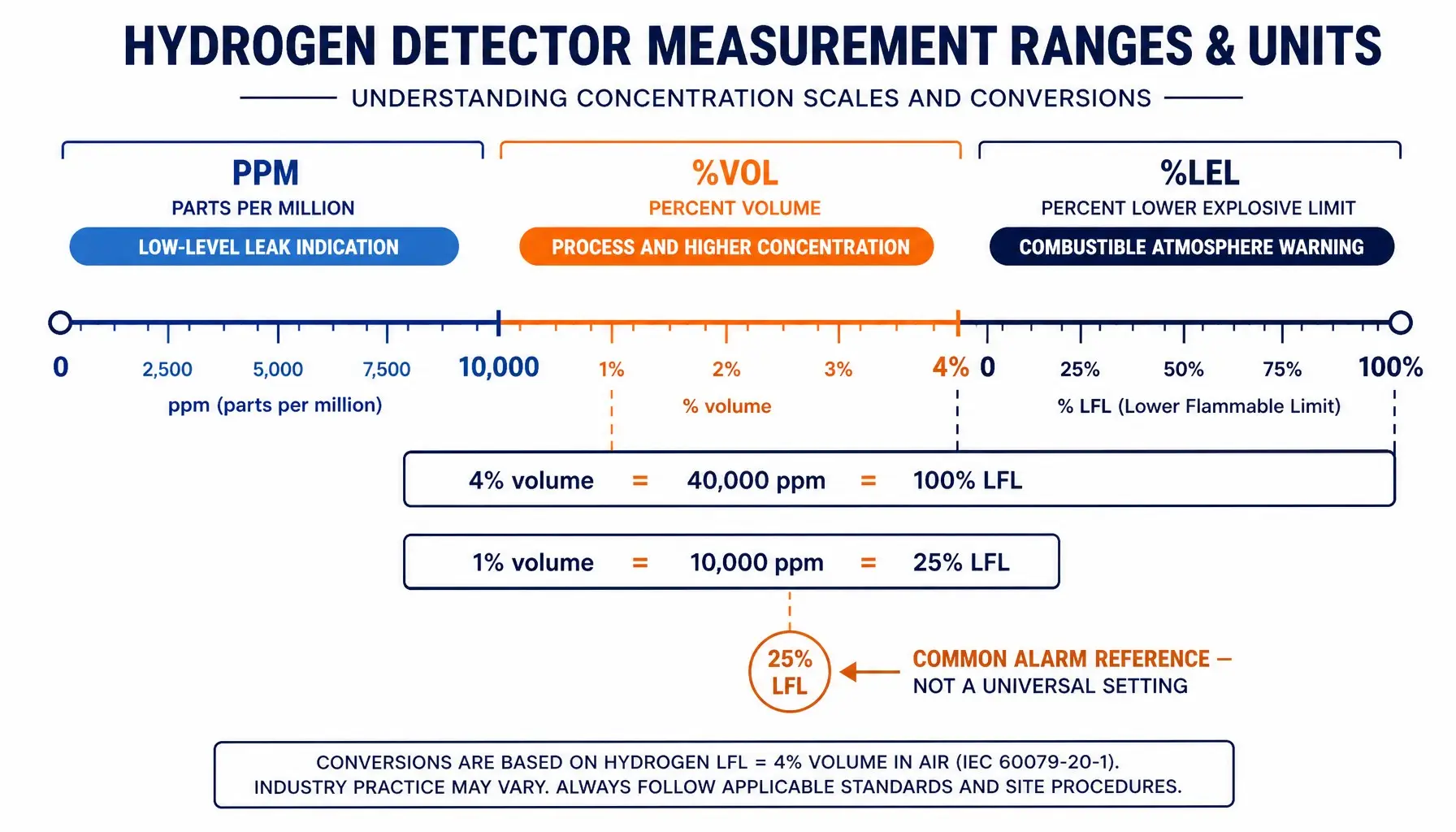
Range should reflect the action you want to take. A narrow ppm detector can show a small change clearly but may go over range during a larger release. أ 0 ل 100% LEL detector is suited to flammability protection but may not provide the resolution needed for an early low-level investigation. Some applications need both capabilities.
| Unit | What it expresses | Typical selection use |
|---|---|---|
| جزء في المليون | Parts of hydrogen per million parts of gas | Low-level leak indication or a defined ppm monitoring objective |
| %المجلد | Hydrogen as a percentage of the total gas volume | Higher concentration or process measurement |
| %LEL or %LFL | Reading as a percentage of hydrogen’s lower flammable limit | Combustible atmosphere warning and control actions |
Hydrogen’s lower flammable limit in air is commonly stated as 4% by volume. On that basis, 4% volume equals 40,000 ppm and represents 100% LFL. One percent by volume equals 10,000 ppm and 25% LFL. These are unit conversions and reference points, not instructions to use a particular alarm.
Do not choose a wider range merely because it appears more capable. Check the accuracy and resolution around the actual alarm region, how the device indicates an over-range condition, and whether a high exposure can temporarily or permanently affect the sensor.
Plan hydrogen gas detector placement
Hydrogen rises in still air, so high-level mounting is a sensible starting point for many indoor installations. It is not a complete placement rule. A detector must intercept the likely gas path before dilution, ventilation, or room geometry carries the release somewhere else.
Begin at credible release points such as valves, manifolds, compressors, battery charging equipment, storage connections, and electrolyzer components. Then review normal and failed ventilation, roof shape, ceiling pockets, obstructions, outdoor wind, and service access.
ال NASA hydrogen safety standard hosted by the U.S. Department of Energy recommends basing detector distribution on factors such as leak rate, ventilation, and room volume. That is more reliable than using one fixed distance for every room.
- Place the sensor where the expected plume can reach it, not simply at the highest convenient wall position.
- Check whether supply air could push gas away from the detector or exhaust air could remove it before detection.
- Consider roof ridges, ceiling voids, beam pockets, and enclosed equipment canopies where H2 may accumulate.
- Avoid dead locations blocked by cabinets, ducts, cable trays, or structural members.
- Keep the sensor accessible for gas application, inspection, replacement, and safe work at height.
- For outdoor equipment, assess prevailing wind and whether several detectors or another detection method is needed.
Smoke studies, dispersion modeling, or engineered gas-release testing may be appropriate for complex sites. The detector manufacturer and a qualified safety professional should review uncertain locations before installation.
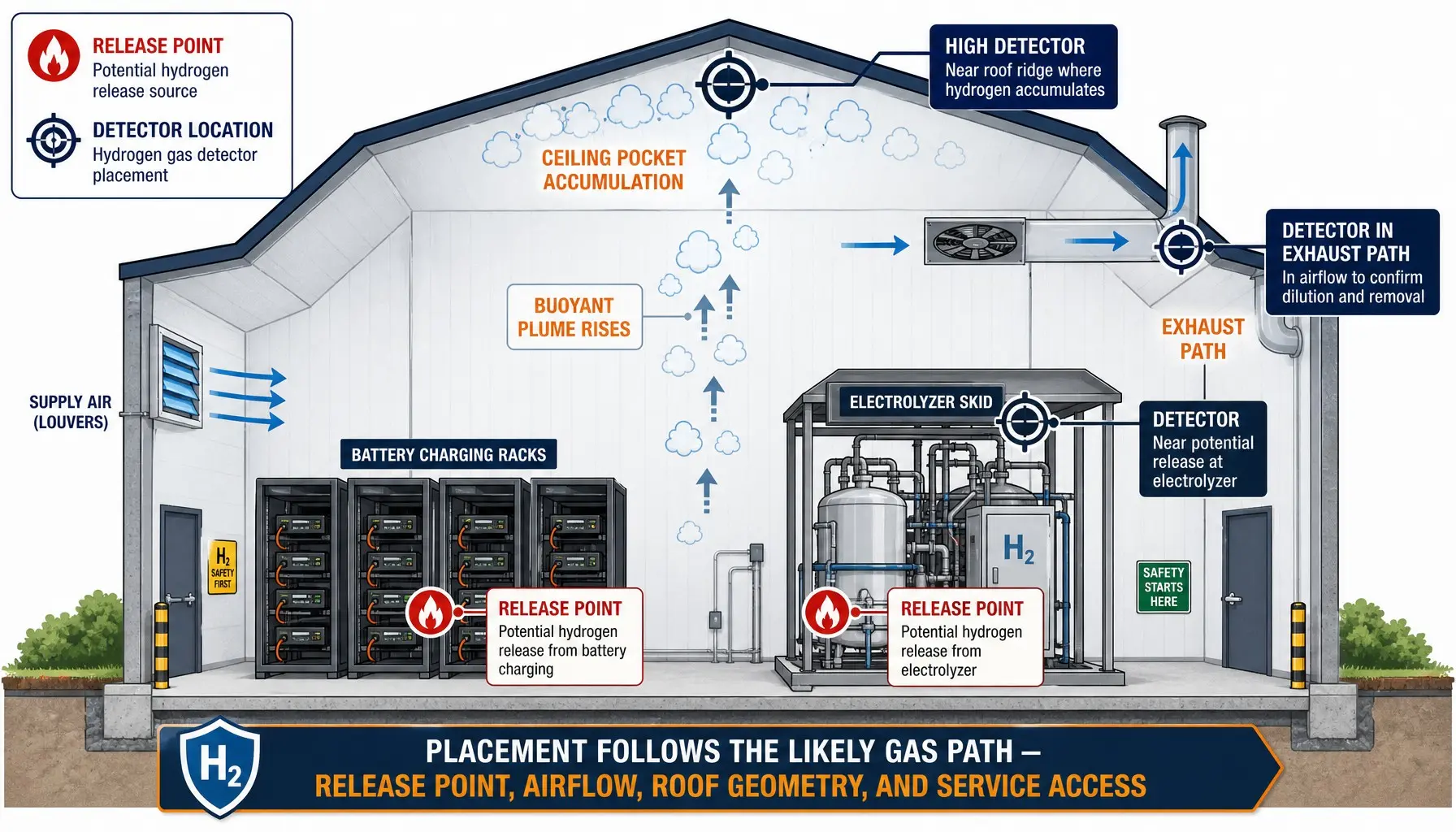
Set alarms around a defined response plan
An alarm number needs a defined action. State who receives it, what ventilation or process response occurs, when people evacuate, and who may investigate. Fault and power-loss conditions also need a response.
The California Energy Commission hydrogen safety workshop presents 25% of the LFL, equivalent to 1% hydrogen in air, as a good-practice alarm reference. Treat it as a design reference, not a universal setting.
A site may use separate low and high alarms. The low alarm might notify operators and start ventilation. A high alarm might activate evacuation signals, isolate hydrogen supply, or shut down equipment through approved logic. Actual actions must be decided through the hazard analysis and applicable requirements. A detector relay should not directly control safety-critical equipment without a reviewed fail-safe design.
Check alarm delay, latching, relay state on power loss, fault signals, resets, and control-room display. During commissioning, test the full cause-and-effect sequence, not only the sensor display.
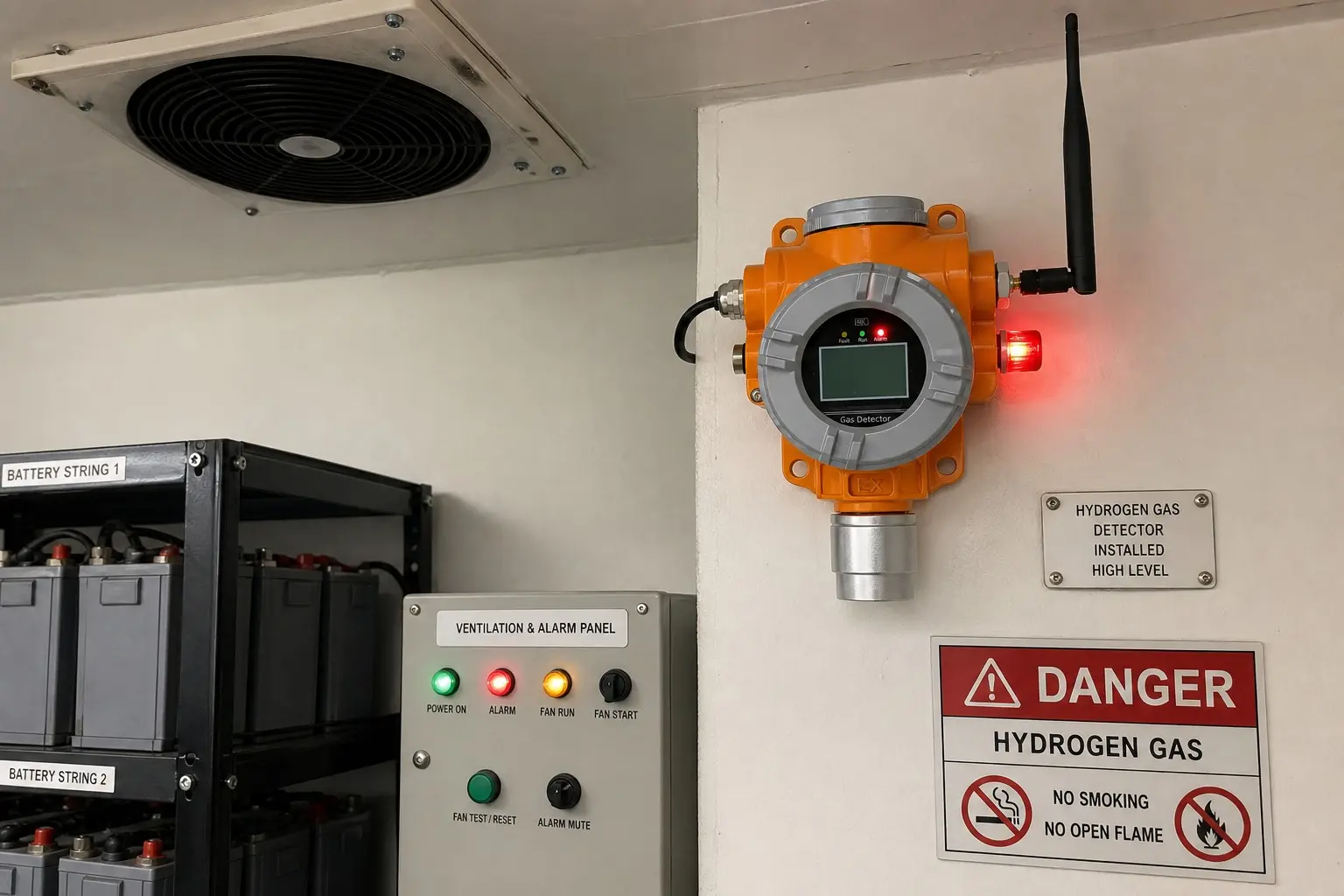
Review environment, approvals, and system integration
A detector that works on a bench may behave differently beside a cold outdoor manifold, in a humid battery room, or near corrosive chemicals. Compare the complete operating and storage specifications with the actual installation.
- درجة حرارة, رطوبة, and pressure: Confirm both operating limits and any effect on accuracy or response.
- Water, تراب, and corrosion: Select an enclosure rating and materials suitable for washdown, التكثيف, salt, acid mist, or industrial dust.
- Hazardous location approval: Verify the exact certification, gas group, temperature class, protection method, and installation conditions required by the site.
- Cross-sensitivity: Review all expected gases, vapors, cleaning products, العادم, and process chemicals.
- Oxygen dependence and poisoning: Confirm whether the sensor needs oxygen and which substances can suppress or damage its response.
- Signals and relays: Match 4 ل 20 أماه, RS485, Modbus, relay, لاسلكي, or other outputs to the controller and cable plan.
- Diagnostics: Look for fault indication, calibration status, over-range behavior, sensor end-of-life warning, and communication supervision.
Wireless systems still need power, interference, cybersecurity, and fail-safe reviews, plus a documented response to lost communication.
Plan bump testing, calibration, and commissioning
A bump test exposes the sensor to hydrogen test gas to confirm that gas reaches the sensor and that the instrument responds and alarms. Calibration adjusts the reading against a known concentration. They are related tasks, but one does not automatically replace the other.
Use the gas concentration, balance gas, regulator, flow rate, tubing, calibration cap, and procedure specified by the manufacturer. A substitute gas or incorrect adapter may give a reassuring result that does not represent H2 performance. Record the cylinder concentration, expiration date, detector identity, result, technician, and corrective work.
There is no universal calibration interval for every hydrogen detector. Follow the manufacturer and site policy, considering exposure history, environment, requirements, and failed bump tests. Commission new instruments after installation.
- Confirm detector identity, غاز, range, units, firmware, and configuration.
- Verify mounting location, orientation, wiring, قوة, grounding, and sample path.
- Apply the specified H2 test gas and check response and recovery.
- Test local sounders, beacons, display messages, and remote indications.
- Verify each relay, ventilation command, interlock, and shutdown step against the approved cause-and-effect plan.
- Create a maintenance schedule and keep test records available for review.
Match the detector to the application
Battery and UPS rooms
Lead-acid battery charging can release hydrogen, particularly during overcharge or abnormal conditions. The design should consider battery type, charger operation, room volume, ceiling geometry, ventilation reliability, and likely release locations. Fixed high-level area monitoring is common, but detector placement should still follow the specific airflow and equipment layout.
For continuous monitoring, ال Otywell TCB2-W fixed gas detection alarm is available with configurable gas options that include hydrogen and supports industrial signal integration. Confirm the required H2 range, output, approvals, and installation environment before ordering.
Hydrogen production, تخزين, and refueling
Electrolyzers, compressors, تخزين, dispensers, and enclosed skids present different leak paths. One specification may not cover every zone. Evaluate detection, ventilation, emergency isolation, and portable surveys as one system.
Laboratories and process areas
Labs may use small cylinders and low flow rates, yet cabinets, ceiling pockets, or equipment enclosures can create local accumulation. Process areas may also contain gases that interfere with the selected sensor. List the background atmosphere and chemicals before choosing the sensing method.
For mobile checks, ال Otywell G90 portable gas detection alarm can be configured for hydrogen variants. For work that requires a pumped multi-gas configuration, ال Otywell OT139 multi-gas detector supports configurable gas channels that include hydrogen. Confirm the gas combination, measurement range, sampling arrangement, and certifications for the intended task.
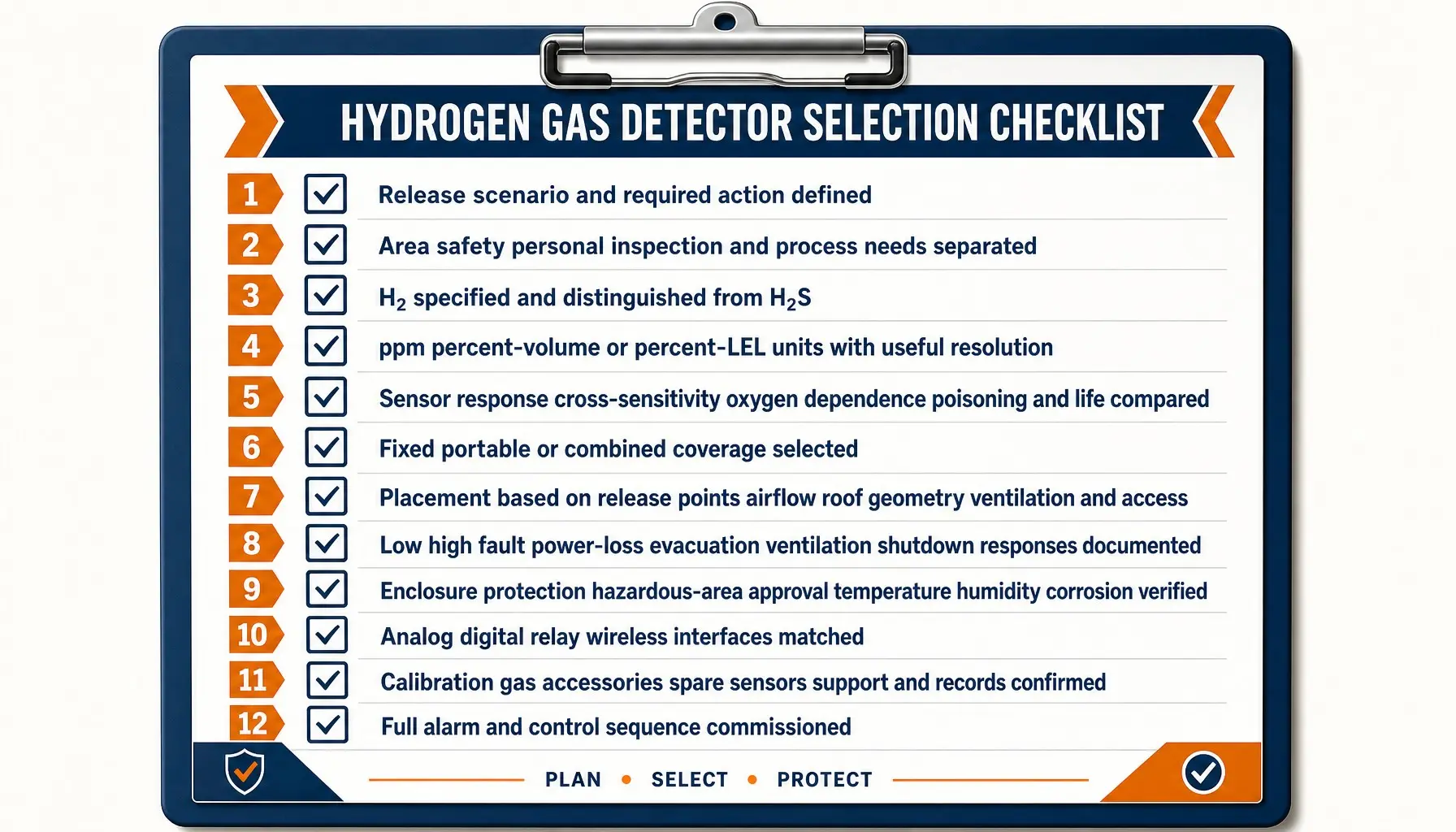
Hydrogen gas detector selection checklist
- Define the release scenario and the action the detector must initiate.
- Separate area safety, personal inspection, leak survey, and process analysis requirements.
- Specify H2 explicitly and distinguish it from H2S.
- Choose ppm, %المجلد, or %LEL units and a range with useful resolution at the action level.
- Compare sensor response, cross-sensitivity, oxygen dependence, poisoning risk, and service life.
- Choose fixed, محمول, or combined coverage based on how and when the area is occupied.
- Base placement on release points, airflow, roof geometry, ventilation, and maintenance access.
- Document low alarm, إنذار عالي, fault, power-loss, evacuation, ventilation, and shutdown responses.
- Verify enclosure protection, hazardous area approvals, درجة حرارة, رطوبة, and corrosion resistance.
- Match analog, digital, relay, or wireless interfaces to the control architecture.
- Confirm calibration gas, accessories, spare sensors, service support, and recordkeeping needs.
- Commission the complete alarm and control sequence before relying on the system.
Frequently asked questions
How does a hydrogen gas detector work?
It uses a sensor that changes electrically or chemically when exposed to H2. The instrument converts that response into ppm, %المجلد, or %LEL and activates alarms at configured thresholds. حبة الحفزية, الكهروكيميائية, أشباه الموصلات, and thermal conductivity sensors work differently, so their ranges and limitations must be compared.
Where should hydrogen gas detectors be installed?
Place them where gas from a credible release is likely to travel. High points often matter because hydrogen is buoyant, but source location, ventilation, ceiling shape, obstructions, and outdoor airflow can change the best position. A qualified site assessment should determine the final quantity and location.
What is a common hydrogen detector alarm setpoint?
Twenty-five percent of the hydrogen LFL, equivalent to 1% volume in air, is a commonly referenced value. It is not a universal setting. The correct threshold and response depend on the release scenario, ventilation, applicable requirements, equipment design, and approved emergency plan.
Can a standard four-gas monitor detect hydrogen?
Not necessarily. Many standard four-gas monitors are configured for oxygen, أول أكسيد الكربون, كبريتيد الهيدروجين, and combustible gas calibrated to methane. Their combustible sensor may respond differently to hydrogen, and some sensor designs may not be suitable. Use an instrument and calibration method approved for the specific H2 task.
What is the difference between H2 and H2S?
H2 is hydrogen, a highly flammable, colorless, odorless gas. H2S is hydrogen sulfide, a toxic and flammable gas associated with a characteristic odor at low concentrations. They require different sensor specifications. Never use the names or detector channels interchangeably.
How often should a hydrogen gas detector be calibrated?
Follow the detector manufacturer’s interval and the site’s written program. The schedule may be adjusted according to sensor technology, environmental conditions, exposure history, regulations, and bump-test results. Calibrate after a failed test or any event identified by the manufacturer, and document the work.
Make the specification fit the hazard
The best hydrogen gas detector is not simply the model with the longest feature list. It is the one whose sensor, range, placement, approvals, outputs, alarm logic, and maintenance plan fit a documented release scenario. Start with the monitoring objective, then review the complete detection and response chain.
For a project quotation, prepare the target gas and range, fixed or portable format, expected gas combination, installation environment, required certification, output signals, quantity, and intended alarm actions. Those details make product selection faster and reduce the chance of choosing an instrument that cannot perform the required job.

WeChat
مسح رمز الاستجابة السريعة مع WeChat